Pools and Water Features in Arun
West Sussex enjoys some of the highest sunshine totals in the United Kingdom, and Arun sits squarely in that favourable band. Combined with substantial detached properties across Rustington, East Preston, Angmering, and the villages inland toward the South Downs, that climate has supported a meaningful private pool sector. Add holiday lets and guest houses along the coast that offer pools as a selling point, plus a large and growing population of hot tubs and swim spas, and there is real demand for competent maintenance.
Pool care in Arun carries local specifics. Hard water across the district raises calcium levels steadily through evaporation and top-up, leading to scale formation on surfaces and in heat exchangers if not managed. Coastal wind carries sand, salt, and organic debris into outdoor pools, increasing filtration load. High summer sunshine accelerates chlorine depletion through ultraviolet degradation, requiring careful stabiliser management. Autumn leaf fall from Arun's mature tree cover creates a demanding seasonal cleaning period.
The Ten Leading Pool Services in Arun
Arun Pool Services is among the district's most established maintenance providers, handling regular servicing, water testing, equipment repair, and seasonal opening and closing. Their scheduled visit programmes cover chemistry balancing, filtration checks, cleaning, and equipment inspection, with written reports after each visit.
Sussex Coast Pool and Spa covers both pools and hot tubs across the coastal towns. The dual capability is practical, since many properties have both, and spa water chemistry differs meaningfully from pool chemistry due to higher temperatures, greater bather load relative to volume, and different sanitiser behaviour.
Littlehampton Pool Maintenance focuses on regular servicing for residential clients. Weekly and fortnightly visits during the swimming season, with reduced winter frequency, keep water consistently safe rather than swinging between neglect and correction. Consistency is the single greatest factor in pool water quality.
Bognor Regis Pool Engineering specialises in equipment rather than routine cleaning. Pump replacement, filter overhaul, heater diagnosis and repair, automated dosing system installation, and control panel work are its territory, including the heat pump systems that have largely replaced gas heating for pools.
Arundel Country Pool Care serves larger rural properties and estates. Bigger volumes, natural swimming ponds, and pools with complex circulation and feature systems require different expertise, and the firm handles indoor pools where humidity control and air handling are as important as water treatment.
Rustington Hot Tub Services concentrates entirely on hot tubs and swim spas. Filter cleaning and replacement, drain-and-refill cycles, sanitiser management, pipework flushing to address biofilm, cover care, and jet and pump repair make up its work. Biofilm in spa plumbing is widely underestimated and a common cause of persistent water quality problems.
Felpham Pool Renovations handles refurbishment rather than maintenance. Liner replacement, tile and mosaic repair, coping stone renewal, resurfacing, and upgrading circulation and filtration to modern efficiency standards extend the life of ageing pools considerably.
Barnham Water Treatment Specialists takes a technical approach to chemistry. Alternative sanitisation including salt chlorination, ultraviolet and ozone secondary treatment, and low-chlorine systems appeal to users sensitive to conventional chemicals, and the firm's testing and balancing work is notably rigorous.
Angmering Pool Safety and Compliance serves commercial and rental settings including guest houses and holiday lets. Water testing to required standards, record keeping, safety equipment provision, barrier and cover compliance, and risk assessment support operators through inspection regimes and insurance requirements.
Arun Valley Pond and Water Features extends beyond swimming pools into ornamental ponds, koi systems, and water features. Biological filtration, ultraviolet clarification, aeration, and plant management require ecological understanding quite distinct from chlorinated pool chemistry.
What Proper Pool Maintenance Involves
Effective pool care rests on several parallel activities. Water chemistry management balances sanitiser level, pH, total alkalinity, calcium hardness, and stabiliser concentration. Each interacts with the others, and imbalance produces cloudy water, corroded equipment, scaled surfaces, or ineffective sanitisation.
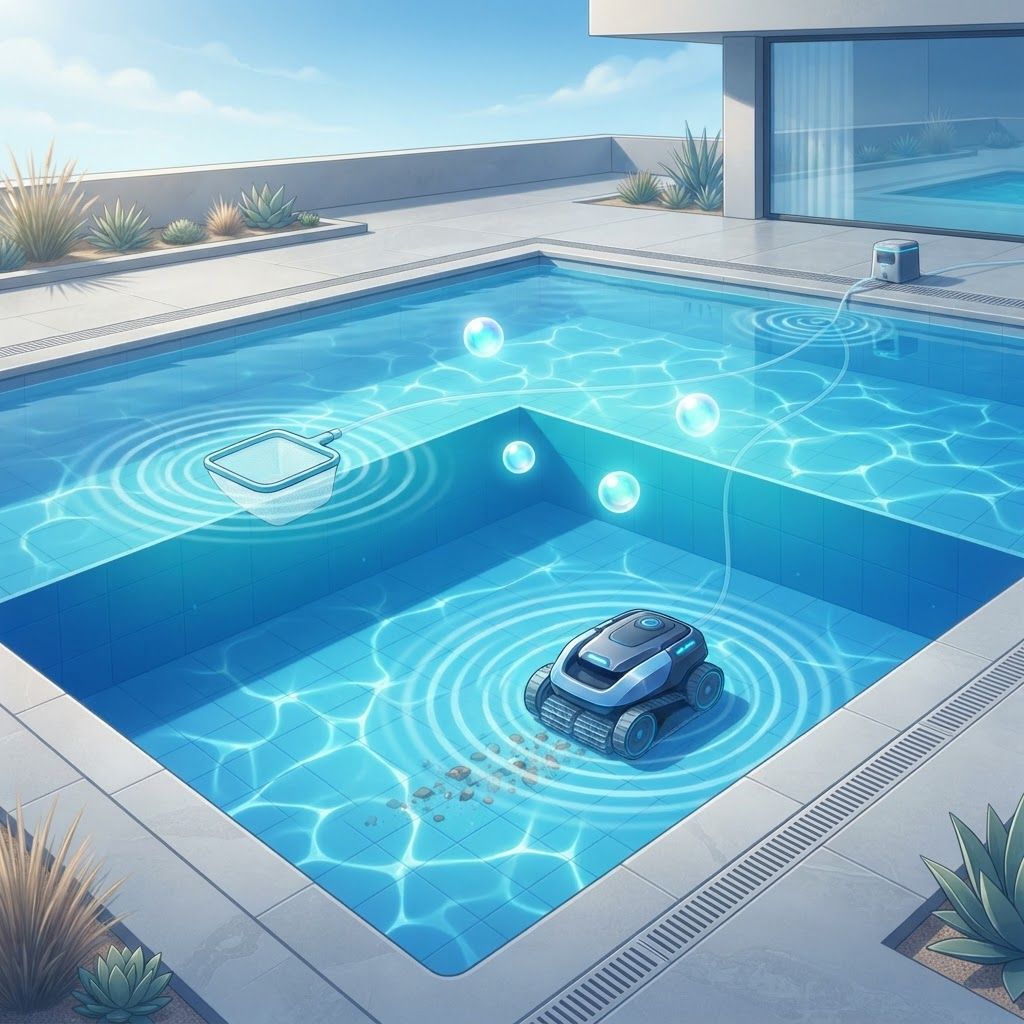
Physical cleaning removes debris through skimming, brushing walls to disrupt algae attachment, and vacuuming the floor. Robotic cleaners handle much of this routinely, but manual brushing of steps, corners, and waterline remains necessary.
Filtration and circulation require ongoing attention. Filters must be backwashed or cleaned on a schedule appropriate to their type, pump baskets emptied, and run times adjusted seasonally to achieve adequate turnover. Undersized run times are a frequent cause of water quality problems.
Seasonal work bookends the year. Spring opening involves reactivation, deep cleaning, and chemistry re-establishment. Winterisation protects pipework and equipment from frost damage, which in Arun's mild but not frost-free climate is still a genuine risk.
Trends in Pool Technology
Energy efficiency dominates current development. Variable-speed pumps consume dramatically less electricity than single-speed equivalents by running longer at lower speeds, and air source heat pumps have largely displaced gas heating for pool warming. Insulated covers reduce heat loss and evaporation substantially.
Automation has advanced considerably. Automated dosing systems monitor and adjust chemistry continuously, remote monitoring allows engineers and owners to check status from an application, and robotic cleaners have become genuinely capable.
Alternative sanitisation continues to grow. Salt chlorine generators produce chlorine on demand from dissolved salt, giving gentler water without eliminating chlorine chemistry. Ultraviolet and ozone systems reduce chemical demand as secondary treatment. Mineral systems appeal to users seeking lower chemical exposure.
Water conservation is rising in importance given southern England's supply constraints, driving interest in covers to limit evaporation, backwash water recovery, and regenerative filter media that require less flushing.
Choosing a Pool Service Provider
Ask about qualifications and industry training, and whether the company holds relevant trade association membership. Pool water is a genuine health matter, and competence in chemistry is not optional.
Establish exactly what a service visit includes: which tests are performed, whether chemicals are supplied within the price, whether brushing and vacuuming are covered, and whether equipment inspection is part of the visit. Written reports after each visit are a mark of a professional operation.
Clarify response arrangements for equipment failure, which is when a maintenance contract proves its value. Ask whether the firm can undertake repairs itself or subcontracts them.
Finally, favour providers who educate. A good Arun pool engineer will explain your water chemistry, show you how to test between visits, and advise on run times and cover use. That knowledge transfer reduces your costs and improves your water, and it distinguishes a genuine service partner from a chemical delivery round.
Want your brand featured in front of decision-makers? Publish a guest post or get a link insertion in our guides through AAMAX's guest post and link insertion service.
Helpful Links
 SponsoredAAMAX — Full-Service Digital Agency
Write for Us
Share your expertise with our readers. We welcome guest contributions from industry specialists.
Pitch your idea