

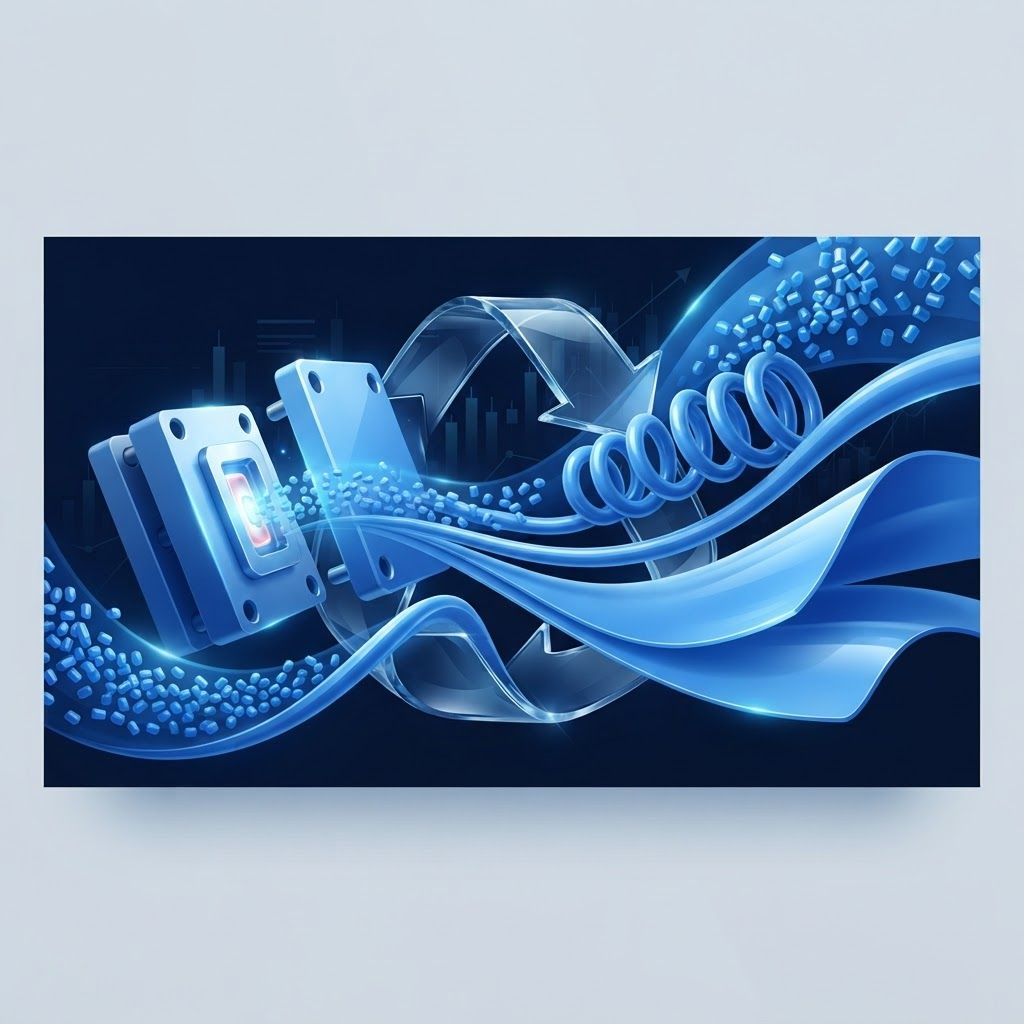
Plastics and the Wrexham Economy
Plastics manufacturing rarely features in discussions of prestigious industry, yet it underpins an enormous share of modern production. Medical devices, vehicle interiors, food packaging, electrical enclosures, construction components and consumer goods all depend on polymer processing. Wrexham has a substantial plastics sector concentrated on its industrial estate and in surrounding units.
The borough's appeal to plastics manufacturers is straightforward. Injection moulding and extrusion require large floor areas, heavy power supply, good road access for bulk material delivery and outbound distribution, and a workforce comfortable with shift-based manufacturing. Wrexham Industrial Estate provides all of these at a cost well below major conurbations.
Injection Moulding
Injection moulding dominates the local sector. The process forces molten polymer into a steel tool under high pressure, producing identical parts in cycle times measured in seconds. It suits high volume production of complex geometries with excellent repeatability.
Moulders in the Wrexham area operate machines across a wide clamping force range, from small presses producing intricate medical components to large tonnage machines making automotive parts and industrial containers.
Tooling is the critical variable. An injection mould is a significant capital investment, often representing more cost than the first production run. Quality toolmaking determines part accuracy, surface finish, cycle time and tool life, and the region's precision engineering base supports this directly.
Technical moulders differentiate themselves through materials expertise. Engineering polymers such as polyamide, polycarbonate, acetal and high temperature resins behave very differently from commodity polypropylene, and processing them successfully requires genuine knowledge of drying, shrinkage, warpage and gate design.
Extrusion and Profile Manufacture
Extrusion produces continuous sections including pipe, tube, sheet, film and custom profiles. Manufacturers in the region supply construction, cable management, horticulture, packaging and industrial markets.
Co-extrusion, where multiple materials are combined in a single profile, enables products with different properties in different zones, such as a rigid core with a soft sealing lip. Window and door profile manufacture uses this extensively.
Sheet extrusion feeds thermoforming operations, which heat sheet and form it over a tool to produce trays, packaging and larger formed components at lower tooling cost than injection moulding.
Packaging Production
Packaging is the largest global plastics application and features strongly in the local economy, supported by North Wales food production. Manufacturers produce trays, films, bottles, closures, containers and protective packaging.
Food contact applications impose additional requirements. Materials must be approved for food use, production areas must meet hygiene standards, and traceability must be maintained. Certification under recognised food safety schemes is expected by major retailers and processors.
Pharmaceutical and medical packaging represents a higher specification tier, with cleanroom production, validated processes and extensive documentation.
The Plastic Packaging Tax and Recycled Content
Regulation has reshaped commercial priorities in the sector. The Plastic Packaging Tax applies to packaging containing less than a defined threshold of recycled content, creating a direct financial incentive to incorporate recyclate.
This has driven substantial technical work. Recycled polymer is more variable than virgin material, with differences in melt flow, colour and contamination that affect processing and part quality. Manufacturers have invested in improved material handling, blending and quality control to use recyclate reliably.
Demand for food-grade recycled polymer has outstripped supply, pushing prices up and encouraging investment in advanced recycling. Companies able to demonstrate verified recycled content have gained commercial advantage with brand owners facing their own sustainability commitments.
Recycling and Circular Economy
Wales has one of the highest household recycling rates in the world, a position achieved through sustained policy and public participation. That performance creates feedstock and a supportive environment for circular business models.
Plastics recyclers and reprocessors in the region collect, sort, wash, granulate and compound post-industrial and post-consumer material. Closed-loop arrangements, where a manufacturer's scrap returns as usable feedstock, are increasingly common and improve both cost and carbon performance.
Design for recyclability has become a live engineering consideration. Mono-material packaging, avoiding mixed polymer laminates, and eliminating problematic additives all improve recyclability. Manufacturers who advise customers on this at the design stage add genuine value.
Alternative Materials and Bioplastics
Bio-based polymers derived from plant feedstocks and compostable materials attract considerable interest, though the picture is nuanced. Compostable plastics require industrial composting conditions rarely available through domestic collection, and mixing them into conventional recycling streams causes contamination.
Regional manufacturers generally take a pragmatic view, recommending recyclable conventional polymers with recycled content for most applications, and reserving compostable materials for genuinely suitable uses such as food waste caddy liners.
Quality, Certification and Technical Support
Serious plastics manufacturers operate ISO 9001 quality systems, with ISO 14001 environmental certification common. Automotive suppliers require IATF 16949, and medical component producers work to ISO 13485.
Technical capability beyond production distinguishes the better companies. Mould flow simulation predicts filling behaviour and identifies problems before tool manufacture. Design for manufacture review optimises wall sections, draft angles and rib design. Metrology confirms dimensional conformance.
Energy and Cost Pressures
Polymer processing is energy intensive, and electricity costs have become a defining commercial issue. Manufacturers have responded with all-electric moulding machines, which use considerably less energy than hydraulic equivalents, improved thermal insulation of barrels, heat recovery from cooling systems, and on-site solar generation on extensive factory roofs.
Raw material price volatility, linked to oil and gas markets, remains a persistent challenge that manufacturers manage through contract structures and index-linked pricing.
Choosing a Plastics Manufacturer
Match process to product, since injection moulding, extrusion and thermoforming suit very different geometries and volumes. Discuss tooling ownership and location explicitly. Assess material expertise relevant to your polymer. Confirm quality certification for your sector, and ask about recycled content capability if packaging tax exposure applies.
Visit the site. Housekeeping, material storage discipline and machine condition indicate far more about likely quality performance than any brochure.
Want your brand featured in front of decision-makers? Publish a guest post or get a link insertion in our guides through AAMAX's guest post and link insertion service.
Helpful Links
 SponsoredAAMAX — Full-Service Digital Agency
Write for Us
Share your expertise with our readers. We welcome guest contributions from industry specialists.
Pitch your idea

