

Plastics and the Carrington Legacy
Trafford's plastics industry traces directly back to Carrington, where large-scale polymer production established the borough as a significant location in the UK plastics supply chain. That upstream polymer production shaped an ecosystem of downstream converters, compounders and fabricators who located nearby to access material, expertise and skilled labour.
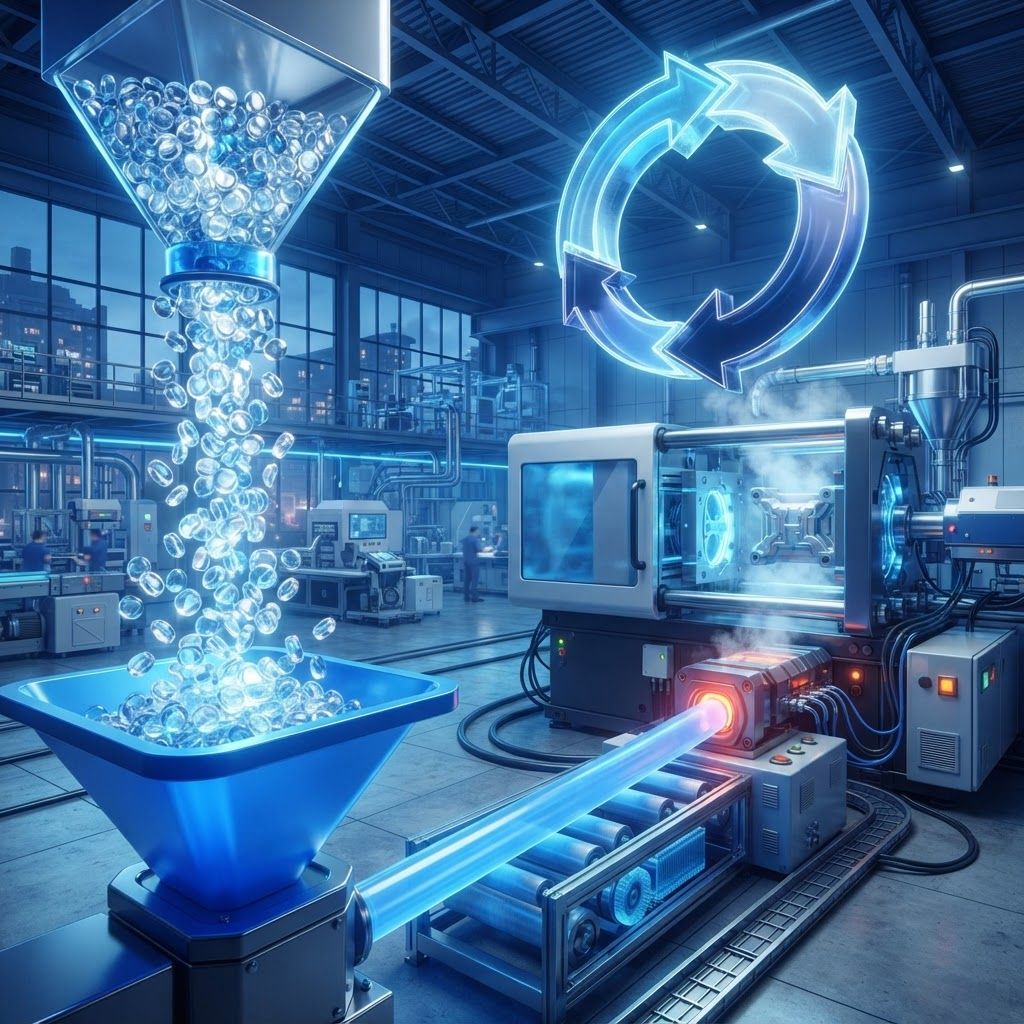
The industry today is more diverse and considerably more focused on recycling and material efficiency. Trafford companies convert polymer into components, packaging, sheet, pipe and fabricated products, serving customers across construction, automotive, medical, food packaging, electronics and general engineering. Alongside them sit reprocessors turning waste plastic back into usable feedstock, an activity that has grown from marginal to strategically central within a decade.
Plastics Processing Methods
Injection moulding forces molten polymer into a steel tool to produce identical parts at high rates, ideal for volumes from thousands upward given the tooling investment required. Extrusion pushes polymer through a die continuously to make pipe, profile, sheet and film. Blow moulding produces hollow items such as bottles and tanks. Thermoforming heats sheet and forms it over a mould, offering lower tooling costs suited to larger parts and smaller volumes. Rotational moulding produces large hollow items like water tanks. Fabrication cuts, bends, machines and welds sheet and rod into finished assemblies.
Compounding sits upstream of these processes, blending base polymer with additives, colourants, fillers and reinforcement to achieve specific properties. It is a technically demanding activity that has become especially important for recycled material.
The Top 10 Plastic Manufacturers in Trafford
1. Carrington Polymer Processing. The borough's largest injection moulding operation, running a substantial press fleet across a wide tonnage range. It offers tool design and management, insert moulding, overmoulding and full assembly, serving automotive, electrical and industrial customers.
2. Trafford Park Extrusions. Producing pipe, profile and tubing in a range of polymers for construction, drainage, cable protection and industrial applications. Its in-house die making allows rapid development of custom profiles for specific projects.
3. Northern Plastics Fabrication. Fabricating tanks, ducting, enclosures, machine guards and chemical handling equipment from sheet materials, using CNC routing, bending and plastic welding. Its work for chemical and water treatment clients demands high standards of weld integrity.
4. Urmston Recycled Polymers. A reprocessor collecting, sorting, washing and pelletising post-industrial and post-consumer plastic waste into recycled feedstock. Its consistent quality control has made it a credible alternative to virgin material for a range of applications.
5. Sale Medical Plastics. Moulding components for medical devices, diagnostics and laboratory consumables under cleanroom conditions with appropriate quality management certification. Validation, traceability and material biocompatibility documentation govern every aspect of its operation.
6. Stretford Packaging Products. Manufacturing rigid plastic packaging including trays, tubs, closures and containers for food, cosmetics and industrial products. It has invested heavily in lightweighting and in mono-material designs that improve recyclability.
7. Altrincham Thermoforming. Producing vacuum and pressure formed parts for vehicle interiors, machine housings, point of sale displays and medical trays. Lower tooling costs make it the natural route for large parts at moderate volumes.
8. Old Trafford Rotational Moulding. Manufacturing large hollow products such as water and chemical storage tanks, containers, and playground equipment components. Rotational moulding produces seamless, stress-free parts well suited to heavy-duty outdoor use.
9. Timperley Compounding. Blending polymer compounds and masterbatches, including formulations that restore mechanical properties and colour consistency in recycled material. This capability is central to increasing recycled content without sacrificing performance.
10. Partington Bioplastics. Developing and processing bio-based and compostable polymers for packaging and single-use applications where recycling infrastructure is impractical. It provides careful guidance on where compostable material genuinely helps and where it does not.
Trends Reshaping the Plastics Industry
Regulation is the dominant force. The Plastic Packaging Tax has created a direct financial incentive to incorporate at least thirty percent recycled content, transforming demand for quality recyclate. Extended producer responsibility rules shift the cost of collection and recycling toward those placing packaging on the market, sharpening focus on recyclable design.
Design for recyclability has consequently become a core engineering discipline. Mono-material construction, avoidance of problematic pigments such as carbon black that defeat optical sorting, removable labels and elimination of multi-layer laminates all improve end-of-life outcomes.
Chemical recycling is developing as a complement to mechanical recycling, breaking polymer back to feedstock to handle contaminated or mixed waste streams that mechanical processes cannot. It remains capital intensive and energy hungry, but capability is advancing.
Lightweighting continues to deliver both cost and environmental benefit. Advanced simulation allows designers to reduce wall thickness while maintaining performance, cutting material use and cycle times simultaneously.
Choosing a Plastics Manufacturer
Match process to product. Volume, part size, geometry, tolerance and material requirements will usually point clearly to one processing method, and a good manufacturer will advise honestly even if it means recommending a different process than the one they operate.
Examine tooling arrangements carefully. Clarify who owns the tool, where it is stored, who maintains it and what happens if you move production. Tooling ownership disputes are among the most common and damaging problems in plastics supply relationships.
For regulated applications, confirm appropriate certification: ISO 13485 for medical devices, food contact compliance documentation for packaging, and relevant flammability or electrical safety approvals where applicable.
Discuss recycled content openly. Ask what percentage the manufacturer can achieve for your application, what property changes to expect, and how batch-to-batch consistency is controlled. A manufacturer with genuine recyclate experience will discuss the trade-offs frankly rather than promising no compromise.
Final Thoughts
Trafford's plastic manufacturers are navigating a period of rapid regulatory and technical change with considerable adaptability. The borough's combination of established converting capability and growing reprocessing capacity positions it well for a market where recycled content and recyclable design have become commercial necessities rather than optional virtues.
Want your brand featured in front of decision-makers? Publish a guest post or get a link insertion in our guides through AAMAX's guest post and link insertion service.
 SponsoredAAMAX — Full-Service Digital Agency
Write for Us
Share your expertise with our readers. We welcome guest contributions from industry specialists.
Pitch your idea

