

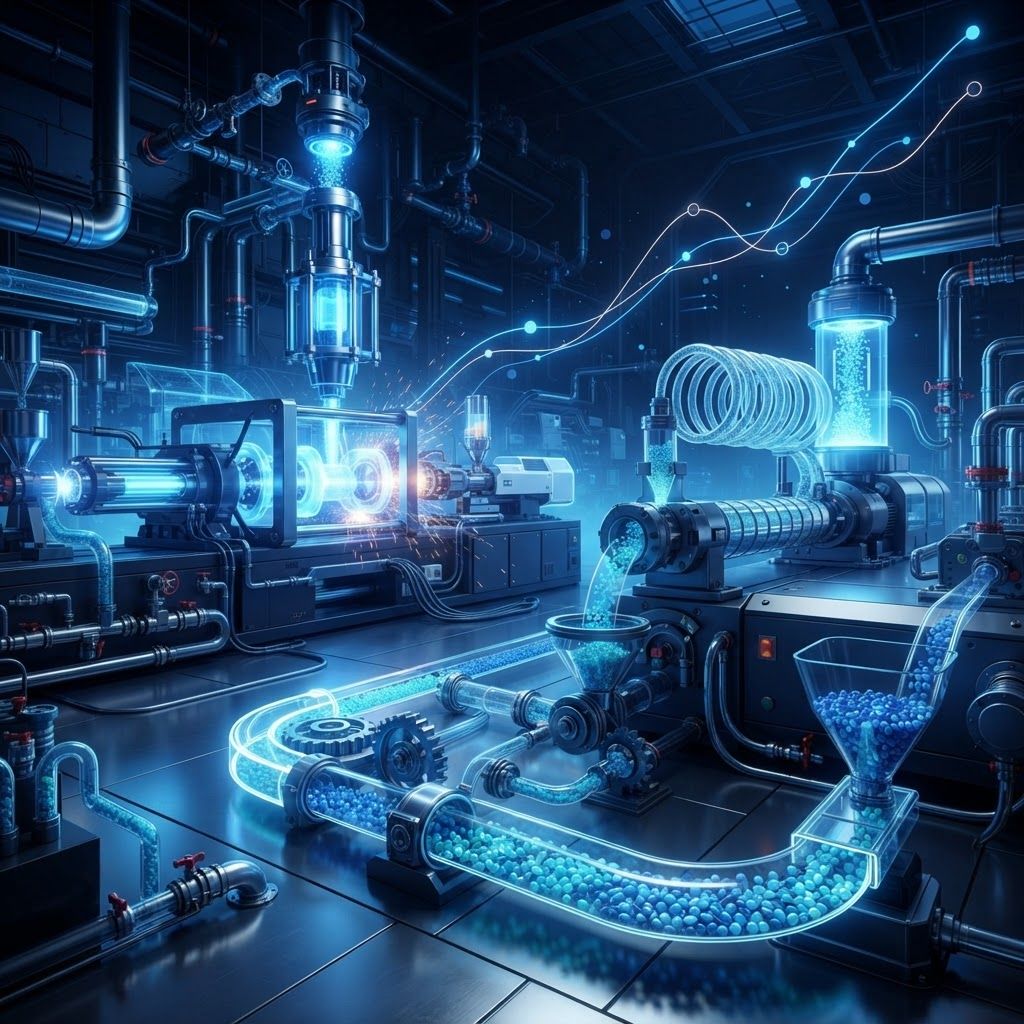
Plastics Processing: A Quiet Strength of the South Norfolk Economy
Plastics manufacturing rarely makes headlines locally, yet it underpins a surprising share of South Norfolk's industrial output. Injection moulders, extruders, thermoformers and fabricators operate from units around Wymondham, Attleborough, Diss, Snetterton and the villages fringing Norwich, supplying components to agricultural machinery builders, food processors, construction merchants, laboratories and consumer brands. The district's plastics firms tend to be privately owned, technically focused and closely tied to specific customer sectors, which gives them unusual depth in their chosen niches.
Two local factors have shaped this. First, the agricultural and food economy needs enormous quantities of durable, weather-resistant and food-safe plastic parts, from crop covers and irrigation fittings to trays, crates and closures. Second, the region's machinery builders require moulded and machined components that would be uneconomic to import in small volumes. Local processors have therefore specialised in short and medium runs with fast tooling turnaround, an area where overseas competition is weakest.
Understanding the Main Processes
Choosing a manufacturer starts with matching the process to the part. Injection moulding suits high volumes and complex geometry but requires significant tooling investment. Extrusion produces continuous profiles, pipe, sheet and film efficiently. Vacuum forming and pressure forming handle large, shallow parts with modest tooling costs, making them ideal for machine guards, trays and covers. Rotational moulding creates hollow items such as tanks, while CNC machining and fabrication of sheet materials suit one-offs, prototypes and very large assemblies.
Material selection matters equally. Polypropylene and polyethylene dominate for chemical resistance and food contact, ABS and polycarbonate for impact strength and clarity, acetal and nylon for wear surfaces and gears, and PVC for construction profiles. A capable manufacturer will discuss shrinkage, UV stabilisation, flame retardancy and regulatory requirements before quoting, not after.
The Top 10 Plastic Manufacturers in South Norfolk
1. Wymondham Injection Moulding
A technical moulder running a range of machine tonnages with in-house tool maintenance and modification. Its strengths are process consistency, scientific moulding discipline and detailed dimensional reporting, which suit customers supplying regulated markets. Insert moulding and assembly services are offered alongside standard production.
2. Attleborough Polymer Products
Focused on agricultural and horticultural plastics, this manufacturer produces fittings, trays, guards and containers designed for outdoor life. Heavy UV stabilisation, generous wall sections and pragmatic design for field repair make its products popular with growers and machinery dealers.
3. Diss Extrusion Company
Producing profiles, tube and sheet for construction, signage and industrial customers, Diss Extrusion is known for dimensional consistency on long runs and its willingness to develop custom dies for modest volumes. Co-extrusion capability allows dual-hardness and dual-colour profiles.
4. Harleston Vacuum Forming
Specialising in thermoformed panels, machine covers, trays and point-of-sale components, this business offers rapid tooling in timber and resin as well as aluminium tools for longer runs. CNC trimming ensures clean, repeatable edges, and it handles unusually large formings that many competitors cannot accommodate.
5. Long Stratton Plastic Fabrication
Fabricating tanks, bunds, ducting, enclosures and machine guarding from sheet acrylic, polypropylene and polycarbonate. Its welded seams and structural detailing are well regarded, and it frequently works from site surveys to produce retrofit solutions for existing plant.
6. Loddon Rotational Moulding
Manufacturing hollow products including water tanks, chemical containers, floats and kayak-style mouldings. Uniform wall thickness, integrated fittings and food-grade options are core capabilities, and the durable, seamless nature of the products suits demanding agricultural and marine environments.
7. Hethersett Medical and Technical Plastics
Serving laboratory, diagnostic and device customers with clean-room moulding and assembly, this manufacturer emphasises traceability, validation documentation and controlled material sourcing. Tight tolerance work and low-particulate finishing set it apart from general-purpose moulders.
8. Poringland Packaging Plastics
Producing containers, closures and trays for food and cosmetic brands, the company offers decoration options including in-mould labelling and pad printing. Increasing use of recycled content and lightweighting programmes reflects its focus on helping customers meet packaging obligations.
9. Costessey Precision Plastic Machining
A machinist rather than a moulder, this business produces engineering components from cast and extruded stock in materials such as acetal, nylon, PEEK and PTFE. Prototype turnaround, reverse engineering of worn parts and reliable tolerance control make it a valuable partner to local machinery builders.
10. Snetterton Plastics Recycling and Compounding
Collecting, sorting, regrinding and compounding post-industrial polymer waste into usable feedstock. Consistent melt-flow control and thorough contamination screening allow local processors to incorporate recycled material with confidence, closing the loop within the region rather than exporting waste.
Trends Driving Change in Plastics
Regulation and public expectation are the strongest forces. Packaging taxes and recycled-content thresholds have pushed processors to qualify recyclate, redesign parts for monomaterial recycling and reduce weight without losing performance. Several local firms now run parallel trials on virgin and recycled grades so customers can see real mechanical data rather than marketing claims.
Energy management is a second priority, with all-electric moulding machines, insulated barrels and optimised chilling substantially reducing consumption per part. Third, digital manufacturing is spreading: process monitoring, cavity pressure sensing and automated inspection improve first-pass yield, which matters more than headline cycle time. Finally, reshoring continues to benefit local processors as brands rediscover the value of short lead times and low freight risk.
How to Choose a Plastics Partner
Share the function of the part, not just a drawing. Good manufacturers add value through design for manufacture, suggesting rib layouts, draft angles, wall thickness and gate positions that cut cost and improve quality. Ask who owns the tooling and where it is stored, request sample parts with a dimensional report, and clarify how colour and material changes will be validated. If recycled content matters, agree measurable specifications rather than general commitments.
Also consider capacity and continuity. A processor with multiple similar machines can absorb a breakdown without stopping your supply, and one that holds agreed safety stock protects you against demand spikes. These practical arrangements often matter more than the unit price.
Final Thoughts
South Norfolk's plastics manufacturers combine technical rigour with genuine flexibility, covering everything from clean-room medical components to rotationally moulded farm tanks and locally reprocessed feedstock. Engage them early in the design process, be explicit about performance and sustainability requirements, and you will find capable, responsive partners on your doorstep.
Want your brand featured in front of decision-makers? Publish a guest post or get a link insertion in our guides through AAMAX's guest post and link insertion service.
Helpful Links
 SponsoredAAMAX — Full-Service Digital Agency
Write for Us
Share your expertise with our readers. We welcome guest contributions from industry specialists.
Pitch your idea

