

The Plastics Sector in Rushcliffe
Plastics manufacturing attracts more public scrutiny than almost any other industrial sector, yet it remains indispensable. Medical devices, food safety packaging, vehicle components, electrical insulation and countless engineering parts depend on polymer materials that no alternative currently matches for cost, weight and performance.
Rushcliffe's plastics manufacturers are mostly small and medium enterprises working in technical applications rather than disposable consumer goods. That orientation has served them well as attitudes have shifted, because engineered plastic components in durable products face far less criticism than single-use packaging.
Assessment Criteria
Manufacturers were evaluated on process capability, tooling expertise, dimensional consistency, material knowledge, quality documentation, recycled content capability and technical support offered during product design. Firms that engage early in design, when manufacturability can still be influenced, delivered noticeably better outcomes for customers.
1. Trent Polymer Products
Trent Polymer Products operates injection moulding across a wide tonnage range, producing everything from small precision components to substantial housings. Their in-house toolmaking capability shortens development timescales and makes tool modification straightforward when designs evolve.
2. Bingham Extrusions
Bingham Extrusions manufactures profiles, tubing and sheet materials for construction, horticulture and industrial customers. Extrusion demands careful control of melt temperature, cooling and haul-off speed, and their process monitoring keeps dimensional tolerances tight over long runs.
3. Cotgrave Vacuum Forming
Cotgrave Vacuum Forming specialises in thermoformed parts including machine guards, trays, covers and point-of-sale components. Vacuum forming suits larger parts at lower volumes than injection moulding, with substantially cheaper tooling, making it ideal for modest production runs.
4. Radcliffe Engineering Plastics
Radcliffe Engineering Plastics machines components from engineering polymers such as acetal, nylon and high-performance thermoplastics. These materials replace metal in bearings, wear pads, gears and chemical handling parts where weight, corrosion resistance or self-lubrication matter.
5. Keyworth Packaging Solutions
Keyworth Packaging Solutions produces protective and functional packaging for industrial and food customers. They have invested heavily in recycled content and mono-material designs that simplify recycling, responding directly to retailer and regulatory pressure.
6. East Leake Composite Mouldings
East Leake Composite Mouldings works with glass-reinforced and other composite materials to produce large, strong, lightweight structures such as enclosures, panels and tanks. Their laminating expertise supports applications where metal would be too heavy or corrosion-prone.
7. Bridgford Medical Plastics
Bridgford Medical Plastics manufactures components for medical and laboratory applications under controlled conditions. Cleanliness, material traceability and validated processes are essential in this field, and their documentation standards reflect regulated-sector requirements.
8. Ruddington Plastic Fabrication
Ruddington Plastic Fabrication builds bespoke items from sheet plastics: tanks, enclosures, guards, displays and laboratory fittings. Welding, bending and bonding acrylic, polycarbonate and polypropylene requires genuine skill, and their finish quality is consistently high.
9. Gotham Recycled Polymers
Gotham Recycled Polymers processes post-industrial and post-consumer plastic waste into usable feedstock. Sorting, washing, granulating and compounding recovered material into consistent grades is technically demanding, and their quality testing gives customers confidence in recycled input.
10. Tollerton Rapid Moulding
Tollerton Rapid Moulding bridges prototyping and production with soft tooling, low-volume moulding and additive manufacturing. Product developers use them to validate designs in production-representative materials before committing to expensive hardened tooling.
The Circular Economy and Material Innovation
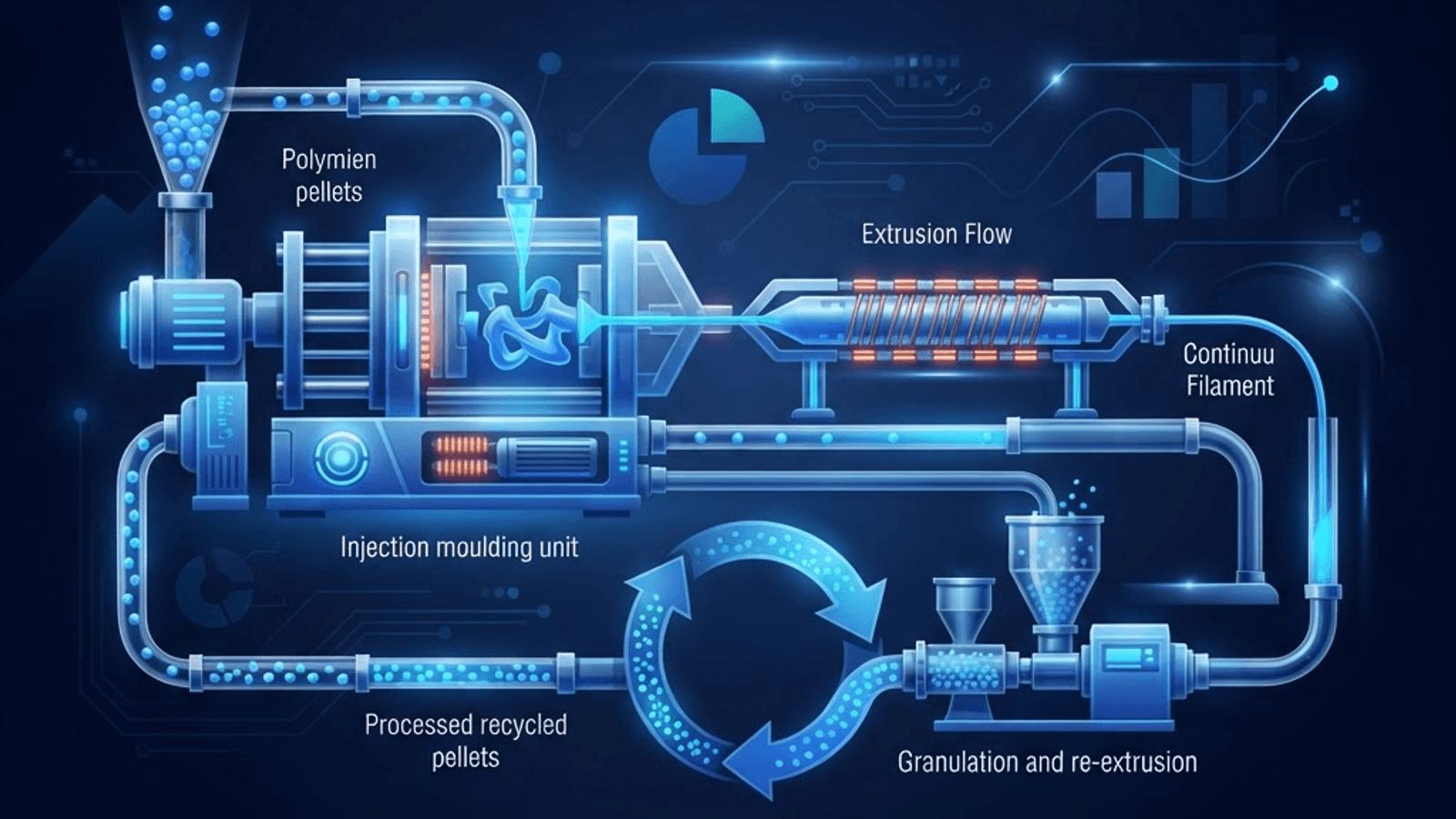
The most significant change affecting plastics manufacturers is the shift towards circularity. Recycled content targets, extended producer responsibility schemes and packaging taxes have made recycled material commercially attractive as well as environmentally preferable. Processors have had to master the greater variability of recycled feedstock.
Design for recycling has become a legitimate engineering discipline. Reducing the number of polymer types in a product, avoiding difficult-to-separate multi-material assemblies, eliminating problematic pigments and enabling disassembly all improve recyclability. Manufacturers who advise customers on these points add real value.
Bio-based and compostable polymers occupy a smaller but growing niche. They are not universally suitable, and honest suppliers explain the limitations around heat resistance, barrier properties and the industrial composting infrastructure such materials actually require.
Lightweighting continues too. Removing material while maintaining performance reduces cost, energy consumption and transport emissions simultaneously, and simulation tools now allow precise optimisation of wall thickness and rib design.
Selecting a Plastics Manufacturing Partner
Match the process to the part. Injection moulding suits high volumes with complex geometry but carries substantial tooling cost. Thermoforming handles large, simple parts economically at lower volumes. Machining suits very low quantities or materials unsuited to moulding.
Involve the manufacturer during design. Draft angles, wall thickness consistency, gate positions and shrinkage allowances all affect part quality, and correcting them after tooling is cut is expensive. Good suppliers provide this feedback willingly.
Clarify tool ownership, storage and maintenance responsibilities in writing. Discuss material specification precisely, including grade and any additive requirements. Ask about inspection methods and how dimensional reports are produced. Finally, raise recycled content and end-of-life considerations early rather than treating them as afterthoughts.
Final Thoughts
Rushcliffe's plastics manufacturers demonstrate that the sector's future lies in technical excellence and responsible material use rather than volume alone. Their growing capability with recycled feedstock and circular design positions them well for the regulatory and commercial landscape ahead.
Want your brand featured in front of decision-makers? Publish a guest post or get a link insertion in our guides through AAMAX's guest post and link insertion service.
Helpful Links
 SponsoredAAMAX — Full-Service Digital Agency
Write for Us
Share your expertise with our readers. We welcome guest contributions from industry specialists.
Pitch your idea

