

Polymers in a Rural Industrial Economy
Plastic manufacturing in Perth and Kinross is a practical, application-driven industry. There is no vast petrochemical complex here converting raw feedstock, but there is a solid network of processors, fabricators, converters and recyclers producing the components and packaging that regional industries depend on. Agriculture needs silage film, crop covers, drainage pipe and livestock equipment. Food and drink producers need containers, closures, trays and shrink films. Construction needs pipework, membranes, glazing sheet and cladding. Engineering needs machined polymer parts, guards and wear components.
These are unglamorous products, but they are essential, and the businesses making them combine polymer knowledge with fabrication skill and an increasingly serious focus on recycling and material recovery.
Processing Methods Used Across the Region
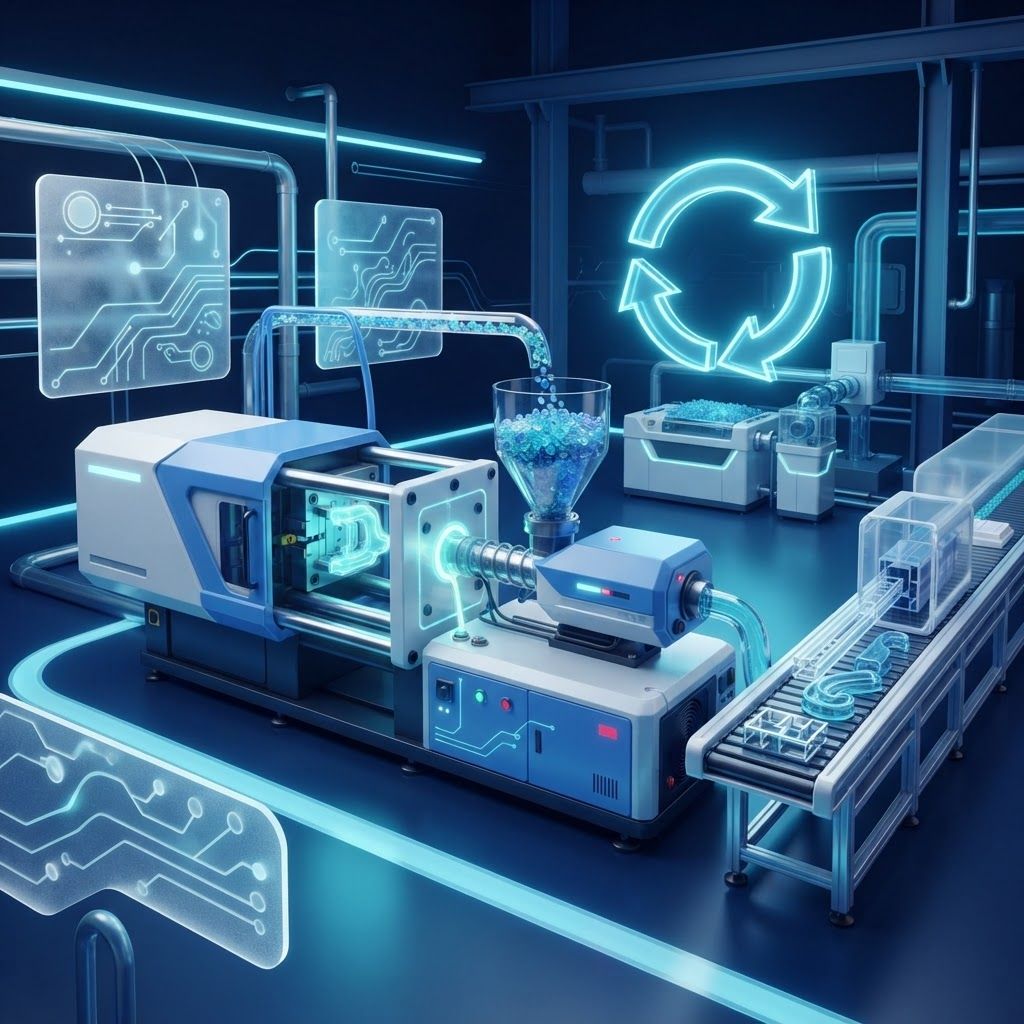
Injection moulding produces high volumes of identical parts from a steel tool, suiting closures, housings, fittings and components. Tooling cost is significant, so it favours established products with predictable demand.
Vacuum forming and thermoforming shape heated sheet over a mould, offering much lower tooling costs and suiting trays, covers, packaging inserts and machine guarding in medium volumes.
Extrusion produces continuous profiles, pipe, film and sheet, and underpins agricultural film and drainage products.
Rotational moulding creates large hollow items such as tanks, bins and troughs, which is particularly relevant to farming and water management applications.
Plastic fabrication and machining cuts, bends, welds and CNC-machines sheet and rod into tanks, ducting, signage, screens and engineering components. This is highly flexible, ideal for one-offs and small batches, and widely used across Perthshire industry.
Ten Notable Plastic Manufacturers and Converters
1. Perth Plastics Fabrication — Fabrication specialists cut, form and weld acrylic, polycarbonate, polypropylene and PVC into bespoke items including tanks, guards, display units and ducting. Their strength is responsiveness on one-off and small-batch work that moulders cannot economically supply.
2. Tayside Injection Moulding — Moulders serving food, engineering and consumer clients provide tool management, production moulding, assembly and packing. Key differentiators include in-house tool maintenance, material selection advice and quality systems suitable for food contact applications.
3. Strathmore Agricultural Plastics — Suppliers and converters of agricultural film, silage sheeting, netting, mulch film and crop covers serve the intensive farming of Strathmore. Increasingly they also operate collection and recycling schemes for used farm plastics, which addresses a longstanding rural waste problem.
4. Kinross Polymer Engineering — Engineering plastics machinists produce wear parts, bearings, rollers, gears and guides from materials such as nylon, acetal, PTFE and UHMWPE. These components often replace metal parts to reduce noise, weight and lubrication needs in food and processing machinery.
5. Highland Rotational Moulding — Rotational moulders produce water tanks, chemical tanks, feed bins, planters and buoyancy products. Their large hollow items are widely used in agriculture, water treatment and outdoor infrastructure across Highland Perthshire.
6. Perthshire Food Packaging — Packaging converters supply trays, punnets, films, lidding and closures to soft fruit growers, bakeries, meat processors and drinks producers. Barrier performance, sealing reliability, and increasingly recyclability and reduced material weight determine specification.
7. Blairgowrie Horticultural Plastics — Suppliers of pots, trays, propagation equipment, polytunnel film and irrigation components support the region's berry and nursery sector. Durability under UV exposure and compatibility with automated handling systems are important technical factors.
8. Tay Recycling and Polymer Recovery — Plastic recycling operations collect, sort, wash and reprocess post-industrial and post-agricultural plastics into reusable granulate. This closes the loop for farm film and packaging waste and reduces reliance on virgin polymer.
9. Perth Sign and Display Plastics — Manufacturers producing signage, protective screens, retail displays and architectural panels combine plastics fabrication with digital printing and CNC routing, serving businesses across central Scotland.
10. Crieff Composite and Specialist Mouldings — Composite and GRP fabricators produce enclosures, panels, covers and bespoke mouldings where high strength-to-weight ratios or corrosion resistance are needed, including applications in water infrastructure and renewable energy.
Sustainability: The Sector's Defining Challenge
No manufacturing sector faces more public scrutiny than plastics, and the industry in Perth and Kinross has responded substantively rather than cosmetically. Several developments stand out.
Material reduction through lightweighting cuts polymer use per unit without compromising function, delivering both cost and environmental gains. Design for recyclability means favouring single-polymer constructions and avoiding hard-to-separate laminates and dark pigments that defeat sorting equipment.
Recycled content incorporation is expanding, driven partly by packaging tax structures that reward recycled material. Agricultural plastic recovery schemes have become notably better organised, addressing the significant volumes of silage wrap and crop cover generated across Perthshire each season.
Bio-based and compostable polymers occupy a genuine but limited niche. They perform well where collection infrastructure exists and where contamination of food waste streams is the primary concern, but they are not a universal substitute, and responsible suppliers are honest about that.
Selecting a Plastics Supplier
Match the process to your volume. Fabrication suits ones and tens, thermoforming suits hundreds, injection moulding suits thousands and above. Choosing wrongly leads either to unaffordable tooling or unsustainable unit costs.
Be specific about the operating environment. UV exposure, temperature range, chemical contact, food contact status and impact loading all narrow material choice considerably, and a good supplier will interrogate these before quoting.
Ask about tooling ownership and storage if moulding is involved, as this affects future flexibility. Confirm quality systems, material certification and traceability, particularly for food or regulated applications.
Finally, discuss end-of-life openly. Suppliers who can advise on recyclability, take-back arrangements and recycled content demonstrate the kind of forward thinking that will matter increasingly as regulation tightens.
Outlook for Plastics in Perth and Kinross
Demand for polymer products is not disappearing, because in many applications plastics remain the lowest-impact option available, particularly where they reduce food waste, save vehicle weight or prevent water loss. What is changing is how they are designed, sourced and recovered. The regional manufacturers best positioned for the coming decade are those investing in recycling capability, recycled feedstock and design expertise that reduces material use. Perth and Kinross has a compact but capable sector doing exactly that, serving agriculture, food production and engineering with practical, locally supported solutions.
Want your brand featured in front of decision-makers? Publish a guest post or get a link insertion in our guides through AAMAX's guest post and link insertion service.
Helpful Links
 SponsoredAAMAX — Full-Service Digital Agency
Write for Us
Share your expertise with our readers. We welcome guest contributions from industry specialists.
Pitch your idea

