

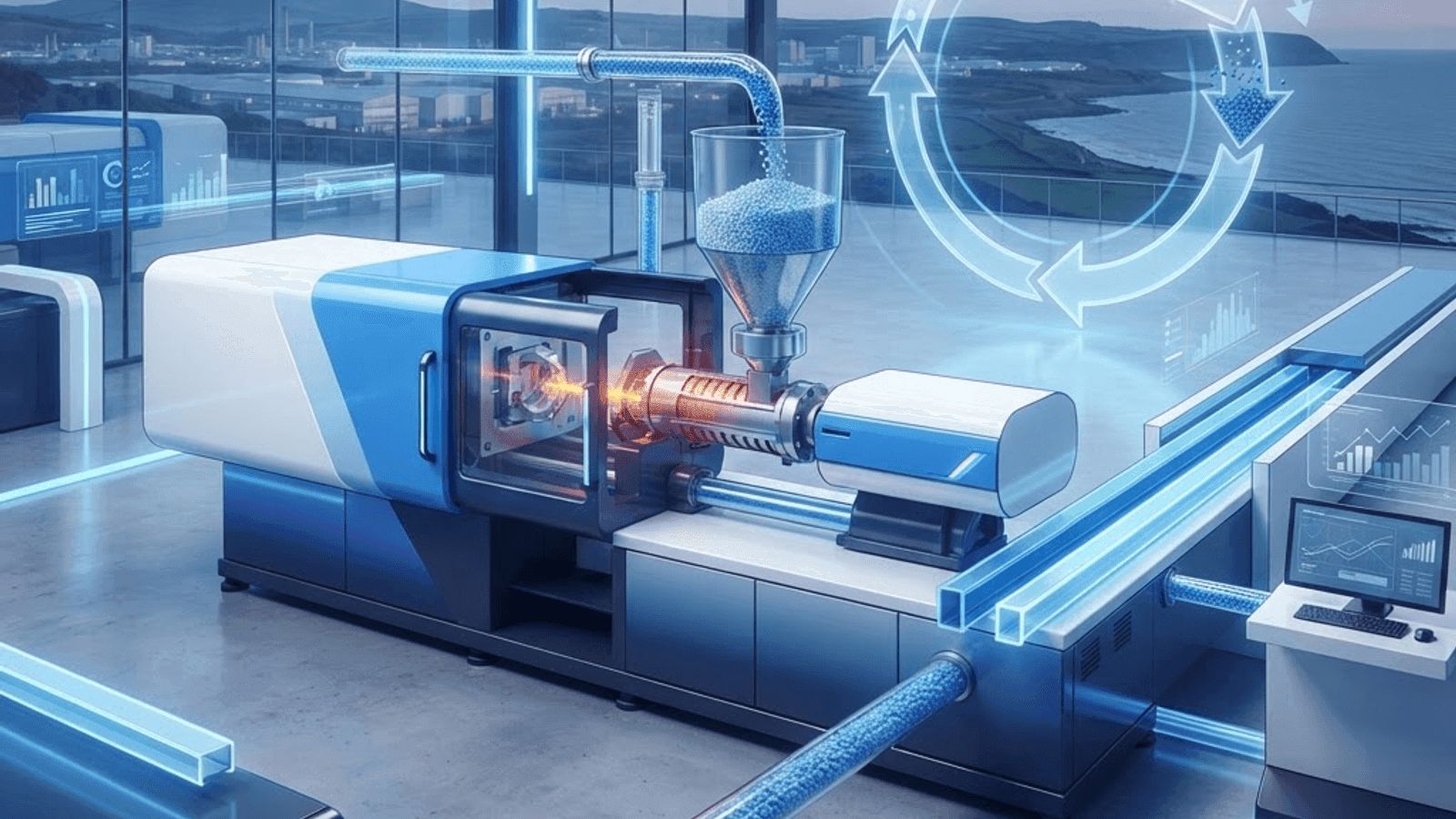
Plastics as an Industrial Enabler
Plastics rarely attract positive attention, yet they remain essential to sectors that matter greatly in Pembrokeshire. Agriculture depends on silage film, water tanks, troughs, pipework and crop protection materials. The marine industry relies on glass reinforced plastic hulls, buoys, fenders and corrosion resistant fittings that outperform metal in saltwater. Food processing requires hygienic food contact packaging and handling equipment. Construction uses pipes, drainage, insulation, cladding and window systems. Energy operations need chemically resistant tanks, ducting and cable management.
Local plastics businesses therefore serve practical industrial needs rather than consumer disposables, and they are increasingly judged on how well they handle recycling, material efficiency and product longevity.
The Main Plastics Processes
Injection moulding produces high volumes of identical components from a steel tool, suited to parts needed in quantity. Rotational moulding creates large hollow items such as tanks and containers. Vacuum forming shapes heated sheet over a mould, useful for trays, covers and packaging. Extrusion produces continuous profiles including pipe, trunking and edging. Plastic fabrication involves cutting, bending and welding sheet material into tanks, guards, signage and bespoke enclosures. Composites and glass reinforced plastic work builds strong lightweight structures for marine and industrial use. Recycling and reprocessing converts waste polymer back into usable material.
Ten Plastics Manufacturers and Fabricators in Pembrokeshire
1. Cleddau Polymer Products
An injection moulding business producing technical components for agricultural, industrial and equipment manufacturing clients, with in house tooling maintenance and batch traceability.
2. Haven Composite Engineering
A glass reinforced plastic specialist fabricating marine components, hulls, covers, tanks and corrosion resistant structures for boatyards, ports and industrial sites.
3. Preseli Agricultural Plastics
A manufacturer and supplier of livestock troughs, water tanks, feed bins, ducting and farm handling products designed for outdoor durability in exposed Welsh conditions.
4. West Wales Plastic Fabrication
A sheet fabrication workshop producing machine guards, tanks, enclosures, signage and bespoke acrylic and polypropylene assemblies using plastic welding and machining.
5. Milford Industrial Pipework Systems
A supplier and installer of chemically resistant plastic pipework, ducting and containment systems for process plants, water treatment and industrial facilities.
6. Coastway Food Packaging Solutions
A producer of food contact trays, containers and vacuum formed packaging for local seafood, dairy and food processing businesses, working to hygiene and food safety requirements.
7. Narberth Recycling Polymers
A reprocessing business collecting and converting agricultural and industrial waste plastic into recycled granulate and secondary products, closing the loop for local farms.
8. Pembroke Rotational Moulding
A rotomoulding manufacturer producing large hollow products including water storage tanks, chemical containers, buoys and street furniture.
9. St Davids Marine Plastics
A fabricator of fenders, floats, decking, boat fittings and coastal infrastructure components engineered to resist ultraviolet exposure and saltwater degradation.
10. Pembrokeshire Precision Tooling
A toolmaking specialist designing and manufacturing moulds and formers for local plastics producers, including tool repair and modification for design changes.
Regulation, Recycling and the Circular Economy
The regulatory environment has changed substantially. Extended producer responsibility places the cost of packaging waste management on the businesses that place packaging on the market, which has sharpened attention on material choice and weight reduction. Plastic packaging tax applies where recycled content falls below a threshold, creating a direct financial incentive to incorporate recyclate. Wales has among the strongest recycling performance in the United Kingdom, and workplace recycling requirements now oblige businesses to separate waste streams. Agricultural plastic recovery schemes address the substantial volume of silage wrap and crop film used on Welsh farms. For manufacturers, these changes have shifted recycled content from an optional selling point to a commercial and regulatory expectation.
Material Choice and Sustainable Design
Responsible plastics manufacturing begins at the design stage. Using a single polymer type rather than mixed materials makes a product far easier to recycle at end of life. Avoiding adhesives and unnecessary colourants improves recyclate quality. Designing for durability matters particularly in agriculture and marine, where a product that lasts fifteen years has a vastly lower environmental impact than one replaced every three. There is also growing interest in bio based polymers, though these require careful assessment since biodegradability and recyclability are not interchangeable properties and mixing them incorrectly can contaminate recycling streams.
Choosing a Plastics Manufacturing Partner
Match the process to the product. Injection moulding requires tooling investment that only makes sense at volume, whereas fabrication or rotational moulding suits lower quantities. Ask about tooling ownership and costs explicitly, since this is the most common source of disputes. Confirm material specification, including grade, ultraviolet stabilisation and any food contact or fire performance requirements. Discuss recycled content options and whether they affect performance. Request samples and, for critical applications, ask about testing. Finally, consider lead times and whether the supplier can hold stock, because delivery reliability often matters more than marginal unit price.
Careers and Skills
The sector employs process operators, tool setters, toolmakers, plastic welders, composite laminators, quality inspectors and design engineers. Composite and plastic welding skills in particular are in demand and transfer well between marine, industrial and construction work. Training is generally delivered on the job, supported by regional college engineering provision.
Final Thoughts
Plastics manufacturing in Pembrokeshire is a practical, industrial activity serving farms, boatyards, processors and construction firms with products chosen for durability and performance. The sector's future rests on demonstrating responsible material use, incorporating recycled content and designing products that last. Local manufacturers who embrace that shift are likely to find it strengthens rather than constrains their position.
Want your brand featured in front of decision-makers? Publish a guest post or get a link insertion in our guides through AAMAX's guest post and link insertion service.
Helpful Links
 SponsoredAAMAX — Full-Service Digital Agency
Write for Us
Share your expertise with our readers. We welcome guest contributions from industry specialists.
Pitch your idea

