

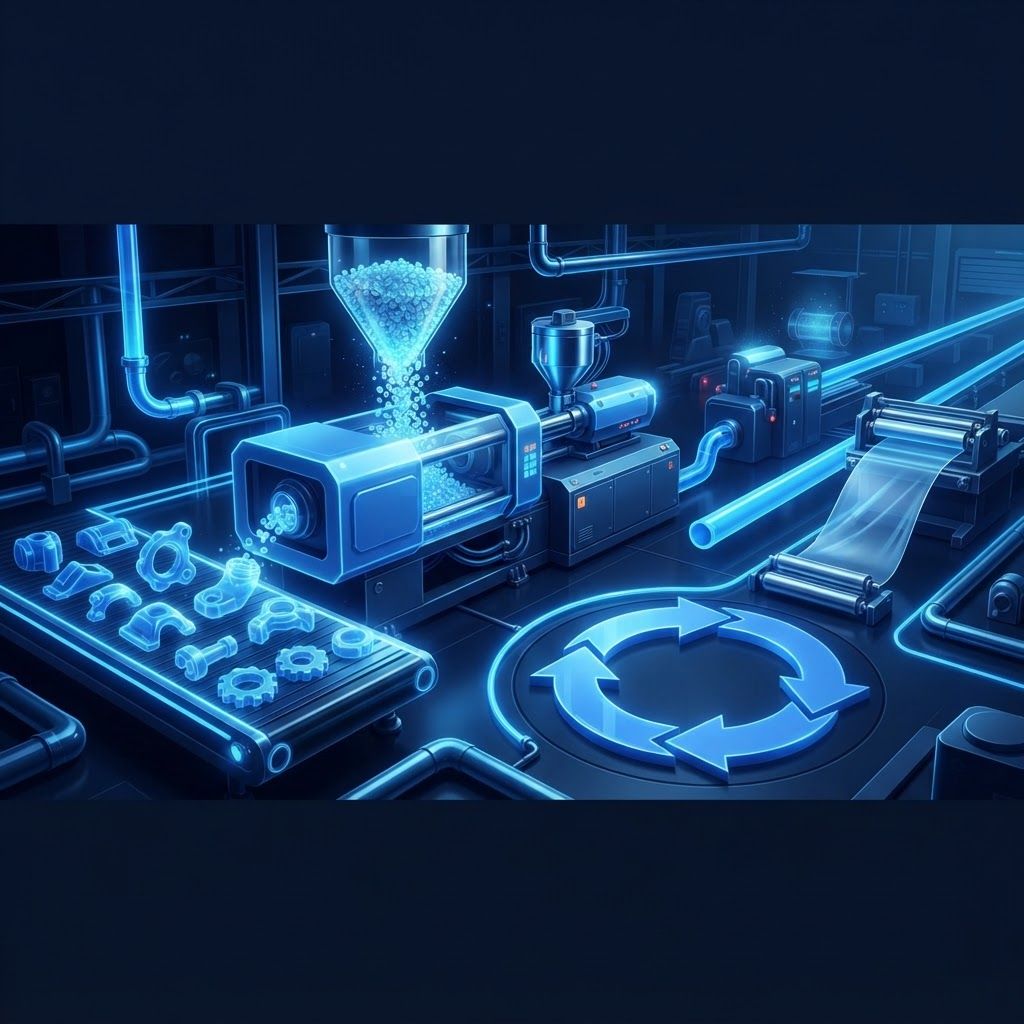
Plastics in the Warwickshire Manufacturing Base
Plastics processing is one of the most widespread manufacturing activities in the Midlands, and businesses in and around Nuneaton and Bedworth depend on it heavily. Automotive interior and under bonnet components, construction products such as pipes and profiles, packaging for food and industrial goods, medical disposables and electrical enclosures all originate from polymer processing operations within reach of the borough.
The sector combines heavy capital investment in machinery and tooling with detailed technical knowledge of material behaviour, which is why choosing a processing partner carries long term consequences.
The Main Processing Methods
Injection moulding is the dominant process for complex, high volume parts, forcing molten polymer into a steel tool under pressure. It offers excellent repeatability but requires significant tooling investment. Extrusion produces continuous profiles, pipes, sheet and film, and suits construction and packaging products. Blow moulding forms hollow items such as bottles and tanks. Thermoforming heats sheet material and shapes it over a mould, offering lower tooling cost for larger, simpler parts at moderate volumes. Rotational moulding produces large hollow items such as tanks and containers. Vacuum casting and additive manufacturing serve prototyping and very low volume needs.
Ten Plastic Manufacturers and Processors Relevant to the Borough
RPC bpi group produces polythene films, containers and industrial packaging with extensive United Kingdom operations serving Midlands manufacturers and distributors.
Wavin UK manufactures plastic pipe systems for water, drainage and heating applications widely used on Warwickshire construction projects.
Polypipe Building Products supplies drainage, ventilation and plumbing systems in plastic, serving housebuilders and contractors across the region.
Epwin Group manufactures extruded plastic building products including window profiles, cladding and rainwater systems from Midlands facilities.
Rutland Plastics is a well established East Midlands injection moulder offering large part capability, design support and toolmaking for industrial customers.
Brookson Plastics style regional injection moulders provide medium volume component production for automotive and industrial customers in Warwickshire.
Omega Plastics specialises in rapid tooling and prototype to low volume injection moulding, useful for engineering firms developing new products.
Luxus produces recycled polymer compounds used by moulders seeking to increase recycled content in automotive and consumer components.
Amcor Flexibles supplies flexible packaging solutions to food and consumer goods producers, including operations distributing through Midlands logistics networks.
Local Warwickshire vacuum forming, fabrication and plastic machining workshops complete the supply base, producing guards, enclosures, signage and bespoke components for manufacturers across the borough.
Tooling Investment and Part Design
Tooling is usually the largest single cost in launching an injection moulded product, and it rewards careful design. Wall sections should be uniform to avoid sink marks and warping, draft angles are essential for part ejection, ribs should be proportioned to wall thickness, and gate location determines flow, weld lines and cosmetic finish. Engaging a moulder during the design phase rather than after drawings are frozen typically reduces tool cost and cycle time substantially.
Clarify tool ownership, storage responsibility, maintenance obligations and expected tool life in the contract. Tools represent a significant asset and disputes over their custody can be disruptive.
Material Selection
Polymer choice balances mechanical performance, temperature resistance, chemical exposure, regulatory requirements and cost. Polypropylene offers chemical resistance and low cost. Acrylonitrile butadiene styrene provides good impact strength and surface finish. Polycarbonate delivers transparency and toughness. Nylon and engineering polymers serve higher temperature and load applications. For food contact or medical use, the material must be approved for the application and traceable through the supply chain. Increasingly, specifications also demand a defined percentage of recycled content.
Recycling, Packaging Tax and Environmental Obligations
Plastic packaging with less than a defined proportion of recycled content attracts the plastic packaging tax, which has sharply increased commercial interest in recycled feedstock. Extended producer responsibility places the cost of packaging waste management onto producers, changing the economics of design and material choice. Manufacturers should be reviewing part design for recyclability, reducing material use through lightweighting, avoiding difficult material combinations that frustrate recycling, and documenting recycled content properly for compliance and customer reporting.
Quality Systems and Sector Requirements
Automotive supply usually requires IATF 16949 certification and structured production part approval processes. Medical components require ISO 13485 and cleanroom moulding for many applications. Food contact parts require documented compliance and hygiene controls. Ask to see certification and, where relevant, evidence of process capability studies rather than accepting general assurances.
Choosing a Processing Partner
Match machine size and volume capability to your requirement, since a moulder equipped for very large tonnage parts is rarely economic for small components and vice versa. Assess in house toolmaking or tool maintenance capability, because tool availability drives production continuity. Consider proximity, as freight cost for bulky plastic parts is significant and local supply reduces both cost and lead time. Finally, evaluate engineering support, which is often the difference between a part that moulds reliably and one that generates scrap for years.
Conclusion
Plastics processing remains central to manufacturing around Nuneaton and Bedworth despite growing environmental scrutiny. The processors listed above cover packaging, construction products, injection moulding and recycled compounds. Design early with your moulder, choose materials with recyclability and regulation in mind, and treat tooling as a strategic asset that deserves clear contractual protection.
Want your brand featured in front of decision-makers? Publish a guest post or get a link insertion in our guides through AAMAX's guest post and link insertion service.
Helpful Links
 SponsoredAAMAX — Full-Service Digital Agency
Write for Us
Share your expertise with our readers. We welcome guest contributions from industry specialists.
Pitch your idea

