

The Plastics Sector in North Ayrshire
Plastics manufacturing rarely attracts the attention given to shipbuilding or renewable energy, yet it underpins an extraordinary range of products across North Ayrshire and beyond. Components in medical devices, food packaging, automotive interiors, electrical enclosures, marine fittings, agricultural equipment and construction systems all emerge from polymer processing operations, many of them located on industrial estates around Irvine, Kilwinning, Stevenston and Dalry.
Irvine in particular developed substantial polymer processing capability during its new town expansion, when purpose-built industrial units and inward investment incentives attracted manufacturers seeking modern facilities with good transport links to Glasgow and the Ayrshire ports. That infrastructure remains, and the businesses occupying it have evolved from commodity production towards technically demanding, precision work.
Types of Plastics Manufacturing in the Region
Injection moulding is the dominant process for high-volume components. Molten polymer is injected into a precision steel tool under high pressure, producing identical parts in cycle times measured in seconds. North Ayrshire moulders run machines ranging from small presses producing intricate medical components to large tonnage machines making automotive and industrial parts. Tooling investment is substantial, so this process suits established products with predictable volumes.
Vacuum forming and thermoforming heat a plastic sheet and draw it over a mould, producing trays, covers, machine guards, point-of-sale displays and packaging inserts. Tooling costs are far lower than injection moulding, making this ideal for medium volumes and larger parts.
Extrusion produces continuous profiles including pipe, tube, edging, seals, cable conduit and window profiles. Co-extrusion allows multiple materials in a single profile, combining rigid and flexible sections or adding weather-resistant outer layers.
Rotational moulding creates large hollow items such as water tanks, agricultural feeders, marine buoys and containment bunds, all products with real relevance to Ayrshire's farming, aquaculture and marine activity.
Plastic fabrication and machining covers CNC machining of engineering polymers such as acetal, nylon, PTFE and polycarbonate, alongside welded fabrication of tanks, ducting and enclosures in polypropylene and PVC for chemical and process industries.
Composite and GRP manufacturing produces glass-reinforced plastic components for marine, construction and renewable energy applications, drawing on skills closely related to Clyde boatbuilding.
What Makes the Best Plastics Manufacturers
Tooling expertise is foundational. The quality of a moulded part is largely determined by tool design: gate positioning, cooling channel layout, venting, draft angles and ejection strategy. Manufacturers with in-house toolmaking or strong toolmaker partnerships, plus mould flow analysis capability, consistently produce better parts with fewer development iterations.
Material knowledge distinguishes true specialists. Polymer selection involves balancing mechanical properties, chemical resistance, UV stability, temperature performance, regulatory compliance and cost. A manufacturer who can recommend switching from ABS to a glass-filled polypropylene to solve a warping problem adds genuine engineering value.
Quality certification varies by market. ISO 9001 is standard; medical work requires ISO 13485; food contact applications demand compliance with relevant food contact regulations and often BRC packaging certification; automotive supply calls for IATF 16949.
Process control and validation matter enormously for consistency. Scientific moulding methodology, cavity pressure monitoring, statistical process control, automated inspection and full process documentation separate manufacturers who understand their process from those who adjust settings by instinct.
Secondary operations capability including ultrasonic welding, pad printing, assembly, insert moulding, overmoulding and packing allows manufacturers to deliver finished products rather than bare mouldings.
Sustainability and the Future of Plastics
No manufacturing sector faces greater environmental scrutiny, and the industry's response has been substantial.
Recycled content has moved from marginal to mainstream. The UK Plastic Packaging Tax applies to packaging containing less than thirty percent recycled plastic, creating a powerful commercial driver. Manufacturers who have qualified recycled grades and validated their performance now hold a genuine competitive advantage.
Material reduction and lightweighting deliver simultaneous cost and environmental benefits. Structural analysis, ribbing optimisation and wall thickness reduction can remove significant material without compromising function.
Design for recyclability increasingly influences specification. Mono-material construction, avoiding mixed polymers and problematic additives, and designing for easy disassembly all improve end-of-life outcomes.
Bio-based and compostable polymers including PLA and PHA have found genuine applications, particularly in food service and horticulture, though performance limitations mean they complement rather than replace conventional polymers.
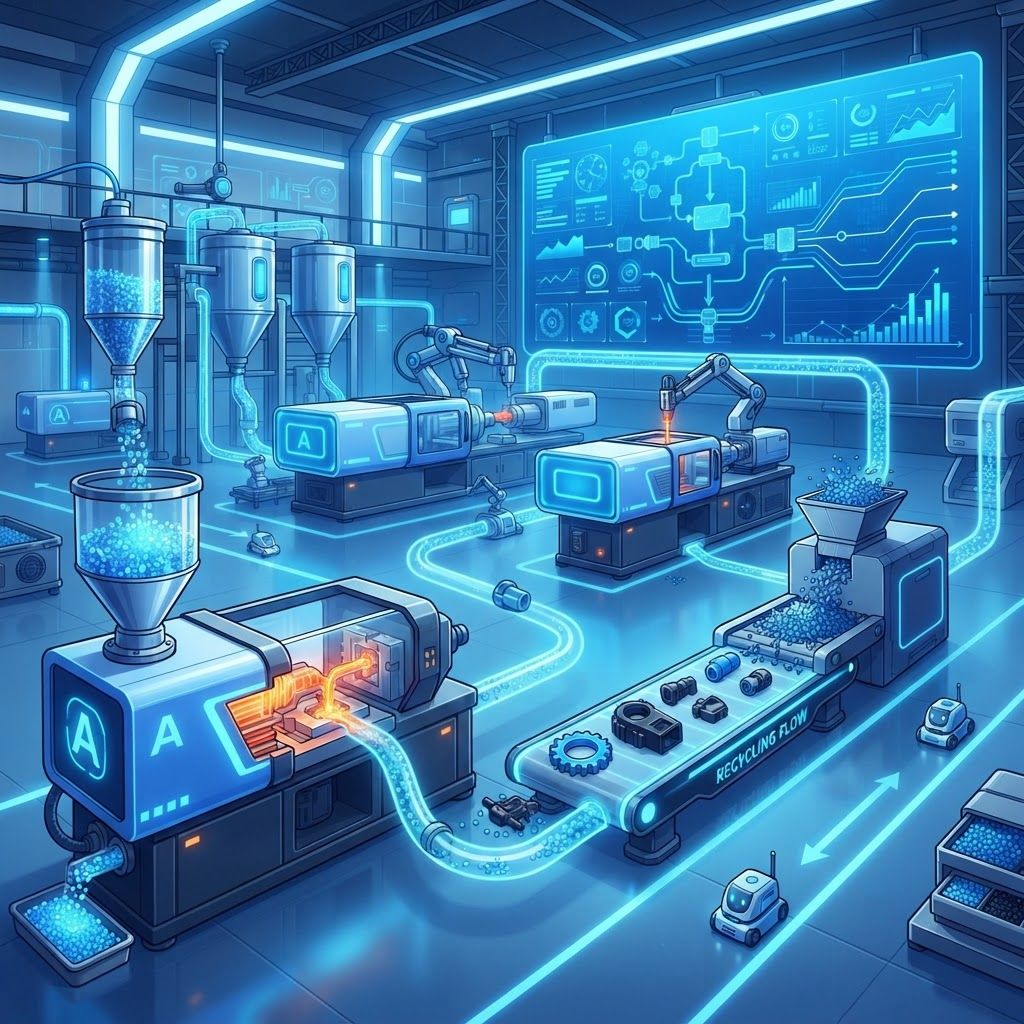
Closed-loop recycling operations regrind sprues, runners and rejected parts back into production, while some manufacturers operate take-back schemes recovering products at end of life.
Energy efficiency improvements through all-electric moulding machines, which use substantially less energy than hydraulic equivalents, plus heat recovery and renewable electricity procurement, have cut both costs and emissions significantly.
Benefits for Local Industry
Plastics manufacturers in North Ayrshire support a broad regional customer base. Food producers need packaging and handling trays. Aquaculture operations need tanks, floats and cages. Farms need feeders, troughs and containment. Engineering firms need machine guards, wear components and enclosures. Construction contractors need drainage, ducting and profile systems.
Sourcing locally reduces freight costs and emissions, shortens lead times dramatically compared with imported alternatives, and allows face-to-face problem solving during product development. It also supports skilled local employment in process engineering, toolmaking, quality control and machine setting.
Choosing a Plastics Manufacturing Partner
Begin with process suitability. High volumes with tight tolerances point to injection moulding; larger, lower-volume parts suit thermoforming or rotational moulding; continuous profiles require extrusion. A good manufacturer will advise honestly even when the answer points elsewhere.
Discuss tooling ownership explicitly. Confirm who owns the mould, where it is stored, and your right to move it if the relationship ends. Ask about tool maintenance schedules and expected tool life.
Request sample parts and, for critical applications, material certificates and dimensional reports. Verify relevant quality certification for your market. Clarify minimum order quantities, lead times for initial and repeat production, and how design changes are handled and costed.
Final Thoughts
Plastics manufacturing in North Ayrshire has matured into a technically capable, quality-focused sector serving demanding markets. The industry is undergoing genuine transformation as recycled content, material reduction and design for circularity move from aspiration to requirement. The manufacturers thriving here are those treating that transition as an engineering challenge to be solved rather than a burden to be resisted, and their capability makes them valuable partners for businesses across Scotland.
Want your brand featured in front of decision-makers? Publish a guest post or get a link insertion in our guides through AAMAX's guest post and link insertion service.
Helpful Links
 SponsoredAAMAX — Full-Service Digital Agency
Write for Us
Share your expertise with our readers. We welcome guest contributions from industry specialists.
Pitch your idea

