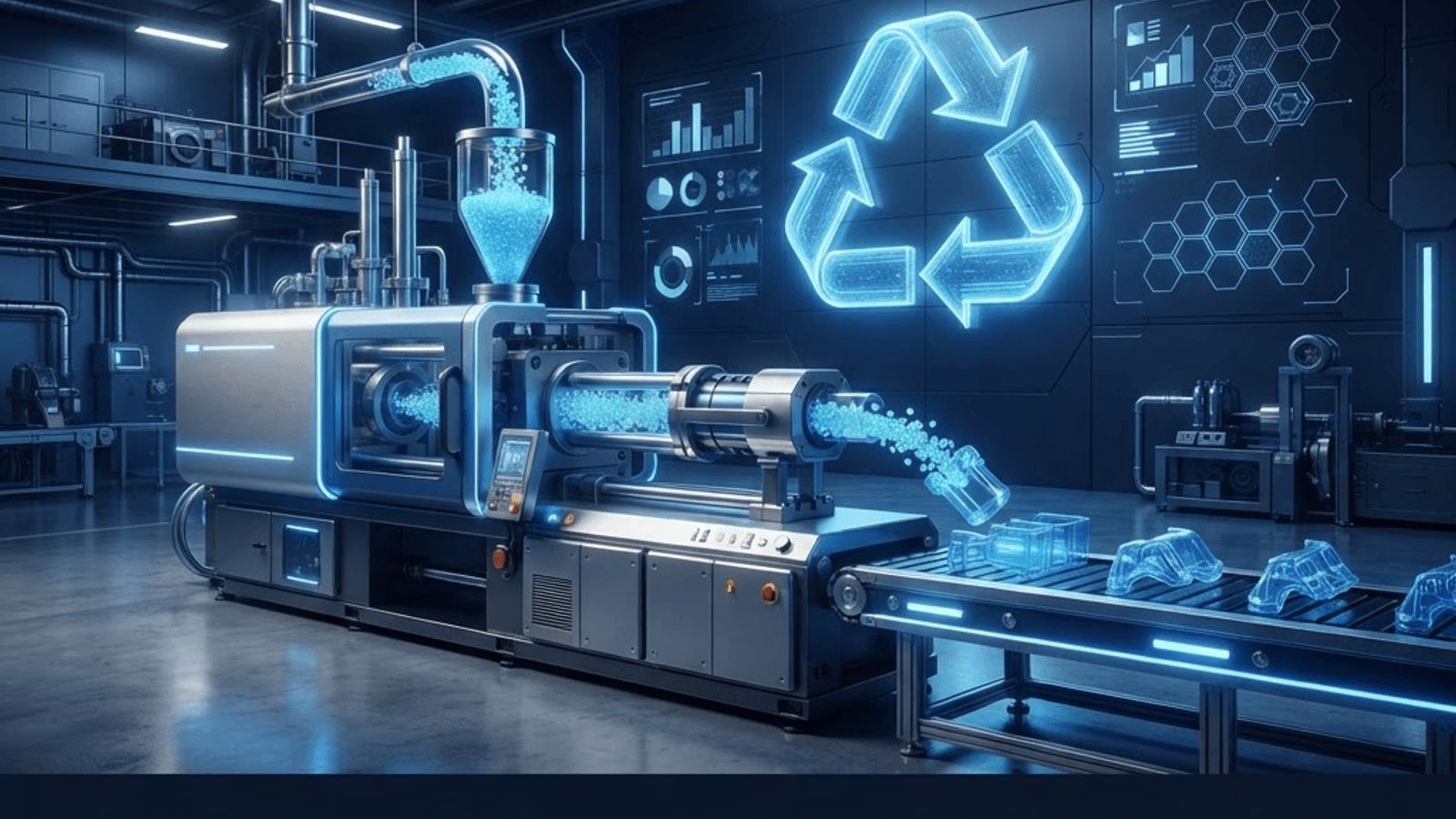
Plastics Manufacturing in the Borough
Plastics manufacturing rarely receives the attention given to engineering or automotive production, yet it sits inside almost every product those industries make. Housings, seals, clips, ducting, guards, containers, trims and countless technical components begin life as polymer granules and end up as precisely formed parts. In Hinckley and Bosworth, plastics processors have grown alongside the borough's engineering and logistics sectors, supplying components to customers frequently located only a few miles away.
The local industry favours technical and mid-volume work over commodity production. Rather than competing on the cheapest possible disposable items, processors here concentrate on engineered components with tight tolerances, demanding material specifications or complex tooling, categories where proximity, technical support and quality control provide real advantages.
Assessment Criteria
Manufacturers were assessed on process capability, tooling expertise, material knowledge, quality systems, sustainability practice and their ability to support customers from design through production.
The Top 10 Plastic Manufacturers
1. Bosworth Injection Mouldings — A technical moulder running a range of clamp tonnages for components from small precision parts to substantial housings. Its scientific moulding approach controls melt temperature, pressure and cooling systematically, producing exceptional dimensional consistency.
2. Hinckley Plastic Fabrications — Specialises in fabricated acrylic, polycarbonate and polypropylene work: machine guarding, tanks, display units, ducting and protective screens. CNC routing, line bending and solvent welding are handled in-house.
3. Watling Extrusions — Produces profile extrusions, tubing and sheet in a range of polymers, including custom profiles from bespoke dies. Continuous processing suits customers needing long lengths in consistent cross-section.
4. Sketchley Vacuum Forming — Offers thermoforming and vacuum forming for larger, shallower components where injection tooling would be uneconomic. Tooling costs are far lower, making it ideal for moderate volumes and prototype-to-production transitions.
5. Mallory Tooling and Moulds — Designs and manufactures injection moulds and tooling, including multi-cavity and hot runner tools. Mould quality determines part quality across an entire programme, making this a critical upstream capability.
6. Earl Shilton Rotational Moulding — Produces hollow components such as tanks, containers, bins and housings. Rotational moulding creates seamless, stress-free parts with uniform wall thickness, well suited to large durable items.
7. Ambion Engineering Plastics — Machines components from engineering polymers including nylon, acetal, PTFE and high-performance thermoplastics. Machined parts avoid tooling cost entirely, which suits prototypes and low volumes.
8. Triumph Composite Solutions — Works in glass and carbon reinforced composites, producing lightweight structural panels and enclosures for motorsport, transport and industrial applications.
9. Leicestershire Polymer Recycling — Collects, sorts, regrinds and compounds post-industrial plastic waste into usable feedstock, closing the loop for manufacturers seeking to reduce both waste costs and virgin material consumption.
10. Bosworth Field Prototyping — Provides additive manufacturing, urethane casting and rapid tooling for design validation before committing to production tooling, significantly reducing the risk of expensive late design changes.
Choosing the Right Process
Process selection is the most consequential early decision in any plastic component project, and it depends principally on volume, geometry and tolerance. Injection moulding delivers the lowest unit cost and best repeatability at scale, but tooling represents a substantial upfront investment that only amortises across large quantities.
Vacuum forming and rotational moulding require far cheaper tooling and suit larger, simpler geometries at moderate volumes. Machining from stock material eliminates tooling altogether, making it ideal for prototypes, very low volumes or extremely tight tolerances. Additive manufacturing has extended this further, now viable for functional end-use parts in small quantities and complex geometries impossible to mould.
Material Selection Matters
Polymer choice determines mechanical strength, temperature tolerance, chemical resistance, ultraviolet stability, flammability behaviour and appearance. A component that performs perfectly indoors may become brittle within two years outdoors without appropriate stabilisation. A part exposed to oils or solvents may craze and fail in a material that appeared entirely suitable on a data sheet.
Good manufacturers interrogate the application before recommending material: operating temperature range, loading, chemical exposure, expected service life, regulatory requirements and cosmetic expectations. Choosing on price alone is a reliable path to field failure.
Design for Manufacture
Many plastic part problems originate in design rather than production. Inconsistent wall thickness causes sinking and warping. Insufficient draft angle makes ejection difficult and marks surfaces. Sharp internal corners concentrate stress and initiate cracks. Overly tight tolerances on non-critical dimensions inflate cost without benefit.
Engaging a manufacturer during design rather than after it is complete typically produces a part that is cheaper, more reliable and quicker to tool. The best local processors offer this review as standard and regularly identify savings that dwarf any difference in quoted piece price.
Sustainability and the Circular Economy
Plastics face intense and justified environmental scrutiny, and the industry's response locally has been substantive rather than cosmetic. Recycled content is increasingly incorporated where performance allows. Regrind from sprues and runners is reprocessed rather than discarded. Lightweighting reduces material consumption per part. Design for disassembly and single-polymer construction improve end-of-life recyclability.
Packaging regulations and extended producer responsibility have sharpened commercial incentives further. Manufacturers who can demonstrate recycled content, document material streams and help customers meet reporting obligations hold a clear competitive advantage.
Conclusion
Plastics manufacturing in Hinckley and Bosworth is a technical, engineering-led sector serving demanding regional customers. The ten firms profiled here span injection moulding, fabrication, extrusion, thermoforming, tooling, rotational moulding, machining, composites, recycling and prototyping. Selecting the right process and material partner early in a project is the single most effective way to control both cost and quality across its lifetime.
Want your brand featured in front of decision-makers? Publish a guest post or get a link insertion in our guides through AAMAX's guest post and link insertion service.
Helpful Links
 SponsoredAAMAX — Full-Service Digital Agency
Write for Us
Share your expertise with our readers. We welcome guest contributions from industry specialists.
Pitch your idea