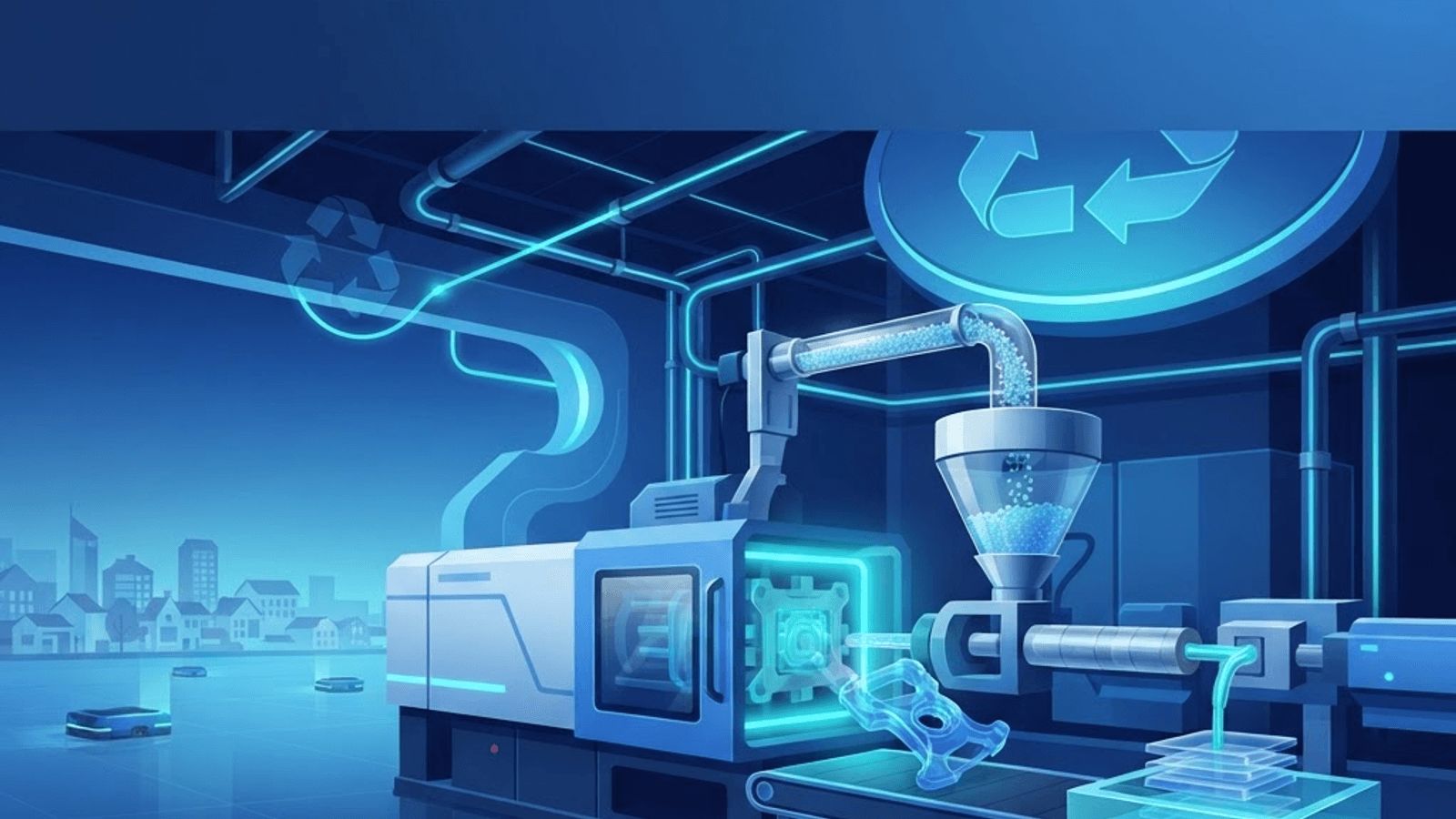
The Role of Plastics Manufacturing in Gedling
Plastics are so embedded in modern products that their manufacture often goes unnoticed, yet the sector supports a substantial number of skilled jobs across Gedling and the surrounding Nottinghamshire industrial estates. Local firms produce components for automotive, medical, packaging, construction, electrical and consumer goods customers, and a growing number focus on recycling and reprocessing rather than virgin material conversion.
The borough's plastics businesses tend to be medium-sized, technically capable and highly responsive. They rarely compete on the very lowest unit cost, instead winning work on tooling expertise, material knowledge, quality consistency and the ability to support customers through design changes and short lead times.
The Main Processes Used Locally
Injection moulding dominates, producing high volumes of dimensionally precise components from a steel or aluminium tool. It suits parts from tiny clips to large housings, with costs driven heavily by tooling investment and cycle time.
Extrusion produces continuous profiles, pipes, sheets and tubing, common in construction and industrial applications. Vacuum and thermoforming shapes heated sheet over a mould, offering low tooling costs for larger, simpler parts and short runs. Rotational moulding creates hollow items such as tanks and containers. Blow moulding produces bottles and hollow vessels. Finally, CNC machining of plastic stock and 3D printing serve prototyping and very low volume needs.
Several Gedling firms combine two or more of these processes, which is genuinely useful for customers because it allows an honest conversation about which method best fits the volume, geometry and budget rather than a push towards whichever process the supplier happens to own.
The Top 10 Plastic Manufacturers Serving Gedling
1. Gedling Injection Moulding
A technical moulder running a range of machine tonnages, handling engineering polymers as well as commodity grades. Strong in-house tooling maintenance keeps repeat work running consistently over many years.
2. Colwick Polymer Products
Produces extruded profiles, tubing and sheet for construction and industrial customers, with the ability to develop bespoke die profiles for customer-specific applications.
3. Netherfield Vacuum Forming
Specialists in thermoformed trays, covers, machine guards and point-of-sale components, offering low tooling costs that suit short runs and frequent design iterations.
4. Arnold Medical Plastics
Focuses on components for medical devices and laboratory equipment, working to strict cleanliness, material traceability and validation requirements.
5. Carlton Plastic Fabrication
Fabricates acrylic, polycarbonate and PVC into tanks, enclosures, screens and signage using cutting, bending, welding and bonding rather than moulding.
6. Mapperley Rotational Moulding
Manufactures hollow products such as water tanks, containers, planters and road safety products, where seamless one-piece construction is essential.
7. Burton Joyce Recycling and Reprocessing
Collects, sorts, granulates and compounds post-industrial plastic waste into usable recycled feedstock, supplying regrind and recycled compounds back into local manufacturing.
8. Lambley Toolmaking for Plastics
A dedicated mould toolmaker producing new injection moulding tools and undertaking repairs, modifications and refurbishment of existing tooling.
9. Ravenshead Plastic Components
A general trade moulder serving smaller customers with modest volumes, valued for flexibility, short set-up times and willingness to take on awkward low-quantity jobs.
10. Gedling Packaging Plastics
Produces containers, closures, trays and protective packaging, increasingly incorporating recycled content and lightweighted designs to reduce material use.
Sustainability: The Defining Challenge
No manufacturing sector faces greater public scrutiny than plastics, and the industry's response has accelerated sharply. The UK Plastic Packaging Tax applies to packaging containing less than thirty per cent recycled content, creating a direct financial incentive to incorporate recycled material. Extended producer responsibility places the cost of packaging waste management on those who place it on the market.
Local manufacturers are responding along several fronts. Lightweighting reduces the amount of polymer in each part without compromising function, cutting both cost and environmental impact. Recycled content incorporation has moved from experimental to routine in many non-critical applications. Mono-material design replaces multi-layer composites that cannot be recycled with single-polymer constructions that can. Process efficiency improvements reduce scrap rates, energy consumption and cooling water use.
It is worth noting that plastics are not uniformly the wrong choice. In many applications, including medical devices, food preservation and vehicle lightweighting, plastics deliver a lower overall environmental impact than the alternatives. The credible position, which the better Gedling manufacturers take, is to use the right material in the right quantity and design it to be recovered at end of life.
Understanding Tooling and Cost
Tooling is the single biggest variable in plastics project economics, and misunderstanding it causes more disappointment than any other factor. An injection mould tool is a significant capital investment, typically amortised over the life of the product. For high volumes, that investment is repaid many times over in low unit costs. For low volumes, it may never be recovered.
This is why an honest supplier will sometimes steer a customer away from injection moulding towards thermoforming, fabrication or machining for early-stage or low-volume products. Bridge tooling in aluminium offers a middle path, producing thousands of parts at lower tooling cost before committing to a hardened steel production tool.
Buyers should also clarify tool ownership at the outset. If you pay for the tool, establish in writing that you own it and can move it to another supplier. Ambiguity here can leave a business effectively locked in.
Choosing a Plastics Manufacturer in Gedling
Match the process to the part before comparing quotes, because comparing an injection moulding quote with a thermoforming quote tells you very little. Ask suppliers to explain why they recommend their proposed route.
Assess material expertise. Polymer selection affects strength, chemical resistance, UV stability, temperature performance and cost dramatically, and a supplier who can advise on grade selection adds real value.
Check quality systems, particularly for regulated applications. ISO 9001 is standard, ISO 13485 signals medical capability, and food contact applications require documented compliance with relevant food-contact material regulations.
Finally, visit. A well-run moulding shop is clean, organised and quiet in a particular way. Granulate handling, tool storage and scrap segregation all reveal how seriously a business takes quality and efficiency.
Outlook
Plastics manufacturing in Gedling is adapting rather than contracting. Firms investing in recycled material capability, energy-efficient machinery and design-for-recycling expertise are finding that regulatory pressure creates opportunity as well as cost. For local buyers, the borough offers a broad and technically credible choice of partners.
Want your brand featured in front of decision-makers? Publish a guest post or get a link insertion in our guides through AAMAX's guest post and link insertion service.
Helpful Links
 SponsoredAAMAX — Full-Service Digital Agency
Write for Us
Share your expertise with our readers. We welcome guest contributions from industry specialists.
Pitch your idea