

The Plastics Sector in East Hampshire
Plastics manufacturing rarely attracts attention, but it supports almost every other industry in the district. Medical device makers need moulded housings and sterile packaging. Electronics manufacturers need enclosures and insulating components. Food producers need trays, films and containers. Construction firms need pipework, glazing, cladding and protective sheeting. Agricultural businesses need tanks, guttering and covers.
Industrial estates in Alton, Bordon, Petersfield and Horndean host a range of plastics businesses, from injection moulders and vacuum formers to fabricators, machinists and distributors. The district's position within reach of the M3, A3 and south coast ports supports both inbound polymer supply and outbound distribution.
Processes Used Locally
Injection moulding produces high volumes of consistent components from a hardened tool, and is the dominant process for anything made in quantity. Vacuum forming and thermoforming suit larger, shallower parts in lower volumes with much cheaper tooling. Plastic fabrication involves cutting, bending, welding and bonding sheet materials to produce guards, tanks, displays and enclosures. CNC machining of engineering plastics such as acetal, nylon, PEEK and PTFE produces precision components where metal is unsuitable. Extrusion produces continuous profiles, pipe and sheet. Rotational moulding creates large hollow items such as tanks. Additive manufacturing now covers prototyping and increasingly low-volume end-use parts.
Ten Plastics Manufacturers and Specialists Serving East Hampshire
1. Injection Moulding Companies
Moulders operating across Hampshire produce components for medical, automotive, electronics and consumer customers. Modern operations combine electric moulding machines, automated part handling and in-line inspection to hold tight tolerances consistently.
2. Rutland Plastics
A well-established British injection moulder handling a wide range of part sizes, Rutland Plastics offers design support, tooling procurement and assembly. Its willingness to engage early in product development is valued by customers bringing new products to market.
3. Vacuum Forming and Thermoforming Specialists
Thermoformers produce machine guards, trays, point-of-sale displays and vehicle components. Low tooling cost makes the process ideal for medium volumes and for products likely to be revised.
4. Plastic Fabrication Workshops
Fabricators working with acrylic, polycarbonate, PVC and polypropylene sheet produce bespoke tanks, screens, covers and enclosures. This capability is widely used by the district's engineering and laboratory customers.
5. Engineering Plastics Machinists
CNC machine shops specialising in engineering polymers produce bearings, bushes, wear strips, manifolds and insulating components. Material selection expertise matters greatly, as chemical resistance and dimensional stability vary widely between polymers.
6. Amari Plastics and Sheet Material Distributors
Distributors supplying sheet, rod, tube and film with cutting services support fabricators and manufacturers across the region. Reliable local stockholding shortens lead times considerably for small-batch work.
7. Packaging Manufacturers
Producers of rigid and flexible plastic packaging serve food, pharmaceutical and industrial customers. This segment is under the most intense pressure to reduce material use and improve recyclability.
8. Rotational Moulding Companies
Rotational moulders produce water tanks, chemical storage vessels, planters and agricultural products. Rural East Hampshire is a strong market for tanks and storage solutions.
9. Medical and Cleanroom Moulding Specialists
Moulders operating cleanroom facilities serve medical device and diagnostics customers in the wider region. Validation, documentation and contamination control define this specialism.
10. Plastic Recycling and Reprocessing Businesses
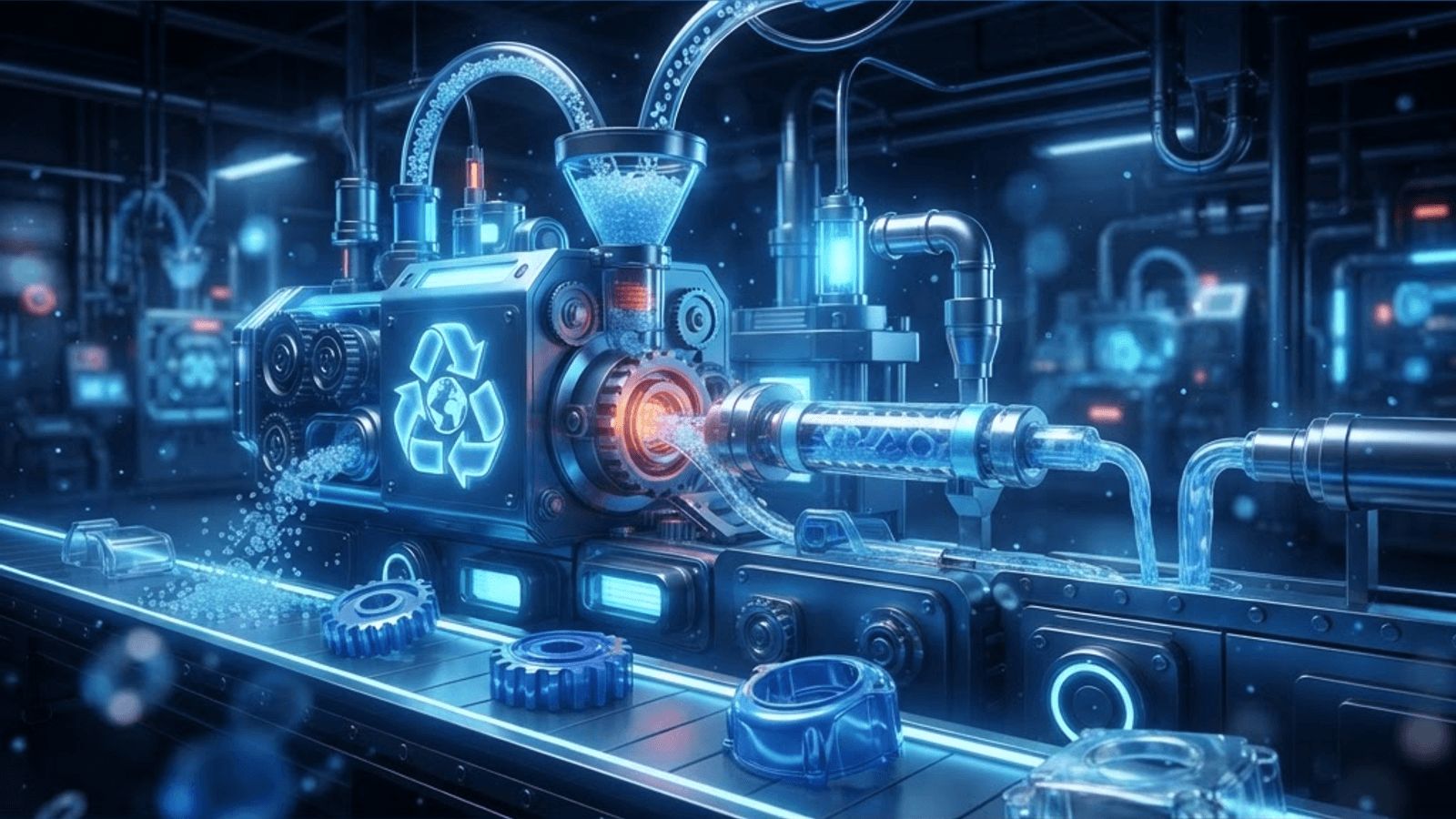
Recyclers collecting, sorting and reprocessing industrial plastic waste into usable regrind and pellets are an increasingly important part of the supply chain, helping manufacturers incorporate recycled content into new products.
Sustainability and the Future of Plastics
No manufacturing sector faces more scrutiny, and the industry's response has become considerably more substantive than it once was. Material reduction through lightweighting and wall-thickness optimisation cuts both cost and environmental impact simultaneously. Recycled content is being designed into products where performance permits, supported by improving reprocessing quality. Mono-material design, replacing multi-layer laminates that cannot be recycled with single-polymer alternatives, is transforming packaging design. Bio-based polymers and compostable materials have genuine applications, though they require appropriate collection infrastructure to deliver benefit.
Extended producer responsibility and packaging taxation have changed commercial calculations decisively. Manufacturers that help customers reduce packaging weight and improve recyclability now win work on that basis.
It is also worth stating plainly that plastics often remain the environmentally preferable choice. Lightweight components reduce transport emissions, insulation reduces building energy use, and sterile single-use medical items prevent infection. The sensible objective is appropriate use and proper recovery, not elimination.
Choosing a Plastics Manufacturer
Match process to volume. Injection moulding tooling is a significant upfront investment that pays back over volume; thermoforming or machining is usually better for tens or hundreds of parts. A good manufacturer will tell you honestly which route suits your quantities.
Engage early on design for manufacture. Draft angles, wall thickness consistency, rib design and gate location determine part quality and tool life. Changes made at drawing stage cost almost nothing; changes made after tooling is cut are expensive.
Discuss material selection thoroughly, covering mechanical requirements, temperature range, chemical exposure, UV stability, flame retardancy and any food or medical contact requirements.
Check tooling ownership terms. Clarify in writing who owns the mould tool, where it is stored, who maintains it and what happens if you move production elsewhere.
Verify quality systems and inspection capability, particularly for regulated applications where documented traceability is mandatory.
Final Thoughts
Plastics manufacturers in East Hampshire deliver essential components across medical, industrial, construction and agricultural markets with a level of technical capability that belies the sector's low profile. The businesses performing best are those treating sustainability as an engineering challenge, designing parts that use less material, last longer and can genuinely be recovered at end of life.
Want your brand featured in front of decision-makers? Publish a guest post or get a link insertion in our guides through AAMAX's guest post and link insertion service.
Helpful Links
 SponsoredAAMAX — Full-Service Digital Agency
Write for Us
Share your expertise with our readers. We welcome guest contributions from industry specialists.
Pitch your idea

