

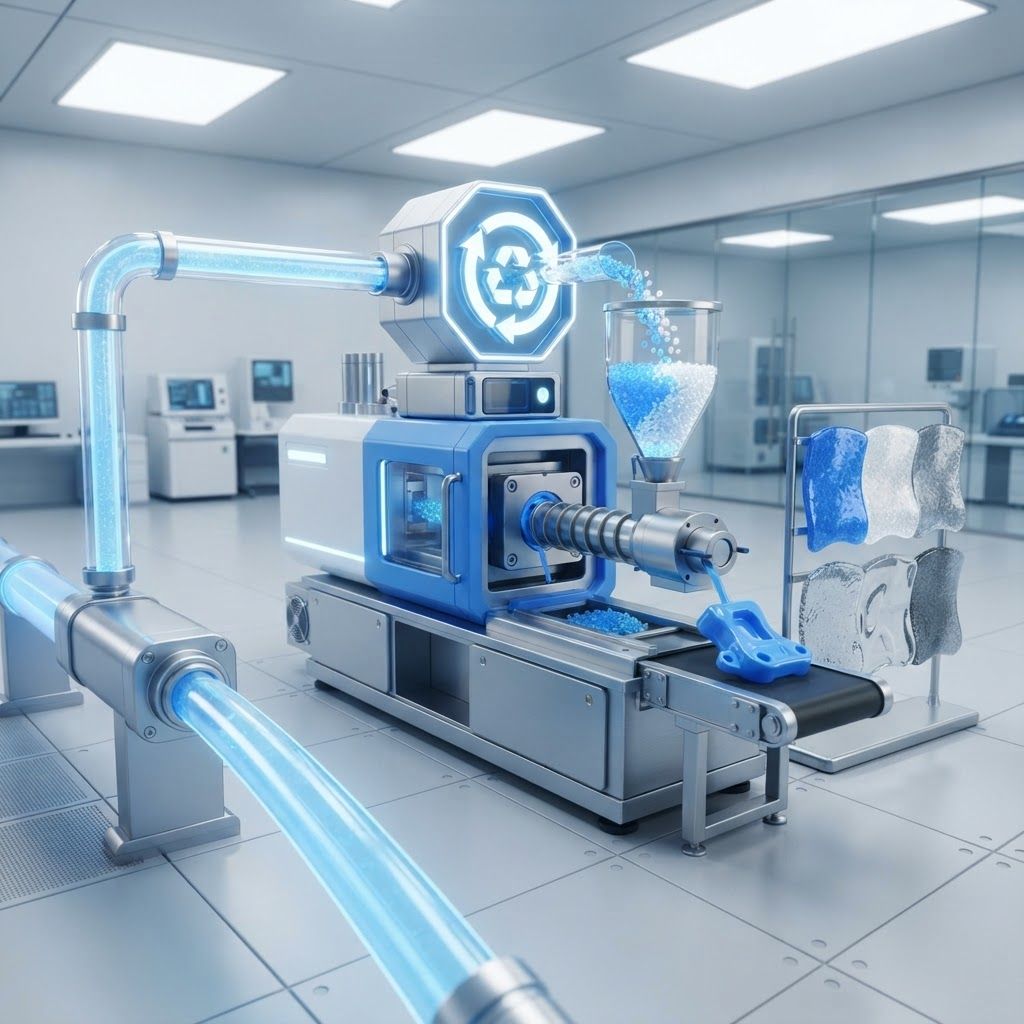
Plastics in the Dumfries and Galloway Economy
Plastics have an image problem, but in practical industrial terms they remain indispensable, and nowhere is that clearer than in a rural region like Dumfries and Galloway. Silage wrap preserves winter feed for thousands of livestock. Land drainage pipe keeps heavy clay fields workable. Food-grade packaging extends the shelf life of dairy and meat products from local processors. Water pipes, guttering, cladding, tanks and troughs are all polymer products in daily use across the region.
The local plastics sector accordingly focuses on the products these industries need. It covers extrusion, injection moulding, thermoforming, rotational moulding, fabrication of sheet materials, and the growing business of recycling and reprocessing.
The Main Manufacturing Processes
Injection moulding produces high volumes of identical parts with excellent dimensional accuracy, suited to components, closures, fittings and housings. Tooling costs are significant, so it makes sense at volume.
Extrusion creates continuous profiles such as pipe, ducting, sheet, film and trim. It is the process behind most agricultural and construction plastics used in the region.
Rotational moulding produces large hollow items, water tanks, chemical storage vessels, feed bins and troughs, with relatively low tooling cost, making it ideal for the modest volumes rural markets require.
Vacuum forming and thermoforming shape heated sheet over a mould, producing trays, covers, panels and packaging economically at low to medium volumes.
Plastic fabrication, meanwhile, involves cutting, bending, welding and bonding sheet materials to create bespoke tanks, guards, signage, glazing and enclosures without any tooling at all.
Leading Plastic Manufacturers and Suppliers
Enviroplas and Scottish reprocessing operations illustrate the growth of plastics recycling in Scotland, collecting and reprocessing agricultural film and hard plastics back into usable polymer.
Polypipe supplies extensive ranges of drainage, plumbing, ventilation and water management systems widely installed throughout the region's housing, agriculture and civil engineering projects.
Wavin similarly provides pipe systems, underground drainage and surface water management products used by contractors and farms across Dumfries and Galloway.
Enduramaxx and rotational moulding specialists produce water tanks, chemical tanks, dosing vessels and agricultural containers that are standard equipment on farms and at treatment sites throughout southern Scotland.
Trioplast and silage film manufacturers supply the bale wrap, silage sheet and crop covers that are absolutely central to the region's grass-based livestock farming.
Amcor and food packaging manufacturers supply the flexible films, trays and closures used by Dumfries and Galloway's dairy, meat and bakery processors, increasingly in recyclable mono-material formats.
Scottish plastic fabrication workshops produce bespoke acrylic, polycarbonate and polypropylene items including machine guards, hygiene screens, tanks, display units and protective glazing for local businesses.
Injection moulding firms across central and southern Scotland offer toolmaking, moulding and assembly services to regional product companies needing custom components at volume.
Plastic sheet and material stockists provide the raw sheet, rod, tube and film that local engineering and signage businesses convert into finished products, typically with cut-to-size services.
Agricultural plastic collection and recycling schemes operating in the region close the loop, gathering used silage wrap, feed bags and netting for reprocessing rather than burning or burial, which is both illegal and environmentally damaging.
The Sustainability Transformation
The plastics industry is changing faster than almost any other manufacturing sector, driven by regulation, retailer requirements and public expectation. Several shifts are directly relevant in this region.
Recycled content is becoming standard. The Plastic Packaging Tax applies to packaging with insufficient recycled content, and manufacturers have responded by incorporating post-consumer material wherever technical performance allows. Many drainage pipes, agricultural products and non-food packaging now contain substantial recycled polymer.
Design for recycling is the second shift. Multi-layer packaging that combines different polymers is difficult to recycle, so manufacturers are moving to mono-material structures that can be processed in existing streams.
Agricultural plastic recovery is the third and is particularly significant locally. Silage wrap and bale netting are generated in enormous quantities across Dumfries and Galloway. Organised collection schemes now recover much of it, turning a disposal problem into a feedstock.
Finally, alternatives are being adopted where they genuinely work. Compostable films suit some applications, paper-based alternatives suit others, but responsible manufacturers are honest that substitution sometimes increases environmental impact rather than reducing it, particularly where food waste rises as a result.
Choosing a Plastics Supplier
Match the process to the volume. If you need fifty parts, injection moulding tooling will be uneconomic, and fabrication or 3D printing will serve better. If you need fifty thousand, moulding becomes the obvious route.
Specify the polymer carefully. UV resistance matters for anything outdoors, chemical compatibility matters for tanks and pipework, and food contact approval is mandatory for anything touching product. A good supplier will guide this rather than simply quoting what you ask for.
Ask about recycled content options and end-of-life routes. Increasingly, commercial customers and public sector buyers require this information, and suppliers who can provide it are easier to work with.
For agricultural users, check whether your supplier participates in a collection scheme, since responsible disposal is a legal obligation and burning farm plastics carries serious penalties.
Final Thoughts
Plastics manufacturing serving Dumfries and Galloway is practical and deeply embedded in the region's farming, food and construction industries. The sector is also changing rapidly, with recycled content, recyclable design and organised recovery becoming the norm rather than the exception. Choosing suppliers who are genuinely engaged in that transition means getting the performance plastics offer without the environmental cost that once came with it.
Want your brand featured in front of decision-makers? Publish a guest post or get a link insertion in our guides through AAMAX's guest post and link insertion service.
Helpful Links
 SponsoredAAMAX — Full-Service Digital Agency
Write for Us
Share your expertise with our readers. We welcome guest contributions from industry specialists.
Pitch your idea

