

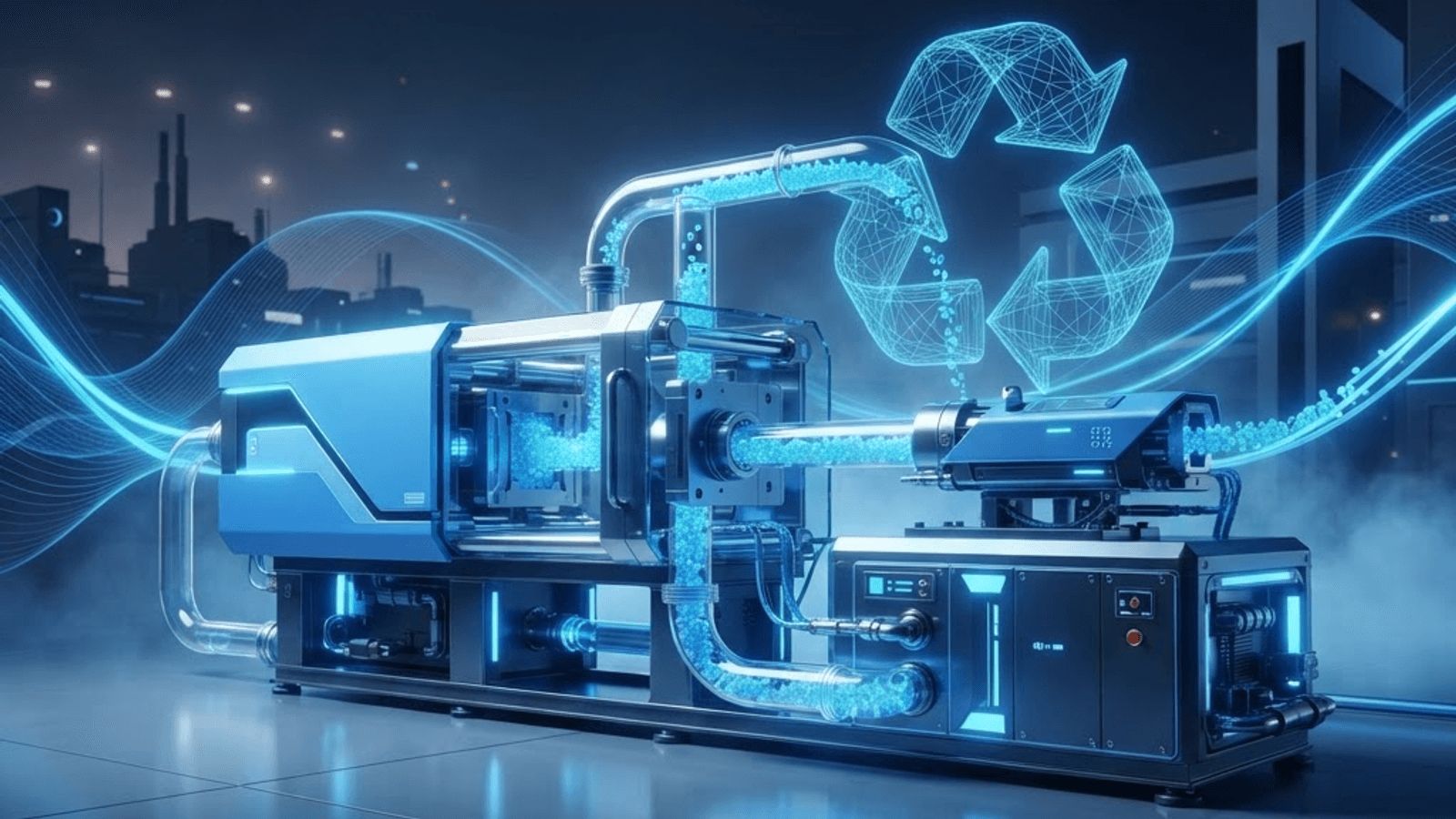
Bridgend's Place in the Welsh Plastics Industry
Polymer processing has been part of the South Wales industrial landscape for decades, and Bridgend holds a meaningful share of it. The county borough's industrial estates house a mix of injection moulders, extruders, thermoformers and fabricators serving customers in automotive, medical devices, construction, packaging and consumer goods. Proximity to the M4, to Cardiff Airport and to the deep-water ports at Port Talbot and Newport gives local processors practical logistics advantages when supplying UK and European customers.
What distinguishes the Bridgend plastics cluster is its technical breadth rather than its scale. Rather than a handful of enormous plants, the area supports a network of small and medium manufacturers, many of which specialise deeply in one process or one market sector. For buyers, that means the right capability is usually available locally, provided you know what you are looking for.
Injection Moulding Capability
Injection moulding is the dominant process by volume. Local moulders typically operate machine fleets ranging from small tonnage presses of around twenty-five tonnes for tiny precision components up to five hundred tonnes and above for larger structural mouldings. The most capable operations offer toolmaking or tool management alongside production, which matters more than most buyers realise. A moulding is only ever as good as the tool that produces it, and a processor who understands tool design will identify problems at the CAD stage rather than after steel has been cut.
Common local applications include automotive interior clips and brackets, electrical enclosures, horticultural products, point-of-sale components and technical parts in engineering polymers such as nylon, polycarbonate, ABS and acetal. Several Bridgend moulders also offer insert moulding and overmoulding, allowing metal inserts or soft-touch elastomer surfaces to be incorporated in a single production step.
Extrusion and Profile Manufacturing
Extrusion serves a different set of markets, principally construction, signage and industrial supply. Extruders in the region produce rigid PVC profiles for windows and cladding trims, polyethylene and polypropylene pipe, protective edging, and co-extruded profiles combining rigid and flexible materials in a single section.
The technical advantage of extrusion is cost per metre at volume, but the constraint is tooling. A bespoke die requires investment and a development period during which the profile is trialled and dimensions dialled in. Buyers considering a custom profile should budget realistically for that development phase and should expect several sampling iterations before signature.
Vacuum Forming and Thermoforming
Vacuum forming occupies a valuable niche between low-volume fabrication and high-volume injection moulding. Tooling costs are dramatically lower, often a tenth or less of an injection tool, which makes the process ideal for larger parts produced in hundreds or low thousands rather than hundreds of thousands.
Bridgend thermoformers produce machine guarding, vehicle interior panels, medical equipment housings, trays and packaging inserts, and display components. Twin-sheet forming, where two sheets are formed and welded simultaneously to create a hollow structure, is available locally and provides a lightweight, rigid alternative to rotational moulding for certain applications.
Medical and Cleanroom Manufacturing
The medical devices sector has grown substantially across South Wales, and it imposes requirements that general engineering plastics work does not. Manufacturers serving this market operate to ISO 13485, maintain validated processes with full batch traceability, and in many cases run cleanroom moulding cells at ISO Class 7 or 8.
Typical output includes diagnostic consumables, fluid handling components, device housings and single-use surgical items. The documentation burden is significant, encompassing installation, operational and performance qualification, design history files and change control. Buyers should verify certification currency directly rather than relying on a logo on a website, and should understand that lead times and unit costs reflect the validation overhead.
Sustainability and Recycled Content
No topic dominates plastics conversations more than sustainability, and the pressure is entirely legitimate. The UK Plastic Packaging Tax has made recycled content a commercial issue rather than a purely ethical one, applying a levy to packaging containing less than thirty percent recycled material. Welsh Government recycling targets, among the most ambitious in the world, reinforce the direction of travel.
Progressive Bridgend processors have responded on several fronts. In-house regrind systems recover sprues and rejected parts back into production. Some have qualified post-consumer recyclate for non-critical applications, working through the technical challenges of variable melt flow and colour consistency. Others have moved customers toward mono-material designs that are far easier to recycle at end of life, or have engineered lightweighting improvements that cut material use by ten to twenty percent without compromising function.
Bio-based and compostable polymers appear in the conversation frequently, though experienced processors are candid about their limitations. Compostable materials require industrial composting infrastructure that is unevenly available, and they can contaminate conventional recycling streams. The more useful sustainability gains for most products still come from design efficiency, recyclability and extended service life.
Tooling, Design Support and Prototyping
The manufacturers who add the most value are those who engage before the design is frozen. Design for manufacture review can identify draft angle problems, wall thickness variation that will cause sink marks, undercuts that will require expensive side actions, and gate positions that will leave visible witness marks on cosmetic surfaces. Catching these at CAD stage costs a conversation; catching them after tooling costs thousands.
Additive manufacturing has become a standard part of the development process. Local processors routinely produce 3D printed prototypes for form and fit assessment before committing to steel, and some use printed soft tooling for bridge production runs of a few hundred parts while the production tool is being manufactured.
Choosing the Right Plastics Manufacturer
Begin with volume and material, because those two variables determine the appropriate process more than anything else. Then assess technical engagement during your initial conversations. A processor who asks searching questions about your application, service environment, regulatory requirements and expected lifetime is a processor who will catch problems early.
Audit the quality system. ISO 9001 is a baseline expectation; IATF 16949 signals automotive competence and ISO 13485 signals medical. Ask about scrap rates, process monitoring and how tool maintenance is scheduled. Enquire about capacity and contingency, because a single-machine dependency is a genuine supply risk. Finally, clarify tool ownership in writing before any tooling is commissioned, as disputes over who owns the steel are unpleasant and entirely avoidable.
Looking Ahead
Bridgend's plastics manufacturers face energy costs, regulatory change and skills shortages, as does the sector nationally. The firms navigating those pressures successfully share a common approach: investment in automation to offset labour constraints, genuine engagement with circularity rather than superficial marketing, and a move up the value chain toward technically demanding work where competing on price alone is not the deciding factor. For buyers in South Wales, the practical implication is encouraging. Capable, well-equipped and increasingly sustainable polymer processing is available within a short drive.
Want your brand featured in front of decision-makers? Publish a guest post or get a link insertion in our guides through AAMAX's guest post and link insertion service.
Helpful Links
 SponsoredAAMAX — Full-Service Digital Agency
Write for Us
Share your expertise with our readers. We welcome guest contributions from industry specialists.
Pitch your idea

