

Precision Polymers in an Engineering Borough
Plastics manufacturing rarely gets the recognition it deserves, partly because its output is usually a component inside something else. Yet the polymer processing sector in and around Antrim and Newtownabbey is technically sophisticated, supplying aerospace, medical device, automotive, construction and food packaging markets with parts that must meet demanding tolerances and regulatory requirements.
The sector benefits from the borough's broader engineering ecosystem. Toolmaking capability, precision machining, electronics assembly and materials handling expertise all sit nearby, which matters because injection moulding depends entirely on the quality of the tool and on the ability to automate downstream handling. Proximity to Belfast harbour supports both raw polymer import and finished goods export.
The Main Processes Explained
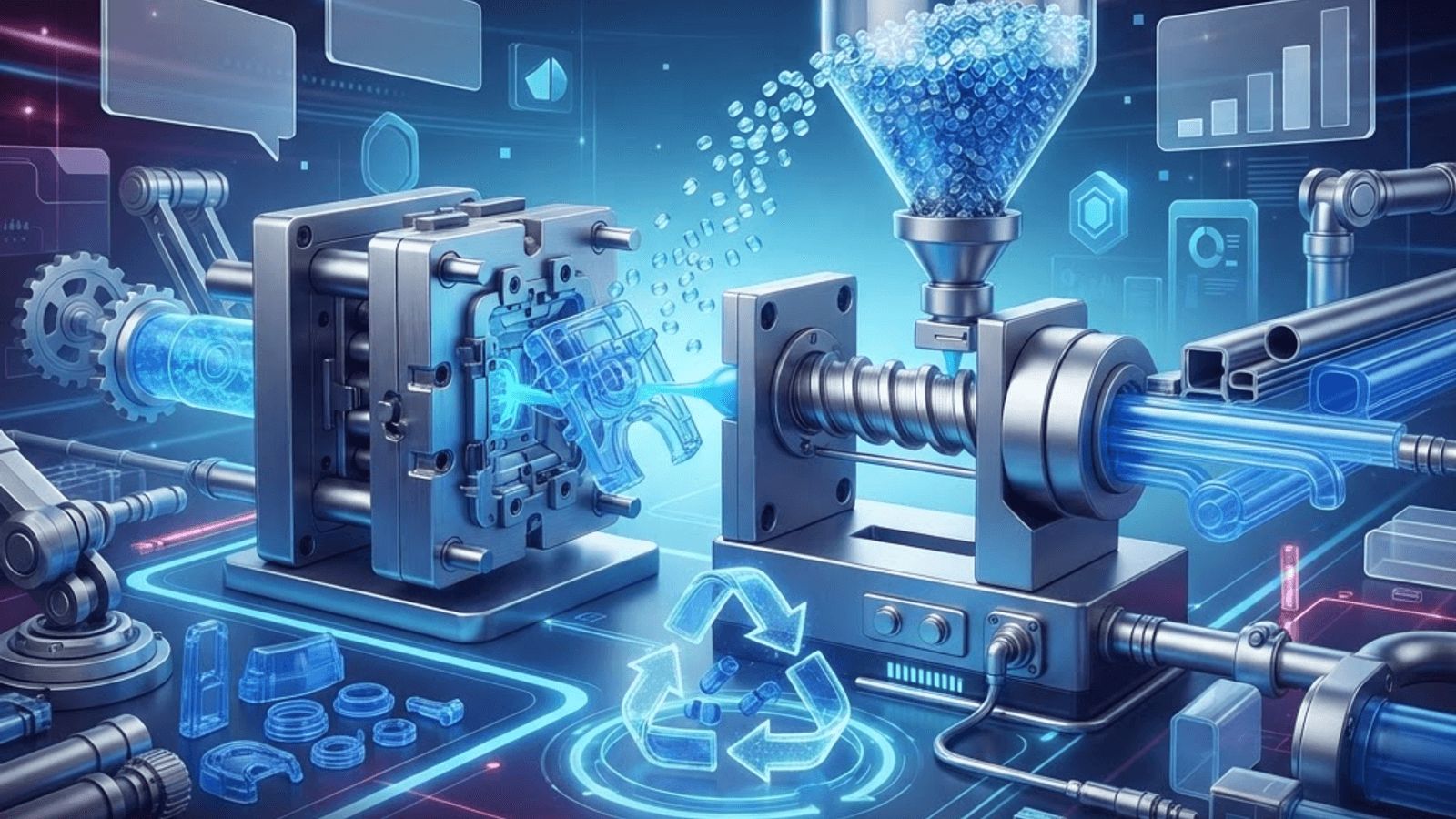
Injection moulding forces molten polymer into a steel tool under high pressure, producing high volumes of dimensionally accurate parts. It has high tooling cost and low unit cost, making it suited to volume production. Extrusion pushes polymer continuously through a die to produce pipe, profile, sheet and film, ideal for long continuous products. Blow moulding forms hollow containers. Vacuum forming and thermoforming heat sheet material and draw it over a mould, offering lower tooling cost for larger, simpler parts in modest volumes. Rotational moulding produces large hollow items such as tanks. Fabrication and machining cut, weld and machine plastic stock for low volume or very large components.
Top 10 Plastic Manufacturers Serving the Borough
1. Denroy Plastics
Denroy is one of Northern Ireland's most respected precision injection moulders, supplying aerospace, medical and industrial customers with technically demanding components. The company combines tooling expertise, engineering polymers, cleanroom capability and assembly, and its aerospace approvals place it in a small group of qualified suppliers.
2. Ballyvesey Plastics
Injection moulding operations serving the Newtownabbey and Mallusk industrial areas produce components for automotive, materials handling and consumer products. Local moulders of this type offer manufacturers rapid access to tooling modification and short run production without international shipping delays.
3. Wright Plastics
Plastic fabrication and machining specialists work with acrylic, polycarbonate, polypropylene and engineering polymers to produce guards, tanks, ducting, signage and bespoke components. Fabrication is invaluable for one off and low volume items where tooling cost cannot be justified.
4. Cherry Pipes
Cherry Pipes manufactures plastic pipe systems for drainage, water, sewerage and ducting applications, serving construction and civil engineering projects across Ireland. Pipe extrusion demands consistent wall thickness, verified material properties and compliance with performance standards for buried infrastructure.
5. Mallusk Packaging Solutions
Plastic packaging manufacturers serving the region's substantial food processing sector produce trays, containers, films and closures. Food contact packaging must satisfy migration limits, hygiene requirements and increasingly recyclability targets, making it one of the most regulated areas of plastics production.
6. Ulster Rotational Moulding
Rotational moulding specialists produce water tanks, oil tanks, bins, containers and large hollow components. With so many rural properties in the borough relying on stored heating oil and water, locally manufactured tanks that meet bunding and construction standards serve a substantial ongoing market.
7. Antrim Toolmaking and Moulding
Toolmaking is the foundation of injection moulding, and businesses that design and manufacture moulds locally allow customers to iterate designs, modify tools and resolve production problems quickly. Access to local toolmaking is a genuine competitive advantage for product developers.
8. Glenpak Thermoforming
Thermoforming and vacuum forming operations produce trays, covers, housings and point of sale items with much lower tooling investment than injection moulding. This makes the process well suited to prototype runs, low volume products and large panels.
9. Re-Gen Plastics
Plastic recycling and reprocessing operations collect, sort, wash and pelletise waste polymer into usable feedstock. As recycled content requirements tighten in packaging regulation, reliable local supply of quality recyclate has become strategically important to manufacturers.
10. Medical Polymer Solutions Northern Ireland
Cleanroom moulding for medical devices and diagnostics requires controlled environments, validated processes, full traceability and quality management appropriate to medical manufacture. The region's strength in life sciences has built genuine capability in this demanding niche.
Choosing the Right Process and Partner
Match process to volume. If you need tens of thousands of identical parts, injection moulding tooling cost is quickly recovered. For hundreds, thermoforming or machining from stock is usually more economic. For very large hollow parts, rotational moulding is often the only sensible route. A good manufacturer will advise honestly even when the answer points away from their preferred process.
Involve the manufacturer at design stage. Design for manufacture guidance on wall thickness, draft angles, ribbing, gate location and material selection prevents expensive tooling revisions. Many part failures trace directly to designs finalised without moulding input.
Specify material properly. Polymer choice governs strength, stiffness, temperature resistance, chemical compatibility, ultraviolet stability and regulatory suitability. Ask for material data sheets and, where the application demands it, evidence of food contact or medical grade compliance.
Verify quality systems, including dimensional inspection capability, process monitoring and traceability from resin lot to finished part. For regulated markets confirm the relevant certification. Discuss tooling ownership explicitly, since who owns the mould determines whether you can move production later.
Sustainability and the Future of Plastics
The plastics industry faces intense scrutiny, and the response locally has been substantive rather than cosmetic. Lightweighting reduces material use per part. Design for recyclability favours single polymer construction over difficult to separate laminates. Recycled content is being incorporated wherever performance permits. Regrind of production scrap is standard practice in well run moulding operations.
Extended producer responsibility and packaging taxes are pushing brand owners to reduce plastic use and increase recycled content, which flows directly into specifications given to manufacturers. Bio based and compostable polymers are advancing, though they suit some applications far better than others and require honest assessment rather than marketing enthusiasm.
Meanwhile, energy efficiency in processing has improved markedly through electric moulding machines, better thermal management and process optimisation, reducing both cost and emissions.
Plastics manufacturing in Antrim and Newtownabbey is a precise, regulated and technically advanced industry supplying critical components into aerospace, healthcare and infrastructure. Choosing a partner with the right process capability, genuine design input and robust quality systems is what separates a component that performs from one that fails in service.
Want your brand featured in front of decision-makers? Publish a guest post or get a link insertion in our guides through AAMAX's guest post and link insertion service.
Helpful Links
 SponsoredAAMAX — Full-Service Digital Agency
Write for Us
Share your expertise with our readers. We welcome guest contributions from industry specialists.
Pitch your idea

