

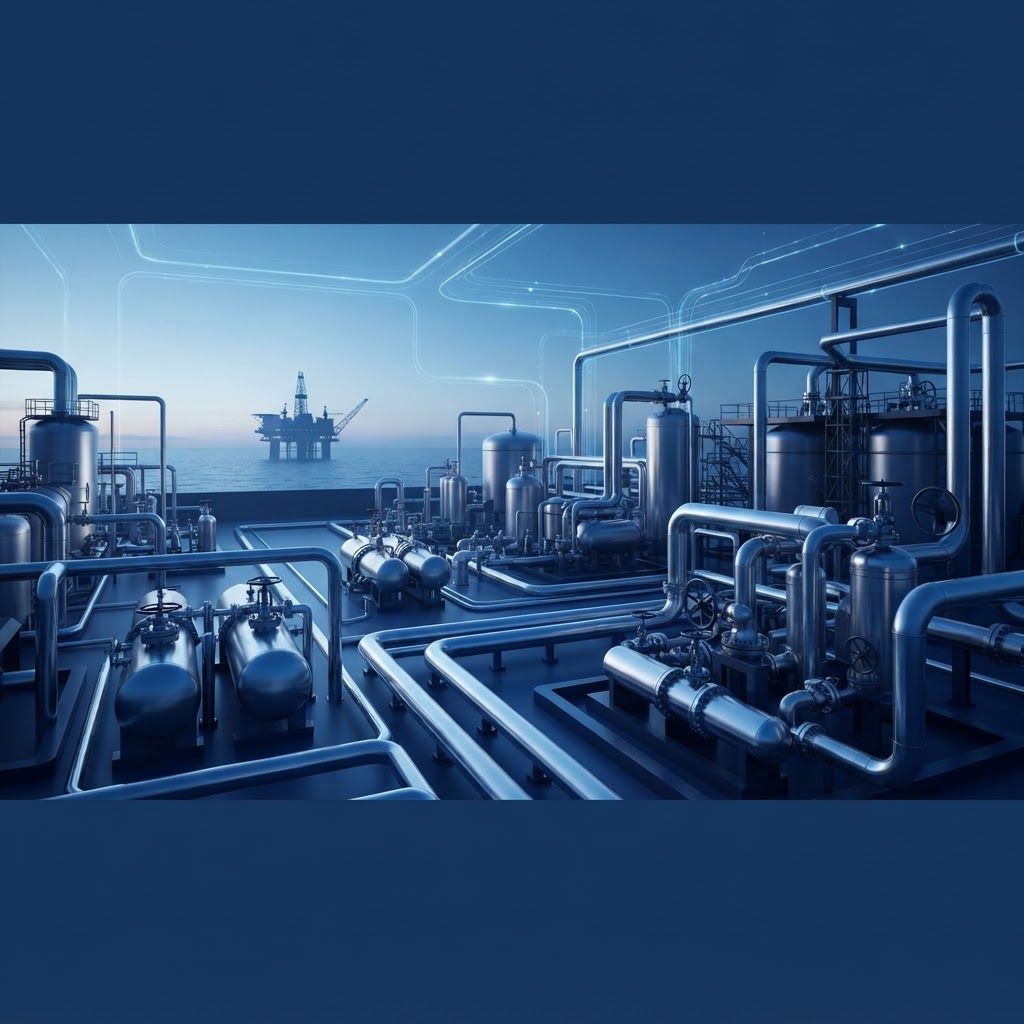
Oil and Gas in the Preston Region
Lancashire's relationship with hydrocarbons is more significant than many assume. The Irish Sea has hosted gas production for decades, with fields off the Fylde coast feeding terminals that have processed a meaningful share of the UK's gas supply. Onshore, the county became nationally prominent during exploration for shale gas, and while that activity has since been curtailed, the technical and regulatory expertise it attracted remains in the local economy.
Today the sector in and around Preston is dominated by services rather than extraction. Fuel distribution, industrial gases, pipeline and pressure systems engineering, terminal maintenance, instrumentation, inspection and compliance, and lubricants supply all sustain substantial local businesses. Many of these firms are simultaneously repositioning towards low carbon fuels, hydrogen readiness and carbon capture infrastructure, which makes the sector considerably more forward-looking than its reputation suggests.
Ten Oil and Gas Companies With a Preston Presence
1. Centrica Storage and Spirit Energy operations. Gas production and storage activity associated with Irish Sea fields and coastal terminals has long anchored the region's upstream footprint, supporting engineering, maintenance and specialist contractor employment across Lancashire.
2. Certas Energy. One of the UK's largest fuel and lubricants distributors, supplying diesel, heating oil, gas oil and industrial lubricants to commercial fleets, farms, construction sites and domestic customers throughout the North West.
3. Crown Oil. A North West fuel supplier providing bulk diesel, kerosene, biofuels and fuel management services including tank supply, uplift, testing and polishing, widely used by agricultural and industrial customers in Lancashire.
4. Calor and regional liquefied petroleum gas suppliers. Essential to rural Lancashire, where mains gas is unavailable. Bulk and cylinder LPG serves farms, holiday parks, rural businesses and off-grid homes, with growing interest in bio-LPG alternatives.
5. Preston-area pipeline and pressure systems engineering firms. Specialists in welding, pipe fabrication, pressure vessel work, valve maintenance and hot tapping, providing the mechanical services on which terminals, refineries and industrial gas systems depend.
6. Instrumentation and process control providers. Businesses supplying and calibrating flow meters, pressure transmitters, gas detection and safety instrumented systems, a discipline where Lancashire's engineering base is genuinely strong.
7. Inspection, testing and certification companies. Providers of non-destructive testing, corrosion monitoring, tank inspection and statutory examination under pressure systems regulations, indispensable for asset integrity and regulatory compliance.
8. Industrial gases suppliers. Companies distributing oxygen, nitrogen, argon, carbon dioxide and welding gas mixtures to Lancashire's manufacturing, food processing and fabrication sectors, plus specialist gases for laboratories and healthcare.
9. Environmental and regulatory consultancies. Advisers handling environmental permitting, emissions monitoring and reporting, contaminated land assessment, and process safety studies including hazard and operability reviews for hydrocarbon installations.
10. Hydrogen and carbon capture project developers. An emerging but rapidly growing group, drawing directly on oil and gas engineering skills to develop hydrogen production, blending trials, industrial fuel switching and carbon transport and storage infrastructure across the North West cluster.
What the Sector Actually Delivers Locally
Fuel distribution is the most visible activity, keeping agricultural machinery, haulage fleets, construction plant, standby generators and off-grid heating supplied. Reliability, tank compliance and fuel quality management are the competitive factors, and larger distributors increasingly offer telemetry-based automatic replenishment.
Engineering services form the technical core. Pipework, rotating equipment, pressure systems, electrical and instrumentation work, and shutdown maintenance require highly certified personnel and rigorous safety systems. These capabilities transfer readily to other heavy industries, including chemicals, food processing and energy from waste.
Compliance and integrity work is the least visible but most critical strand. Hydrocarbon assets operate under demanding regulatory regimes covering process safety, environmental permitting, emissions and worker protection, and specialist consultancies and inspection bodies keep operators within them.
Trends Reshaping Oil and Gas
Energy transition is the defining theme. Rather than disappearing, the regional supply chain is diversifying. Welding, pipeline, pressure and process safety skills are directly applicable to hydrogen networks, carbon dioxide transport, biomethane injection and large-scale heat infrastructure, and many Lancashire firms now describe themselves as energy engineering businesses rather than oil and gas contractors.
Fuel product mixes are also shifting. Hydrotreated vegetable oil has grown quickly as a drop-in diesel replacement for fleets and generators seeking substantial emissions reduction without vehicle modification, and distributors have expanded renewable fuel offerings accordingly.
Asset integrity spending is rising as infrastructure ages. Extending the safe life of terminals, pipelines and storage assets is more economical than replacement, which sustains demand for inspection, corrosion management and refurbishment.
Meanwhile, digital monitoring, predictive maintenance and remote surveillance have reduced unplanned downtime and improved safety performance, changing the skills profile towards data-literate technicians.
How to Choose a Supplier or Contractor
Safety and certification come first. Verify accreditation relevant to the work, such as recognised contractor safety schemes, welding qualifications to appropriate standards, and competency registration for pressure and gas work. In this sector, poor safety performance is a reliable indicator of poor overall management.
For fuel supply, examine delivery reliability, tank compliance support, fuel testing services and pricing structure, including how price fluctuations are handled contractually. Ask about renewable fuel options if emissions reporting matters to you.
For engineering services, assess whether the contractor can support the full lifecycle: design, installation, commissioning, statutory inspection and emergency response. Fragmented supply chains create accountability gaps during incidents.
Finally, consider transition alignment. Suppliers actively investing in hydrogen readiness, renewable fuels and electrification will remain relevant partners as regulation and customer expectations tighten.
Final Thoughts
The oil and gas sector around Preston is substantial, technically sophisticated and evolving rather than declining. Its fuel distribution networks keep Lancashire's rural and industrial economy running, while its engineering and integrity expertise is becoming central to hydrogen, carbon capture and industrial decarbonisation. For businesses procuring energy or engineering services locally, this combination of established capability and transition capacity is a genuine asset.
Want your brand featured in front of decision-makers? Publish a guest post or get a link insertion in our guides through AAMAX's guest post and link insertion service.
Helpful Links
 SponsoredAAMAX — Full-Service Digital Agency
Write for Us
Share your expertise with our readers. We welcome guest contributions from industry specialists.
Pitch your idea

