

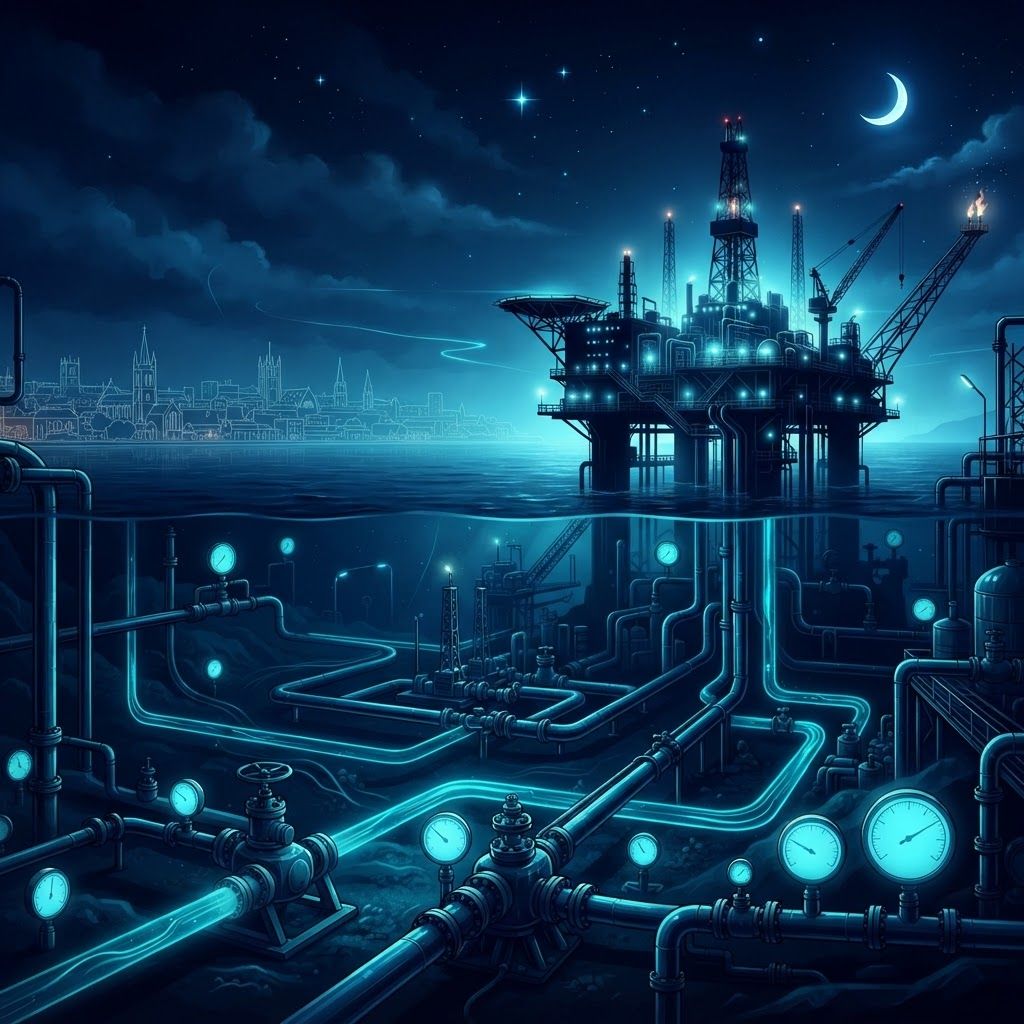
Morecambe Bay and the Making of an Energy Coast
The waters off Lancaster hold a significant place in British energy history. The Morecambe Bay gas fields, discovered in the 1970s and brought into production in the following decade, supplied a substantial share of domestic gas demand for years. Onshore terminals at Barrow processed the output, and an extensive engineering, marine and inspection supply chain developed across the surrounding coastal communities, including Heysham, Morecambe and Lancaster itself.
That legacy remains visible today. Although production from the mature fields has declined considerably from its peak, the infrastructure, skills base and industrial capability built around it continue to underpin employment in the district, and increasingly they are being redirected towards energy transition projects including carbon storage and hydrogen.
The Structure of the Sector
Oil and gas activity divides into upstream, midstream and downstream. Upstream covers exploration, drilling, field development and production. Midstream covers processing, storage, pipelines and transport. Downstream covers refining, distribution and retail supply.
Around Lancaster, the emphasis has always been upstream and midstream: offshore gas production, subsea infrastructure, terminals, storage and the specialist services that keep them operating safely. Downstream activity is limited, though fuel distribution and commercial heating oil supply serve the rural communities of the Lune Valley where mains gas is unavailable.
Leading Oil and Gas Organisations Connected to the Region
1. Spirit Energy
Operating the Morecambe Bay gas fields and associated infrastructure, Spirit Energy has been central to the region's gas production and is progressing plans to repurpose depleted reservoirs for carbon dioxide storage.
2. Centrica Storage
With significant gas storage and processing assets connected to the Irish Sea system, Centrica Storage plays an important role in security of supply and seasonal balancing for the national gas network.
3. Wood
A global engineering and consultancy business serving energy and industrial markets, Wood provides asset engineering, project delivery and decommissioning services to operators in the Irish Sea and beyond.
4. Petrofac
Petrofac delivers engineering, procurement, construction and operations services to oil and gas facilities, including brownfield modification and late-life asset management relevant to mature fields.
5. Bilfinger and Industrial Services Contractors
Industrial service providers supply maintenance, scaffolding, insulation, painting and mechanical work to terminals and processing plants, forming a substantial share of regional site employment.
6. Subsea and Marine Survey Specialists
Companies providing remotely operated vehicle services, pipeline inspection, diving support and hydrographic survey serve both the offshore gas infrastructure and, increasingly, offshore wind developments in the same waters.
7. Inspection, Testing and Certification Providers
Non-destructive testing, pressure system inspection and certification bodies are essential to safe operation of ageing infrastructure, and several such businesses operate across the North West industrial belt.
8. Drilling and Well Services Contractors
Well intervention, plug and abandonment and drilling services remain in demand as fields move through late life and into decommissioning, a phase requiring substantial specialist activity.
9. Fuel Distribution and Commercial Supply Businesses
Across rural Lancaster and the Lune Valley, heating oil and commercial fuel distributors supply homes, farms and businesses off the gas grid, providing an essential service in areas without mains connection.
10. Decommissioning and Energy Transition Specialists
A rapidly growing category, these organisations manage removal of redundant infrastructure and the repurposing of existing assets for carbon capture and storage or hydrogen, drawing directly on oil and gas engineering expertise.
The Sector in Transition
The most significant development in the region is the proposed use of depleted Morecambe Bay reservoirs for permanent carbon dioxide storage. Geologically, these formations held gas securely for millions of years, which makes them technically attractive for storage, and the existing pipelines and platforms offer potential reuse rather than removal.
Hydrogen is the second major theme. Industrial clusters across the North West are exploring hydrogen production and distribution, and gas infrastructure engineering skills transfer directly into that work.
Decommissioning represents a substantial and long-lasting workload in its own right. Removing platforms, plugging wells and clearing subsea infrastructure requires marine, engineering and environmental capability, much of it identical to the skills used in construction.
Skills, Safety and Employment
Oil and gas remains a high-skill, high-safety-culture industry. Roles span process engineering, mechanical and electrical maintenance, instrumentation, control systems, marine operations, health safety and environment, and integrity management. Offshore work requires survival and safety training alongside medical certification.
The safety systems developed in the sector following historic incidents have influenced industrial practice far more widely, and personnel trained in this environment are highly valued across nuclear, chemical and renewable operations. That transferability matters greatly in a district that also hosts nuclear generation and offshore wind.
Choosing Suppliers and Partners
Organisations procuring services in this sector should verify accreditation to relevant safety and quality standards, check track record on comparable assets, and assess competence management systems. Regulatory oversight is stringent, and supply chain failures carry consequences that extend well beyond commercial loss.
Final Thoughts
The oil and gas sector around Lancaster is entering a new phase rather than disappearing. Production from mature fields is declining, but the infrastructure, engineering expertise and safety culture built over half a century are being redeployed into carbon storage, hydrogen and decommissioning. For the district's industrial workforce, that continuity of skills is arguably the sector's most valuable legacy.
Want your brand featured in front of decision-makers? Publish a guest post or get a link insertion in our guides through AAMAX's guest post and link insertion service.
Helpful Links
 SponsoredAAMAX — Full-Service Digital Agency
Write for Us
Share your expertise with our readers. We welcome guest contributions from industry specialists.
Pitch your idea

