

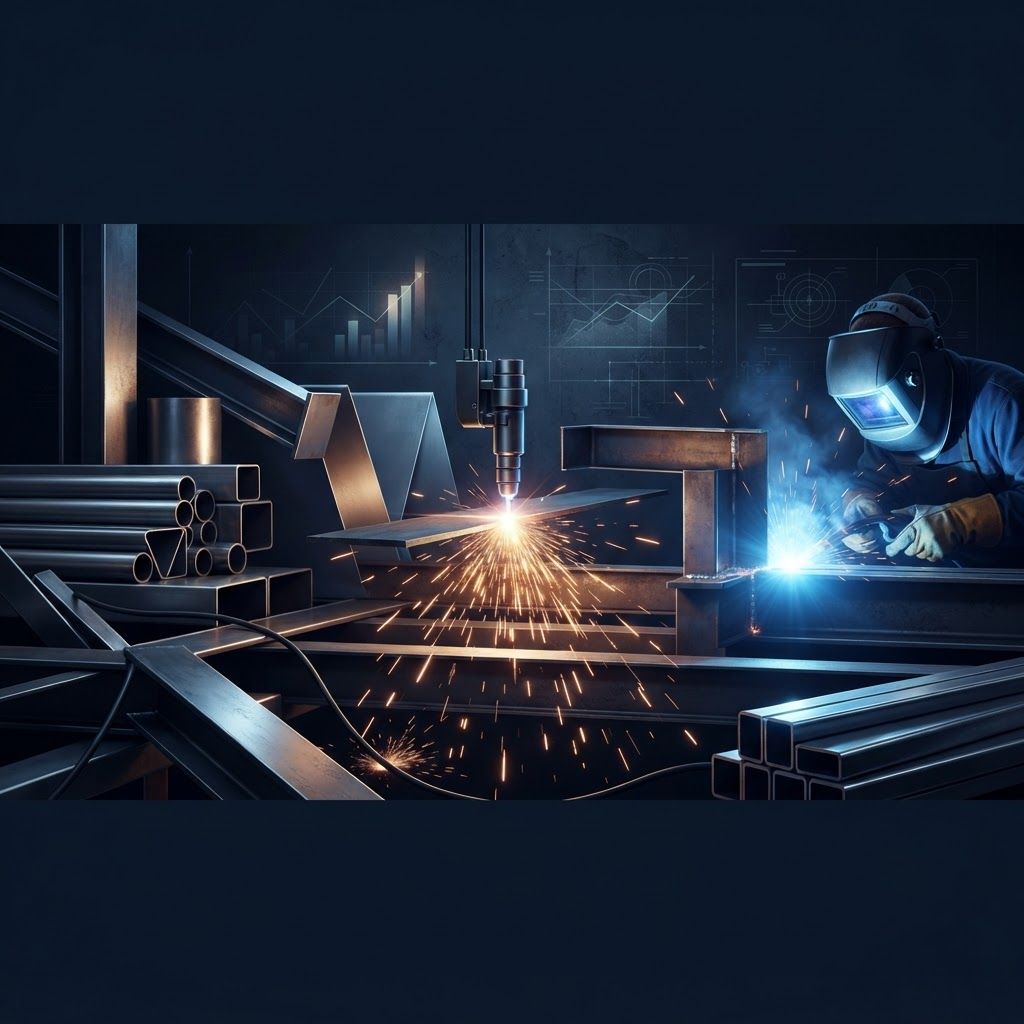
Metalworking and the Wrexham Industrial Tradition
Metal has been worked in and around Wrexham since the industrial revolution transformed the region. Ironworks, foundries, wire drawing and steel fabrication grew alongside coal mining, and although the heavy industries of that era have largely gone, the skills and supply relationships they created persist in a modern metalworking sector.
Today the borough hosts sheet metal fabricators, structural steelwork contractors, precision machinists, welders, surface finishers and architectural metalworkers. Much of this capability sits on Wrexham Industrial Estate, supported by good road access and proximity to steel stockholders across the North West.
Sheet Metal Fabrication
Sheet metal work covers the production of enclosures, panels, brackets, guards, cabinets and housings from flat material. The typical process route involves laser or punch cutting, press brake forming, welding, and finishing.
Fibre laser cutting has largely displaced older technologies for thin and medium gauge material, offering high speed, excellent edge quality and the flexibility to change jobs without tooling. Wrexham fabricators operating modern lasers can turn a customer drawing into cut parts within hours.
Press brake forming with CNC control and offline programming produces accurate bends repeatably. Complex parts requiring many bends demand careful sequence planning, and experienced fabricators advise on design features that make parts easier and cheaper to produce.
Typical customers include electronics manufacturers needing enclosures, machinery builders requiring guarding, food equipment producers needing stainless fabrications, and construction contractors specifying architectural metalwork.
Structural Steel and Heavy Fabrication
Structural steelwork serves construction, industrial plant and infrastructure. Fabricators in the region produce beams, columns, portal frames, platforms, staircases, walkways and access structures.
Structural fabrication in the United Kingdom must comply with execution class requirements under the relevant European standard, and fabricators must hold factory production control certification to supply structural components legally. This is a meaningful barrier that separates qualified structural fabricators from general welders.
Heavy fabrication also serves plant maintenance across Wrexham Industrial Estate, producing tanks, hoppers, chutes, ductwork and pressure-retaining components. Work on pressure equipment brings additional regulatory obligation and requires specific qualification.
Welding Capability and Certification
Welding quality is invisible from the outside, which is precisely why certification matters so much. Coded welders hold qualifications for specific processes, materials, positions and thicknesses, tested and documented under recognised standards.
Common processes in the region include MIG and MAG welding for general steel fabrication, TIG welding for stainless steel and aluminium where appearance and cleanliness matter, and manual metal arc for site work and heavy sections.
Stainless steel welding for food and pharmaceutical applications is a specialism requiring careful technique, since overheating causes carbide precipitation that compromises corrosion resistance. Purging and post-weld pickling and passivation restore the protective oxide layer.
Aluminium welding demands different skills again, given the material's thermal conductivity and oxide layer behaviour.
Non-destructive testing, including dye penetrant, magnetic particle, ultrasonic and radiographic inspection, verifies weld integrity on critical fabrications. Independent testing providers serve manufacturers across the region.
Precision Machining and CNC Services
Machining complements fabrication, producing components to tolerances that forming cannot achieve. Subcontract machinists in the borough operate turning centres, machining centres and multi-axis equipment, working in steel, stainless, aluminium, brass and engineering plastics.
Sectors served include aerospace, medical, energy, defence and general engineering, each with distinct documentation and traceability expectations. Material certification, recording the exact cast and chemical composition of the stock used, is standard in regulated sectors.
Metrology underpins credibility. Coordinate measuring machines and calibrated inspection equipment allow manufacturers to prove conformance rather than assert it.
Surface Finishing and Protection
Finishing determines how long a metal product survives in service. Options available through regional providers include powder coating, wet paint systems, galvanising, anodising for aluminium, electroplating, shot blasting and polishing.
Specification should match environment. Galvanising suits external structural steel exposed to weather, powder coating provides colour and reasonable durability for indoor and moderate outdoor use, and duplex systems combining galvanising with powder coating deliver maximum longevity for demanding applications.
Surface preparation is more important than the coating itself. Inadequately prepared steel will shed even the best coating, and reputable finishers are rigorous about blast profile and cleanliness.
Architectural and Bespoke Metalwork
Alongside industrial work, the borough supports architectural metalworkers producing gates, railings, balustrades, staircases, canopies and decorative features. Blacksmiths working traditionally serve restoration projects on period properties, of which Wrexham has many.
This market blends engineering compliance, since balustrades must meet loading requirements under building regulations, with genuine craft and design sensibility.
Sustainability in Metalworking
Steel and aluminium are among the most recycled materials globally, and scrap generated in fabrication is collected and returned to the melting process. This gives metalwork a strong circular credential relative to many materials.
Energy use in cutting, welding and finishing is a focus for reduction, with modern fibre lasers consuming considerably less power than older CO2 systems. Solvent reduction in coating operations has improved air quality and worker exposure.
Embodied carbon reporting is entering construction specification, and fabricators able to document steel origin and recycled content gain advantage on projects with carbon criteria.
Choosing a Fabrication Partner
Match certification to the application, particularly for structural and pressure work where legal requirements apply. Review welding qualifications relevant to your materials. Assess capacity in terms of both machine capability and available lead time.
Involve the fabricator early in design. Small changes to bend radii, hole positions, material thickness and weld access can reduce cost substantially without affecting function, and experienced fabricators identify these opportunities quickly.
Visit the workshop. Organisation, material segregation, equipment condition and the standard of work in progress tell you most of what you need to know about the quality you will receive.
Want your brand featured in front of decision-makers? Publish a guest post or get a link insertion in our guides through AAMAX's guest post and link insertion service.
Helpful Links
 SponsoredAAMAX — Full-Service Digital Agency
Write for Us
Share your expertise with our readers. We welcome guest contributions from industry specialists.
Pitch your idea

