Metalworking Heritage and Modern Capability
Metalworking is among the oldest continuously practised industries in Hertfordshire, and Welwyn Hatfield's version of it has evolved considerably. The aerospace activity that shaped Hatfield demanded exceptional metalworking standards, and the skills, tooling and quality culture that developed around it seeded a fabrication and machining sector that continues to serve demanding customers today.
Modern local metalworks companies operate across a wide spectrum. At one end sit precision machinists holding tolerances measured in microns for aerospace and medical customers. At the other, heavy fabricators produce structural steelwork, platforms and industrial equipment frames. Between them lie sheet metal specialists, architectural metalworkers and finishing houses.
Core Metalworking Processes
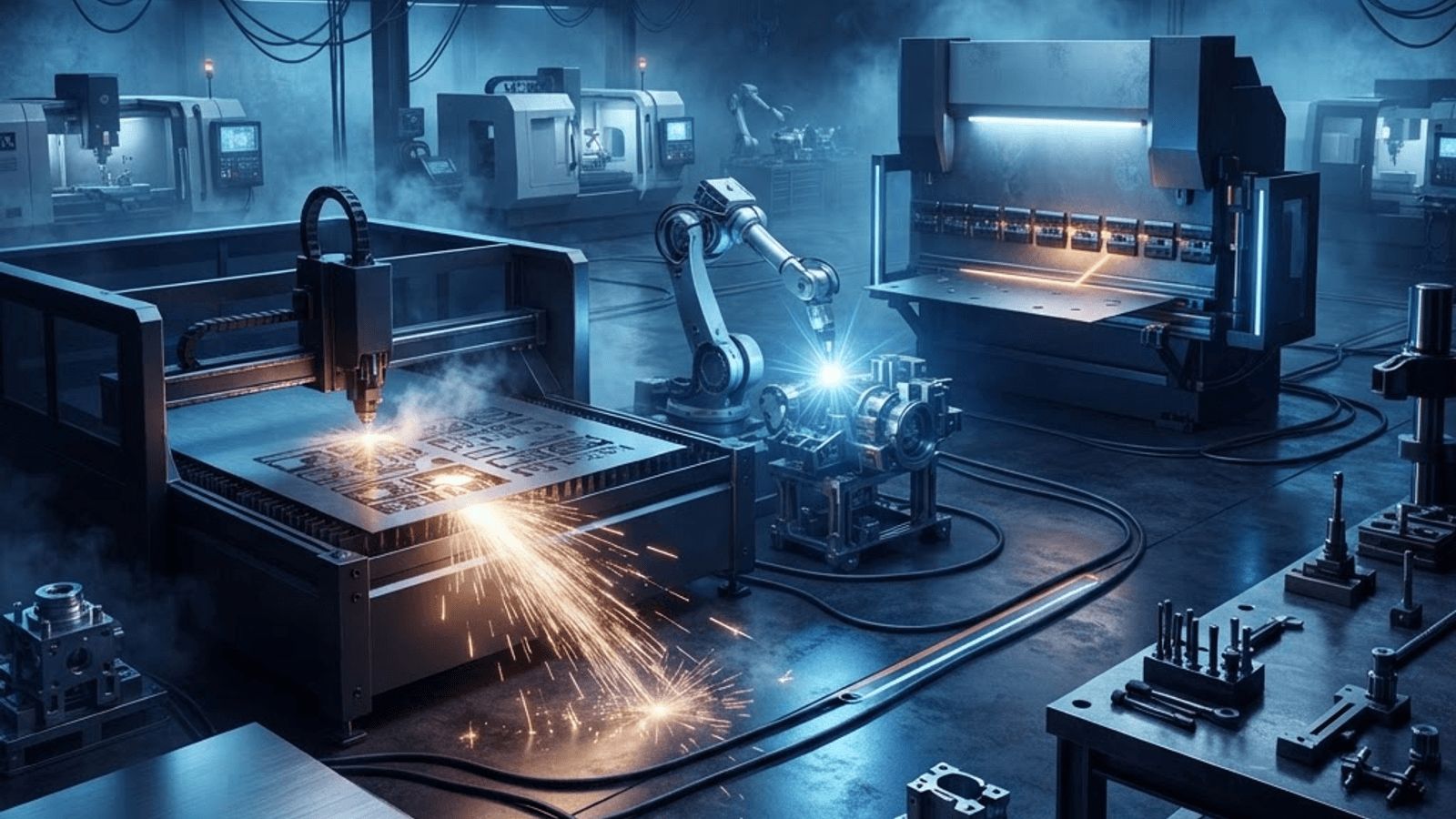
Laser cutting has become the default entry point for sheet metal work. Fibre lasers cut mild steel, stainless steel and aluminium quickly and accurately, working directly from digital files with no tooling required. This has collapsed lead times on prototype and low-volume parts from weeks to days.
Press braking forms cut blanks into three-dimensional shapes. Accuracy here depends heavily on operator skill and tooling selection, since bend allowances vary with material grade, thickness and grain direction. Experienced fabricators account for these factors at the design stage rather than discovering them during forming.
CNC machining removes material to produce precise geometries. Multi-axis machining centres can produce complex components in a single setup, eliminating the cumulative errors that arise when a part is repeatedly re-fixtured. Turning centres with live tooling achieve the same benefit for cylindrical components.
Welding joins the result. Manual metal arc, metal inert gas and tungsten inert gas processes each suit different materials and applications, and coded welders working to recognised procedure specifications are essential wherever structural or pressure integrity matters.
Ten Metalworks Companies to Consider
1. Hatfield Precision Engineering operates multi-axis CNC machining centres serving aerospace and instrumentation customers, with comprehensive inspection facilities including coordinate measuring machines.
2. Welwyn Sheet Metal Works provides laser cutting, punching, forming and welding for enclosures, panels and chassis, with fast turnaround on prototype quantities.
3. Comet Way Fabrication handles heavy structural steelwork, mezzanine floors, walkways and industrial frames, welding to recognised structural execution standards.
4. Shire Park Architectural Metalwork produces staircases, balustrades, gates, canopies and decorative features, combining structural competence with a strong sense of finish quality.
5. Herts Stainless Solutions specialises in stainless steel fabrication for food, pharmaceutical and laboratory environments, with hygienic welding and passivation performed in house.
6. Birchall Toolroom Services manufactures press tools, dies, jigs and fixtures, offering the high-accuracy grinding and spark erosion capability that tooling demands.
7. Old Hatfield Metal Finishing provides powder coating, wet spray, anodising and plating services, completing work for other fabricators as well as direct customers.
8. Panshanger Welding and Repair offers on-site welding, structural repair and maintenance fabrication, keeping plant and equipment operational across the borough.
9. Ellenbrook Aluminium Systems focuses on aluminium extrusion fabrication, framing systems and lightweight structures for machine guarding and modular assemblies.
10. Garden City Metal Supplies completes the list as a stockholder and processor, supplying bar, sheet, tube and section with sawing and profiling to size.
How to Specify Metalwork Properly
Supply proper drawings. A dimensioned technical drawing with material specification, tolerances, surface finish requirements and welding symbols removes ambiguity and allows accurate quoting. Three-dimensional models in a neutral exchange format are helpful alongside, but the drawing remains the contractual document.
Only specify tight tolerances where they are functionally necessary. Every tenth of a millimetre of unnecessary precision adds cost through slower machining, additional inspection and higher scrap rates. Applying a general tolerance across the part and tightening only the critical features is far more economical.
Consider the finishing requirement early. Powder coating hides minor surface imperfections; polished stainless steel reveals everything. If a component will be visible, say so, because fabricators prepare and handle cosmetic work differently from parts destined for a machine interior.
Technology Changing the Sector
Automated nesting software has improved material yield substantially, fitting parts together on a sheet to minimise offcut. Given that raw material often represents the majority of a fabricated part's cost, these gains pass directly into competitive pricing.
Robotic welding is becoming viable at lower volumes as programming becomes easier. Offline programming from a three-dimensional model means a robot cell can be set up for a new part without extended downtime, bringing consistency benefits to batch sizes that previously demanded manual welding.
Additive manufacturing in metal is finding a niche rather than replacing conventional methods. Where a part has internal channels, complex organic geometry or would otherwise require an assembly of several welded components, printing can be genuinely superior. For simple brackets it remains far more expensive than cutting and folding.
Quality and Certification
Look for relevant accreditation. Quality management certification demonstrates process discipline; sector-specific approvals for aerospace or pressure equipment indicate the ability to work under external scrutiny. Structural steelwork requires execution class compliance and factory production control certification, which is a legal requirement rather than a marketing advantage.
Ask about material traceability. Reputable fabricators retain mill certificates linking finished components to material batches, which matters enormously if a defect investigation is ever required.
Final Thoughts
Welwyn Hatfield's metalworks companies combine inherited engineering discipline with substantial investment in modern cutting, forming and machining technology. Whether the requirement is a single precision component, a batch of enclosures or a complete structural installation, the borough offers fabricators capable of delivering to a genuinely high standard.
Want your brand featured in front of decision-makers? Publish a guest post or get a link insertion in our guides through AAMAX's guest post and link insertion service.
Helpful Links
 SponsoredAAMAX — Full-Service Digital Agency
Write for Us
Share your expertise with our readers. We welcome guest contributions from industry specialists.
Pitch your idea