

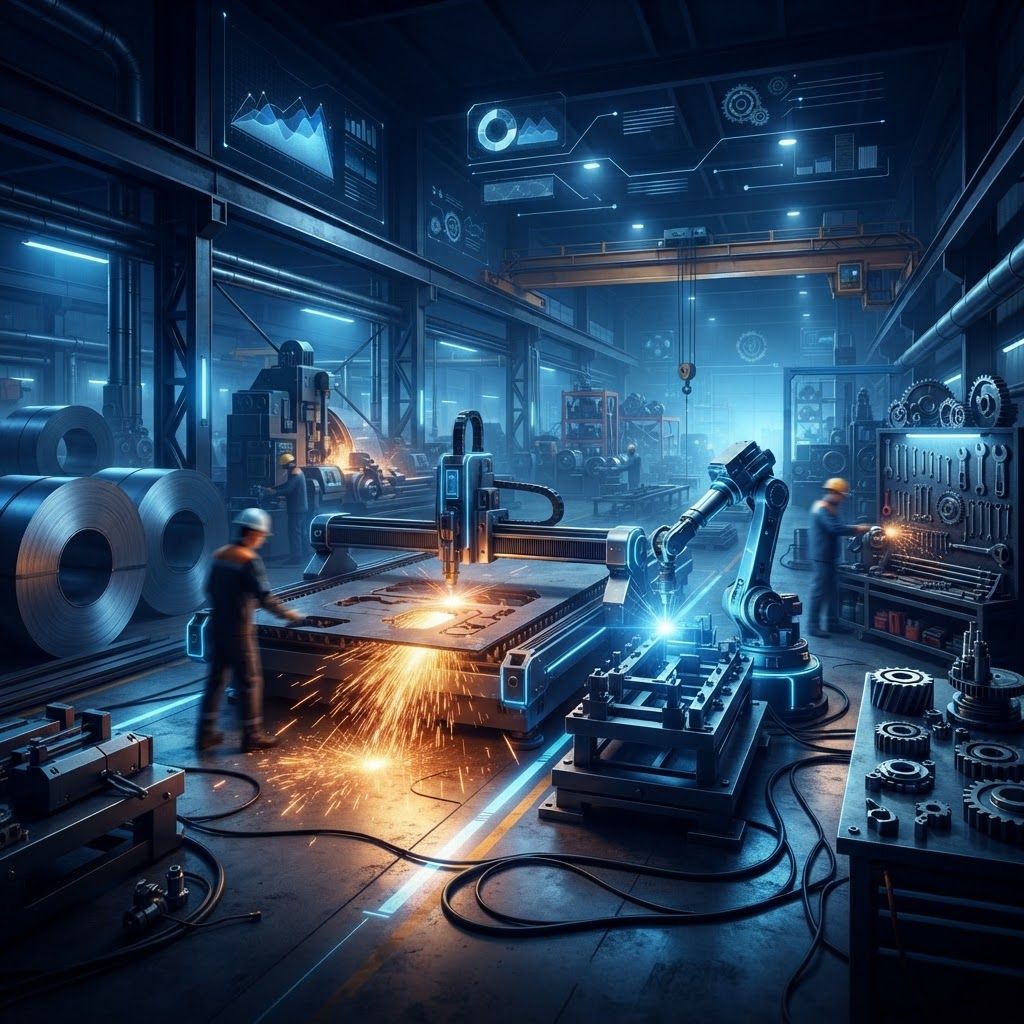
A Town Built on Metal
Few English towns have a stronger claim to metalworking heritage than Warrington. Wire drawing, tool making, foundry work and heavy engineering shaped the local economy for well over a century, and the phrase "Warrington wire" was once known across the industrial world. That history is not merely nostalgic; it explains why the town still supports an unusually deep concentration of fabrication, machining and precision engineering businesses today.
Modern Warrington metalworks companies serve a diverse customer base including nuclear and energy, food and beverage processing, pharmaceuticals, rail and transport, chemicals, construction and architectural sectors. The town's location between Manchester and Liverpool, with immediate motorway access and proximity to major industrial clusters, keeps it commercially relevant in a way that many former industrial centres have struggled to maintain.
Understanding the Metalworks Landscape
The term metalworks covers a very wide range of processes and business models. Some firms are heavy structural fabricators handling multi-tonne assemblies. Others are precision machinists working to micron tolerances. Sheet metal specialists, welders, surface finishers, laser cutting bureaux and architectural metalworkers all fall under the same broad heading while operating entirely different businesses. Identifying the correct process family for your requirement is the most valuable first step any buyer can take.
The Ten Leading Categories of Metalworks Companies in Warrington
1. Structural Steel Fabricators
Structural fabricators produce beams, columns, portal frames, platforms, staircases, mezzanines and walkways for construction and industrial projects. The leading Warrington operators hold recognised execution class certification, employ coded welders, and offer full design, fabrication and site installation packages. Their competitive strengths typically lie in crane capacity, workshop bay size and the ability to hit programme dates on critical-path steelwork.
2. Sheet Metal Fabrication Specialists
Sheet metal firms work in thinner gauges, producing enclosures, cabinets, panels, ducting, guarding, trays and brackets. Modern operations combine CNC punching, laser cutting, press brake forming, welding and powder coating under one roof. Buyers value them for prototyping speed, tight repeatability across batches, and the flexibility to handle both one-off and volume production.
3. CNC Machining and Precision Engineering Firms
Precision machinists use CNC turning centres, vertical and horizontal machining centres, and multi-axis equipment to produce components to exacting tolerances. Warrington has a strong presence in this area, supported by demand from nuclear, energy, pharmaceutical and process industries. Key differentiators include multi-axis capability, quality management certification, inspection equipment such as coordinate measuring machines, and full material traceability.
4. Laser, Plasma and Waterjet Cutting Bureaux
Profile cutting services take customer drawings and produce accurately cut blanks in steel, stainless, aluminium and specialist alloys. Fibre laser technology has transformed this segment, delivering faster cutting, cleaner edges and lower running costs. The best providers offer rapid turnaround, nesting optimisation to reduce material waste, and the option of secondary operations such as forming or welding.
5. Welding and On-Site Fabrication Contractors
Specialist welding contractors handle work that cannot come to a workshop: pipework modifications, tank repairs, structural strengthening and plant maintenance. Their value lies in coded welder qualifications across multiple processes and materials, rigorous procedure documentation, and the flexibility to work within live industrial environments and shutdown windows.
6. Stainless Steel and Hygienic Fabrication Specialists
Given the North West's strong food, beverage and pharmaceutical manufacturing base, hygienic stainless fabrication is a significant local specialism. These firms produce tanks, vessels, hoppers, conveyor frames, pipework and process equipment to hygienic design standards, with polished finishes, crevice-free welds and full material certification. This is technically demanding work where experience genuinely shows.
7. Architectural and Ornamental Metalworkers
Architectural metalworkers produce balustrades, handrails, gates, railings, canopies, feature staircases, cladding and bespoke decorative pieces. They bridge engineering and design, requiring both structural competence and a high standard of visual finish. Warrington firms in this space serve commercial developments, hospitality projects and high-end residential work across the region.
8. Surface Finishing and Treatment Providers
Finishing companies apply powder coating, wet spray, galvanising, anodising, shot blasting, passivation and plating. Finishing is often the difference between a component lasting three years and thirty, and the best providers offer proper surface preparation, controlled application environments, and coating specifications matched to the service environment rather than simply applied by habit.
9. Metal Stockholders and Processing Centres
Stockholders supply plate, sheet, bar, tube, sections and specialist alloys, usually with first-stage processing such as sawing, shearing and profiling. For fabricators and manufacturers, a responsive local stockholder reduces working capital and lead times considerably. Depth of range and cut-to-size accuracy are the main competitive factors.
10. Toolmaking, Jigs and Special Purpose Machinery Builders
At the highly skilled end of the sector, toolmakers and special purpose machinery builders produce press tools, moulds, jigs, fixtures and bespoke automation equipment. These businesses often work closely with manufacturers to improve productivity, and their output is measured in reduced cycle times and improved yield rather than tonnage.
Technology Driving the Modern Metalworks Sector
The gap between modern and outdated metalworking operations has widened dramatically. Fibre laser cutting has largely displaced older CO2 systems, offering substantial speed and efficiency gains on thinner materials. Robotic welding cells deliver consistency on repeat work that manual welding cannot economically match, while freeing skilled welders for complex bespoke tasks.
Digital manufacturing has also arrived properly. Three-dimensional modelling flows directly into nesting and machine programming, reducing drawing errors and setup time. Additive manufacturing is being used for prototyping, tooling inserts and complex geometries that are difficult to machine. Meanwhile, digital inspection using scanning and coordinate measurement produces documented dimensional evidence rather than spot checks.
Skills remain the sector's central challenge. Coded welders, toolmakers and experienced setters are in genuinely short supply nationally. The strongest Warrington firms have responded by running apprenticeship programmes, investing in internal training and building progression routes — an approach that also tends to correlate with better quality and reliability for customers.
How to Select the Right Metalworks Partner
Begin by matching process capability precisely to your requirement. A structural fabricator and a precision machinist may both call themselves engineers, but placing the wrong job with either produces disappointing results. Ask to see the actual machine list and typical work rather than relying on general capability claims.
Verify certification appropriate to your sector, whether that means quality management systems, welding execution classes, pressure equipment competence or hygienic design experience. Ask about material traceability, which is essential in regulated industries. Assess inspection and quality assurance, requesting sample inspection reports.
Consider capacity realistically against your volumes and timescales, and ask candidly how busy the workshop currently is. Evaluate design and value engineering support, because a fabricator who suggests a simpler weldment or a cheaper standard section can save far more than a small unit price difference. Finally, look at whether the firm offers finishing and assembly in-house, since managing fewer suppliers reduces both cost and coordination risk.
The Outlook for Metalworking in Warrington
The medium-term prospects are encouraging. Energy infrastructure investment, including nuclear activity in the North West, generates high-specification fabrication and machining demand. Food and pharmaceutical manufacturing continues to require hygienic stainless work. Construction and logistics development sustains structural steel volumes. And the broader reshoring trend, driven by supply chain caution, is bringing some component manufacturing back to UK suppliers.
Warrington's combination of engineering heritage, skilled labour, industrial infrastructure and logistics access makes it a genuinely strong base for metalworking. For any business across the North West requiring fabrication, machining or precision engineering, the local supply base offers depth and capability that few comparable towns can match.
Want your brand featured in front of decision-makers? Publish a guest post or get a link insertion in our guides through AAMAX's guest post and link insertion service.
Helpful Links
 SponsoredAAMAX — Full-Service Digital Agency
Write for Us
Share your expertise with our readers. We welcome guest contributions from industry specialists.
Pitch your idea

