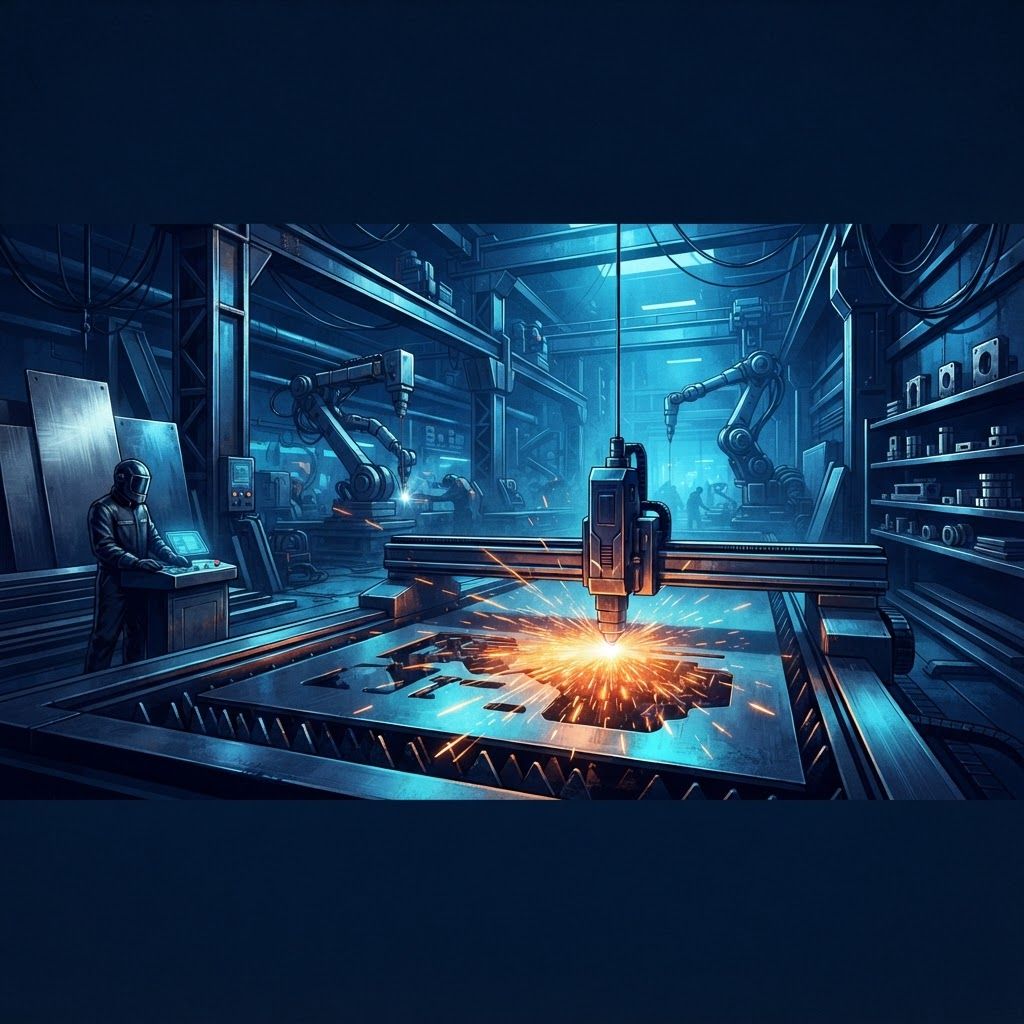
A Broad and Capable Metalworking Sector
Metalworking is one of the most versatile industries in the Vale of White Horse, serving customers whose requirements could hardly be more different. On one end of the spectrum sit scientific and motorsport clients requiring components machined to tolerances measured in microns. On the other sit farms, builders and homeowners needing gates, brackets, trailers and structural steel. Both are well served across the district.
Workshops cluster in industrial areas around Abingdon-on-Thames, Wantage, Grove and Milton, with rural fabricators and blacksmiths operating from converted farm buildings in the Downland villages. This geographic spread reflects the customer base: precision work follows the science and motorsport corridor, while general fabrication and agricultural engineering follow the farming economy.
Matching the Supplier to the Job
The most common procurement error is approaching the wrong type of metalworker. A precision machining business equipped with multi-axis machining centres and coordinate measuring machines is poorly suited to fabricating a farm gate, and a general fabricator will struggle with a tolerance of a few hundredths of a millimetre. Understanding the categories saves time for everyone.
Precision machining covers turning, milling and grinding of components from solid material. Sheet metal fabrication involves cutting, forming and welding of plate and sheet into enclosures, panels and assemblies. Structural steelwork covers beams, columns and frames for construction. Architectural metalwork produces balustrades, staircases, gates and decorative elements. Blacksmithing offers forged, hand-worked traditional ironwork.
Ten Metalworks Companies in the District
Vale Precision Engineering undertakes high-tolerance CNC machining for scientific, motorsport and medical clients, with inspection capability to verify demanding dimensional requirements.
Abingdon Sheet Metal Works specialises in laser cutting, press braking and welded fabrication, producing enclosures, panels, brackets and light assemblies for industrial customers.
Ridgeway Structural Steel fabricates and erects structural steelwork for commercial and agricultural buildings, working to the relevant execution class requirements for construction products.
Downland Agricultural Fabrication serves farms across the Berkshire Downs with equipment repair, bespoke implement manufacture, gates, feeders and hard-wearing fabrication built for field conditions.
Faringdon Forge practises traditional blacksmithing alongside modern fabrication, producing hand-forged gates, railings, ironmongery and restoration work for period properties.
Milton Park Precision Components provides small-batch turned and milled parts with full material traceability, supporting research and instrumentation clients on short lead times.
Thames Valley Welding Services offers mobile and workshop welding across a range of processes and materials, including coded welding for pressure and structural applications.
Wantage Architectural Metalwork designs and manufactures staircases, balustrades, canopies and feature metalwork for residential and commercial projects, coordinating finishing and installation.
White Horse Stainless Fabrication concentrates on stainless steel work for food production, laboratory and hygienic applications, where surface finish and cleanability are critical.
Upper Thames Metal Finishing completes the list with surface treatment services including powder coating, shot blasting and galvanising coordination, supporting other fabricators and end clients.
Welding Quality and Certification
Welding is a process whose quality cannot be fully judged by appearance, which makes certification genuinely important. Structural steelwork for construction requires factory production control and appropriate execution class certification. Pressure applications demand coded welders qualified to specific procedures. Even non-critical work benefits from documented welding procedures and qualified personnel.
Clients should ask what welder qualifications a workshop holds, what procedures are documented and whether non-destructive testing is available for critical joints. In stainless steel work, ask specifically about pickling and passivation, since inadequate post-weld treatment leaves corrosion-prone surfaces even on correctly welded joints.
Materials, Finishing and Corrosion Protection
Material selection affects performance and cost significantly. Mild steel offers economy and easy fabrication but requires protective coating. Stainless steels resist corrosion at higher cost, with grade selection mattering considerably in chloride or chemically aggressive environments. Aluminium provides light weight and natural corrosion resistance but needs different welding technique and joint design.
Finishing determines service life for external work. Hot dip galvanising provides excellent long-term protection for structural and agricultural items. Powder coating offers colour and reasonable durability, and duplex systems combining galvanising with powder coating give the best of both for demanding exposure. Given the Vale's exposed Downland locations, specifying appropriate protection rather than minimal paint prevents premature failure.
Working Effectively with a Metalworker
Provide clear drawings with dimensions, tolerances, material grade and finish specification. Where tolerances are not critical, say so explicitly, because applying tight tolerances across a whole drawing raises cost substantially with no benefit. For fabrication, indicate which faces are visible and what standard of finish is expected on welds, as grinding and dressing take time and should be agreed rather than assumed.
For architectural work, discuss installation early. Access, fixing substrate, structural adequacy and building regulation requirements for balustrade heights and loadings all shape the design, and resolving them before manufacture avoids expensive rework.
Skills and the Future of Local Metalworking
Metalworking depends on skilled machinists, welders and fabricators, and the sector across Oxfordshire has invested in apprenticeship pathways to sustain that supply. Automation is changing rather than replacing this work, with programmable machinery handling repetitive operations while human expertise concentrates on setup, problem solving and quality judgement.
Demand looks resilient. Construction, agriculture, scientific instrumentation, motorsport and the growing electrification sector all require metal components, and the Vale of White Horse hosts suppliers capable across that full range. For clients, the practical lesson is straightforward: define the requirement clearly, choose the workshop suited to the category of work, and pay proper attention to welding quality and corrosion protection.
Want your brand featured in front of decision-makers? Publish a guest post or get a link insertion in our guides through AAMAX's guest post and link insertion service.
Helpful Links
 SponsoredAAMAX — Full-Service Digital Agency
Write for Us
Share your expertise with our readers. We welcome guest contributions from industry specialists.
Pitch your idea