

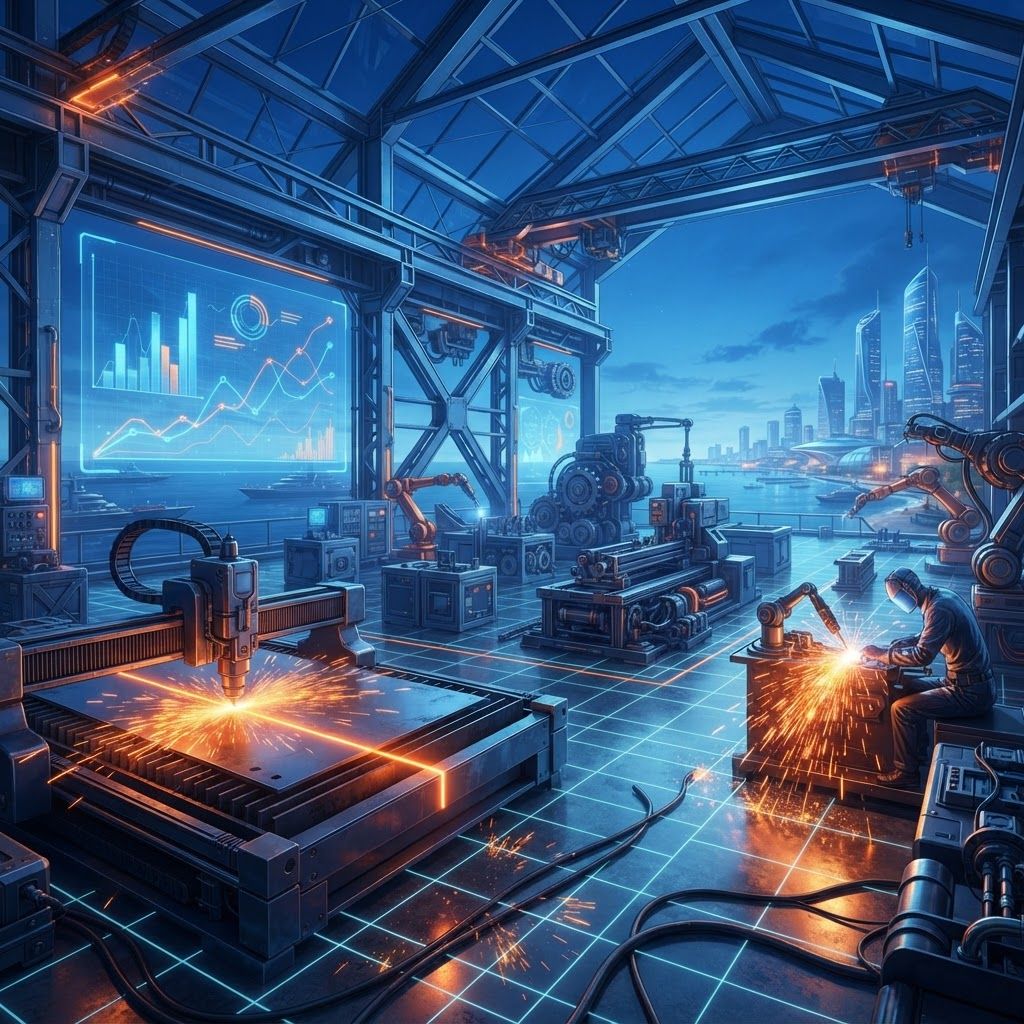
A Region Built on Metal
South Wales has been shaped by metal for well over a century. Ironworks, steelmaking, tinplate and shipbuilding built the industrial identity of the region, and while the scale of heavy industry has changed, the skills have not disappeared. In the Vale of Glamorgan those skills now live in a network of fabrication shops, engineering workshops, architectural metalworkers and precision machinists serving construction, agriculture, energy, food processing and marine sectors.
The county offers practical advantages for this work. Industrial estates around Barry, Llandow and Rhoose provide the high-bay workshop space, crane capacity and yard area that fabrication requires. Proximity to Cardiff and the M4 gives access to a large customer base, while the surrounding rural economy generates steady demand for agricultural steelwork, gates, handling systems and repairs. The Bristol Channel coastline adds marine and coastal infrastructure work, which demands corrosion-resistant specification and brings its own technical challenges.
Core Metalworking Processes Explained
Understanding the processes helps buyers commission work sensibly. Structural fabrication involves cutting, drilling, welding and assembling beams, columns and plate into frames, mezzanines, staircases and support structures. It is governed by execution standards that define welder qualification, tolerance classes and inspection requirements.
Sheet metal fabrication works with thinner gauge material, using laser or plasma profiling, press brake folding, punching and welding to produce enclosures, panels, ductwork, guards and cabinets. Laser cutting has transformed this field, allowing intricate profiles to be produced directly from digital files with minimal setup.
Machining covers turning, milling, drilling and grinding to produce precise components, shafts, flanges, bushes and custom parts. CNC machining centres allow complex geometry and repeatable tolerances. Welding and on-site repair is a distinct service, often using mobile teams who work in farms, factories and construction sites where equipment cannot be moved.
Architectural metalwork sits apart again, combining structural competence with aesthetic finish. Balustrades, staircases, gates, canopies and decorative screens must satisfy both loading regulations and visual expectations, which requires a different mindset from industrial fabrication.
Ten Metalworks Companies Serving the Vale
Glamorgan Steel Fabrication handles structural steelwork for commercial and agricultural buildings, with in-house detailing that speeds up approval and reduces site clashes.
Barry Precision Engineering focuses on CNC machining and component manufacture for industrial and energy customers, supported by coordinate measuring inspection.
Vale Sheet Metal Works operates laser profiling and press braking for enclosures, guards and panel work, offering rapid turnaround on prototype and small batch orders.
Llandow Welding Services provides mobile welding and repair across the county, covering agricultural machinery, plant equipment and emergency structural repairs.
Coastal Stainless Fabrication specialises in stainless steel for food processing, marine and coastal applications where corrosion resistance and hygienic welding are essential.
Cowbridge Architectural Metalwork produces balustrades, gates, railings and staircases, frequently working on period properties where design sympathy matters as much as strength.
Rhoose Aluminium Fabrication concentrates on lightweight aluminium structures, frameworks, access platforms and transport-related fabrication.
Severn Plate and Tank Works handles heavier plate work, including tanks, hoppers, chutes and wear-resistant components for processing industries.
Penarth Metal Finishing supports the wider sector with shot blasting, powder coating and protective coating services that determine how long fabricated steel actually lasts.
Dinas Powys Engineering Works completes the list as a general jobbing shop, the kind of versatile workshop that can make a one-off bracket, repair a broken component or fabricate a small assembly at short notice.
Standards, Certification and Quality Control
Fabricated steelwork used in construction must comply with recognised execution standards, and fabricators supplying structural components need the appropriate factory production control certification. This covers welding procedure specifications, welder qualifications, material traceability and inspection regimes. Asking a fabricator for evidence of this is entirely normal and any competent company will produce it readily.
Welding quality is verified through procedures and, where required, non-destructive testing such as dye penetrant, magnetic particle or ultrasonic inspection. For critical work, specify the inspection level in the enquiry rather than assuming it, as testing adds cost that must be priced in.
Corrosion protection deserves equal attention. In the coastal environment of the Vale, exposure conditions are more aggressive than inland. Galvanising offers excellent long-term protection for external steel, while duplex systems combining galvanising with paint provide both durability and colour. Specifying the right protective system at the outset costs far less than remedial work a few years later.
Industry Trends in Metal Fabrication
Digitalisation is the most visible change. Three-dimensional modelling and detailing software now feed directly into cutting and drilling machines, reducing errors and shortening lead times. Many fabricators can take a model from a structural engineer and produce fabrication drawings within days rather than weeks.
Automation is spreading beyond large plants. Robotic welding cells, automated profiling with nesting optimisation and powered material handling are increasingly viable for mid-sized shops, improving consistency and easing pressure from skilled labour shortages.
Sustainability is becoming commercially relevant. Steel is highly recyclable, and the industry is increasingly able to document recycled content and embodied carbon. Design for disassembly, using bolted rather than welded connections so structures can be dismantled and reused, is gaining traction in commercial projects.
Skills remain the sector's main constraint. Welding, fitting and machining are demanding trades with an ageing workforce, and companies investing in apprenticeships are the ones most likely to sustain capacity over the coming decade.
Commissioning Metalwork Successfully
Provide as much information as possible at enquiry stage: material grade, thickness, tolerances, welding requirements, finish, quantity and delivery location. Vague enquiries produce cautious, inflated quotations. Where a design is not finalised, involve the fabricator early, since practical input on standard sections, plate sizes and connection details can substantially reduce cost.
Clarify who is responsible for site survey and dimensional verification, as this is a common source of dispute. Agree lead times for both fabrication and finishing, remembering that galvanising and coating are usually subcontracted and add days to the programme. Finally, ask about installation. Some fabricators install their own work, which simplifies responsibility considerably if an adjustment is needed.
Final Thoughts
Metalworks companies in the Vale of Glamorgan represent an enduring industrial strength, combining traditional fabrication skill with modern digital and automated capability. Whether a project requires structural steel for a farm building, hygienic stainless work for food production, decorative railings for a period home or a single machined component, the local supply base can deliver. Clear specification, attention to corrosion protection and early engagement with the fabricator are the surest routes to a successful outcome.
Want your brand featured in front of decision-makers? Publish a guest post or get a link insertion in our guides through AAMAX's guest post and link insertion service.
Helpful Links
 SponsoredAAMAX — Full-Service Digital Agency
Write for Us
Share your expertise with our readers. We welcome guest contributions from industry specialists.
Pitch your idea

