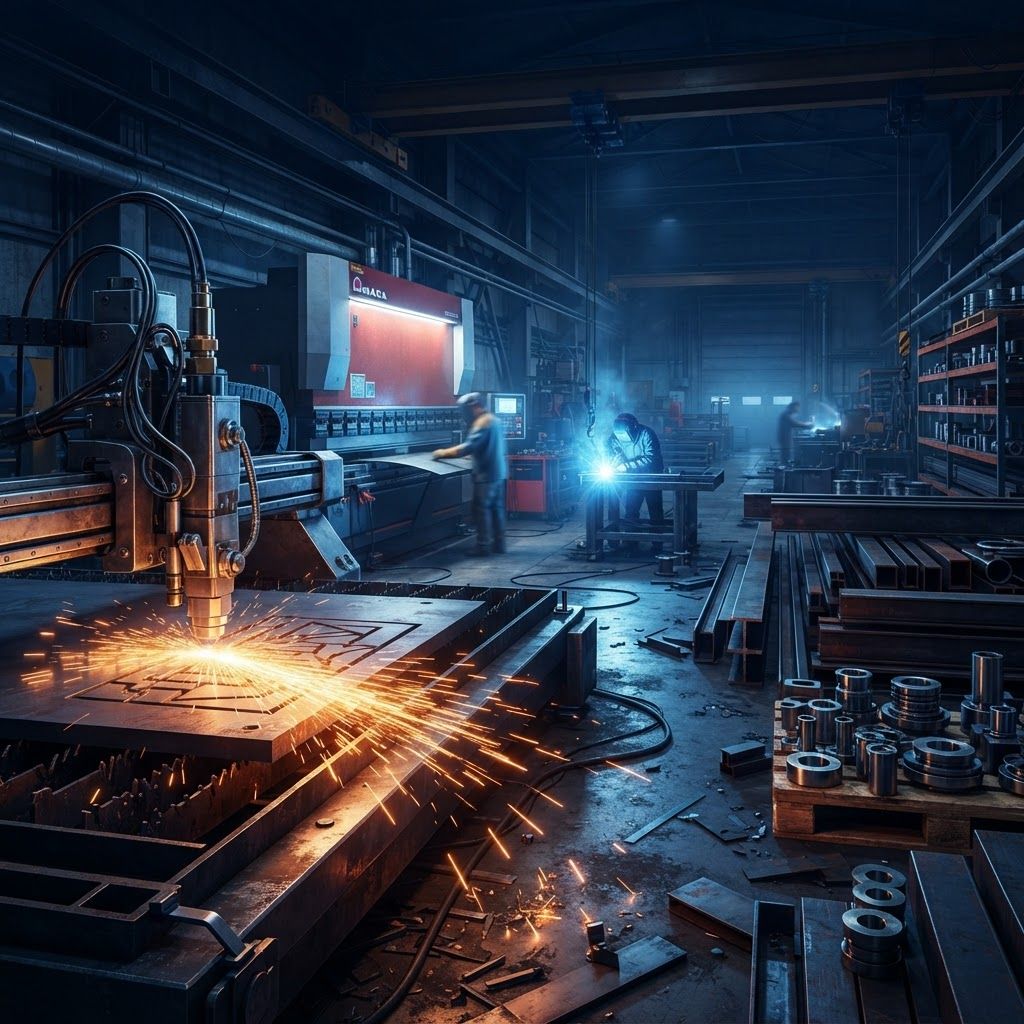
Metalworking and Trafford's Industrial Identity
Trafford Park was purpose-built as an industrial estate and metalworking has been part of its fabric since the beginning. Heavy engineering, steel fabrication, foundry work and precision machining supported the engine, vehicle and machinery industries that made the estate internationally significant. Much of that heavy capacity has gone, but metalworking itself has not. It has instead reorganised into a network of smaller, more specialised and considerably more capable businesses.
Today's Trafford metalworker is more likely to run CNC machining centres, fibre lasers, CNC press brakes and robotic welding cells than the manual equipment of previous generations. The work has moved up the value chain: tighter tolerances, better finishes, full material traceability and shorter lead times. What has not changed is the concentration of skills and the density of suppliers, which means a designer in Trafford can source cutting, forming, welding, machining, finishing and assembly within a very small geographic area.
Understanding Metalworking Processes
Sheet metal fabrication cuts flat material, forms it on press brakes and joins it by welding or mechanical fastening. It suits enclosures, brackets, panels, guarding, ducting and chassis work. Laser and plasma cutting produce accurate profiles directly from CAD data with no tooling cost, which makes low volumes economic.
Machining removes material from solid stock to achieve dimensional accuracy that forming cannot. CNC milling handles prismatic parts, CNC turning handles cylindrical parts, and multi-axis machines combine both to make complex components in single setups. Machining is the right choice where tolerances are tight or where features cannot be formed.
Structural steel fabrication works in heavier section, producing beams, columns, frames, platforms, staircases and balustrades to structural design and, where required, under factory production control certification.
Finishing processes protect and present the metal. Powder coating provides durable coloured finishes. Galvanising gives long-term corrosion protection for external steel. Anodising hardens and colours aluminium. Electroplating, passivation and shot blasting each serve specific functional purposes.
The Top 10 Metalworks Companies in Trafford
1. Trafford Park Precision Engineering. A CNC machining business running multi-axis milling and turning centres with in-process inspection and full material traceability. It works in aluminium, stainless, tool steel and engineering plastics for customers in instrumentation, hydraulics and specialist machinery, and holds quality accreditation that satisfies demanding supply chains.
2. Stretford Sheet Metal Fabrication. A fabricator equipped with fibre laser cutting, CNC punching, press braking and welding, producing enclosures, panels, brackets and machine guarding. Its integrated design-for-manufacture review routinely removes cost from customer drawings before quotation.
3. Carrington Structural Steel. A structural fabricator producing frames, platforms, walkways, staircases and support steelwork under factory production control, with connection design carried out in house. It serves construction and process industry clients across the North West.
4. Old Trafford Welding and Fabrication. A specialist welding operation with coded welders working in carbon steel, stainless and aluminium, covering MIG, TIG and orbital processes. It handles pressure-related work, food-grade stainless fabrication and repair work requiring documented procedures.
5. Sale Metal Finishing. A finishing house providing powder coating, wet spray, shot blasting and chemical pretreatment with colour matching and controlled cure. It works both as a subcontractor to local fabricators and directly for manufacturers needing finished components.
6. Urmston Toolmaking and Jig Manufacture. A toolroom producing press tools, moulds, jigs, fixtures and gauges for manufacturers across the region. Its work sits behind production processes rather than in the end product, and its accuracy directly determines the quality of everything made on it.
7. Trafford Architectural Metalwork. A fabricator specialising in visible metalwork: balustrades, handrails, gates, screens, canopies and feature staircases in stainless steel, mild steel, brass and aluminium. Aesthetic tolerance and finish quality drive the work, and it collaborates directly with architects on detailing.
8. Partington Laser and Profile Cutting. A cutting bureau running fibre laser and plasma capacity across a wide thickness range, offering nesting optimisation and rapid turnaround from CAD files. Many smaller Trafford fabricators use it as their cutting supplier rather than investing in their own capacity.
9. Timperley CNC Turning. A turned parts specialist producing shafts, spindles, bushes, fittings and connectors in volumes from prototype to production runs. Bar-fed machines running unattended give it competitive pricing on repeat components.
10. Davyhulme Metal Stamping and Pressing. A press shop producing stamped components, brackets and clips in volume, with in-house tool maintenance. It serves automotive, electrical and appliance customers who need consistent parts at high rates and low unit cost.
Choosing the Right Metalworking Partner
Match the process to the part before choosing the supplier. A bracket that could be laser cut and folded should not be machined from solid, and a precision spindle should not be fabricated. Getting the process right typically saves more money than any negotiation on rate.
Interrogate quality systems in proportion to the requirement. General fabrication may need nothing formal. Components going into regulated industries need documented quality management, calibrated inspection equipment and material certification. Welded structures may need factory production control certification and coded welders. Ask to see the evidence rather than accepting the claim.
Consider the whole route. A part that needs cutting, machining, welding, finishing and assembly will pass through several hands. A supplier who manages the whole chain removes coordination burden and takes single-point responsibility for the finished item, which is usually worth paying for even when the sum of individual quotations looks cheaper.
Skills, Technology and the Sector's Direction
The persistent challenge across Trafford metalworking is skills. Experienced toolmakers, coded welders and setter-operators are in short supply nationally, and the strongest local businesses have responded by running apprenticeships and by investing in automation that reduces dependence on scarce manual skill.
Technology adoption has accelerated. Fibre lasers have transformed cutting economics. Robotic welding has made mid-volume welded assemblies viable onshore. Offline programming and simulation have cut setup times sharply. Digital quality records have replaced paper. These changes have made Trafford metalworkers genuinely competitive against imported parts on total cost once lead time, freight, tooling amortisation and quality risk are properly accounted for.
Conclusion
Metalworking remains a genuine strength of Trafford's economy, delivered now through specialised businesses rather than the vast integrated works of the past. The companies profiled here span machining, sheet fabrication, structural steel, welding, finishing, toolmaking, architectural metalwork, profile cutting, turning and pressing. Choose the correct process first, verify quality credentials against your actual requirement, and consider using a supplier who can manage the full route from raw material to finished part.
Want your brand featured in front of decision-makers? Publish a guest post or get a link insertion in our guides through AAMAX's guest post and link insertion service.
Helpful Links
 SponsoredAAMAX — Full-Service Digital Agency
Write for Us
Share your expertise with our readers. We welcome guest contributions from industry specialists.
Pitch your idea