

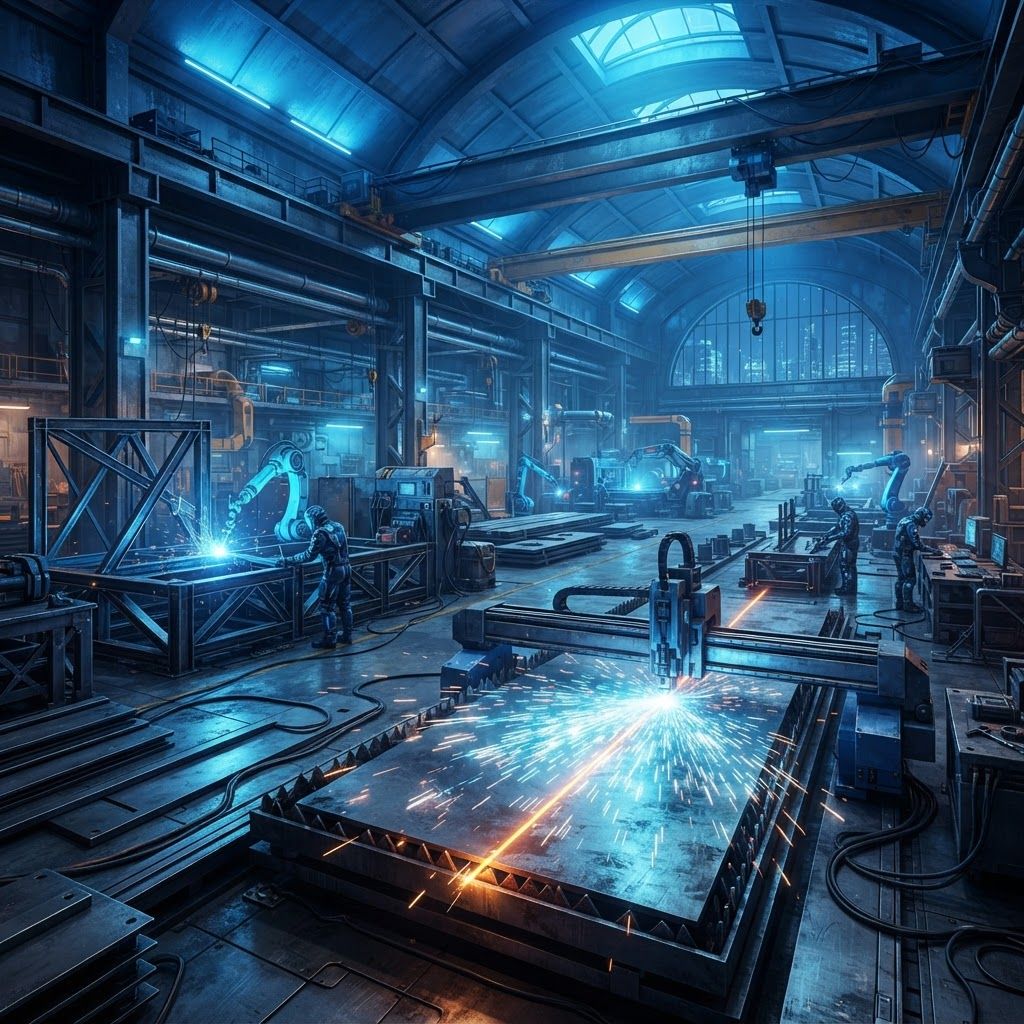
Working Metal in West Kent
Metalworking is among the most versatile of industrial activities, and Tonbridge and Malling supports a wide spectrum of it. At one end are structural steelwork fabricators producing frames for warehouses, schools and commercial buildings. At the other are precision machinists working to tolerances measured in hundredths of a millimetre for aerospace and medical clients. In between sit architectural metalworkers, sheet metal specialists, welders, blacksmiths and surface treatment providers.
The borough's industrial areas offer what metalworking needs: substantial floor space, overhead craneage, heavy power supply and good road access for delivering long or heavy sections. The M20 corridor means finished steelwork can reach London sites or the Channel ports comfortably within a working day, which matters when a crane and an erection team are waiting.
What Defines a Capable Metalworks Company
For structural work, certification is fundamental. Fabricators producing structural steelwork for construction must operate a factory production control system and hold certification to the relevant execution class for the work they undertake. Welding procedures must be qualified, welders must hold current coding for the processes and positions they use, and there should be a responsible welding coordinator overseeing the work.
For precision machining, look at measurement capability. A firm with a coordinate measuring machine, calibrated instruments on a documented schedule and proper first article inspection procedures can prove what it produces. Ask how tolerances are verified rather than simply whether they can be achieved.
Material traceability matters across the board. Mill certificates linking delivered material to specification are essential for structural and safety-critical work, and increasingly expected elsewhere. Good fabricators mark and track material through the shop rather than relying on memory.
Finishing capability affects both durability and appearance. Shot blasting, galvanising, powder coating, anodising, painting and passivation each suit different metals and environments. Understanding what the finishing route requires, including drainage and venting holes for galvanising, is a design consideration rather than an afterthought.
Ten Leading Metalworks Companies Serving the Borough
Medway Structural Steel fabricates and erects structural frames for commercial, industrial and residential construction, handling connection design, fabrication drawings, shop production and site erection.
Aylesford Precision Machining operates computer numerical control turning and milling centres producing close-tolerance components for aerospace, medical and instrumentation clients, with full inspection reporting.
Kings Hill Sheet Metal Works specialises in laser cutting, punching, folding and welding of sheet materials, producing enclosures, panels, brackets and fabricated assemblies in steel, stainless and aluminium.
Tonbridge Architectural Metalwork produces staircases, balustrades, gates, railings, canopies and decorative features, combining design capability with the craftsmanship that visible metalwork demands.
Weald Stainless Fabrication focuses on stainless steel work for food, pharmaceutical and laboratory environments, including hygienic tables, tanks, pipework and enclosures finished to cleanable standards.
Snodland Welding Services provides mobile and workshop welding across a range of processes and materials, including coded welding for pressure and structural applications and on-site repair work.
Malling Metal Finishing offers shot blasting, powder coating, wet spray painting and protective treatment, serving fabricators and manufacturers that need a durable finish applied to a consistent standard.
North Downs Forge and Blacksmiths carries out traditional hot forging and hand-worked metalwork for restoration, heritage and bespoke commissions, including ironmongery for period properties.
Borough Green Tube and Profile Fabrication specialises in tube bending, rolling and profile work for handrails, frames, roll structures and curved architectural elements.
Larkfield Engineering Fabrication undertakes heavy fabrication including platforms, walkways, hoppers, tanks and plant structures, working from client drawings or providing design support where required.
Trends in the Metalworking Sector
Automation has changed shop floor economics substantially. Fibre laser cutting has largely displaced older cutting methods for sheet work, offering higher speed, better edge quality and reduced consumable cost. Automated panel benders, robotic welding cells and pallet-fed machining centres allow smaller firms to run productive unattended shifts.
Digital workflow is now standard among well-run fabricators. Three-dimensional models flow into fabrication drawings, nesting software and machine code with minimal manual re-entry, which reduces errors and shortens lead times. For structural steel, building information modelling coordination catches clashes before fabrication rather than on site.
Sustainability has arrived in metalworking through several routes. Steel and aluminium are highly recyclable, and recycled content is increasingly reported. Embodied carbon assessment on construction projects has prompted interest in lighter structural solutions, reuse of existing steel frames and lower-carbon production routes.
Skills remain the sector's central challenge. Experienced welders, fitters and setters are in short supply, and the firms performing best are those investing seriously in apprenticeships and in equipment that makes skilled people more productive rather than trying to replace them.
Specifying Metalwork Successfully
Provide complete information: material grade, section sizes, tolerances that genuinely matter, weld types and sizes, surface preparation and finish specification, and any testing required. Vague drawings produce assumptions, and assumptions produce disputes.
Consider the whole sequence. How will the item be transported, lifted and installed? Are lifting points needed? Will it fit through the access available? Can it be delivered in sections and joined on site? Fabricators asked these questions early will often suggest design changes that save considerable cost.
Agree inspection and acceptance arrangements before work starts, including whether non-destructive testing is required and who witnesses it. For architectural work, approve a physical sample of the finish, since colour and texture rarely translate accurately from a chart or screen.
Final Thoughts
Metalworks companies in Tonbridge and Malling range from heavy structural fabricators to precision machinists and traditional blacksmiths. The firms profiled here cover structural steel, machining, sheet metal, architectural work, stainless fabrication, welding, finishing, forging, tube work and heavy engineering. Clear specification, early engagement and attention to certification will get the best from any of them, and the depth of capability locally means most projects can be delivered without looking far beyond the borough.
Want your brand featured in front of decision-makers? Publish a guest post or get a link insertion in our guides through AAMAX's guest post and link insertion service.
Helpful Links
 SponsoredAAMAX — Full-Service Digital Agency
Write for Us
Share your expertise with our readers. We welcome guest contributions from industry specialists.
Pitch your idea

