Copperopolis and Its Modern Descendants
No British city has a stronger claim to metallurgical heritage than Swansea. In the mid-nineteenth century the Lower Swansea Valley smelted a large share of the world's copper, earning the city the nickname Copperopolis, and tinplate, zinc, nickel and steel followed. The environmental cost was severe and the industrial collapse of the twentieth century left a scarred valley, but the human legacy proved durable: generations of families who understood metal.
That understanding underpins today's sector. Swansea and the surrounding Swansea Bay region host structural steelwork fabricators, sheet metal specialists, laser and waterjet cutting bureaus, precision machinists, architectural metalworkers, blacksmiths and surface finishing companies. The nearby steelworks at Port Talbot keeps material knowledge and metallurgical skills concentrated in the area, while Swansea University's materials research and the region's engineering training pipeline continue to feed the industry.
Modern local metalwork serves construction, energy, marine, food processing, transport and architecture. Some firms handle tonnes of structural steel; others produce a single stainless balustrade. The best share a common trait: they understand how metal behaves and design around it rather than fighting it.
Fabrication Processes Explained
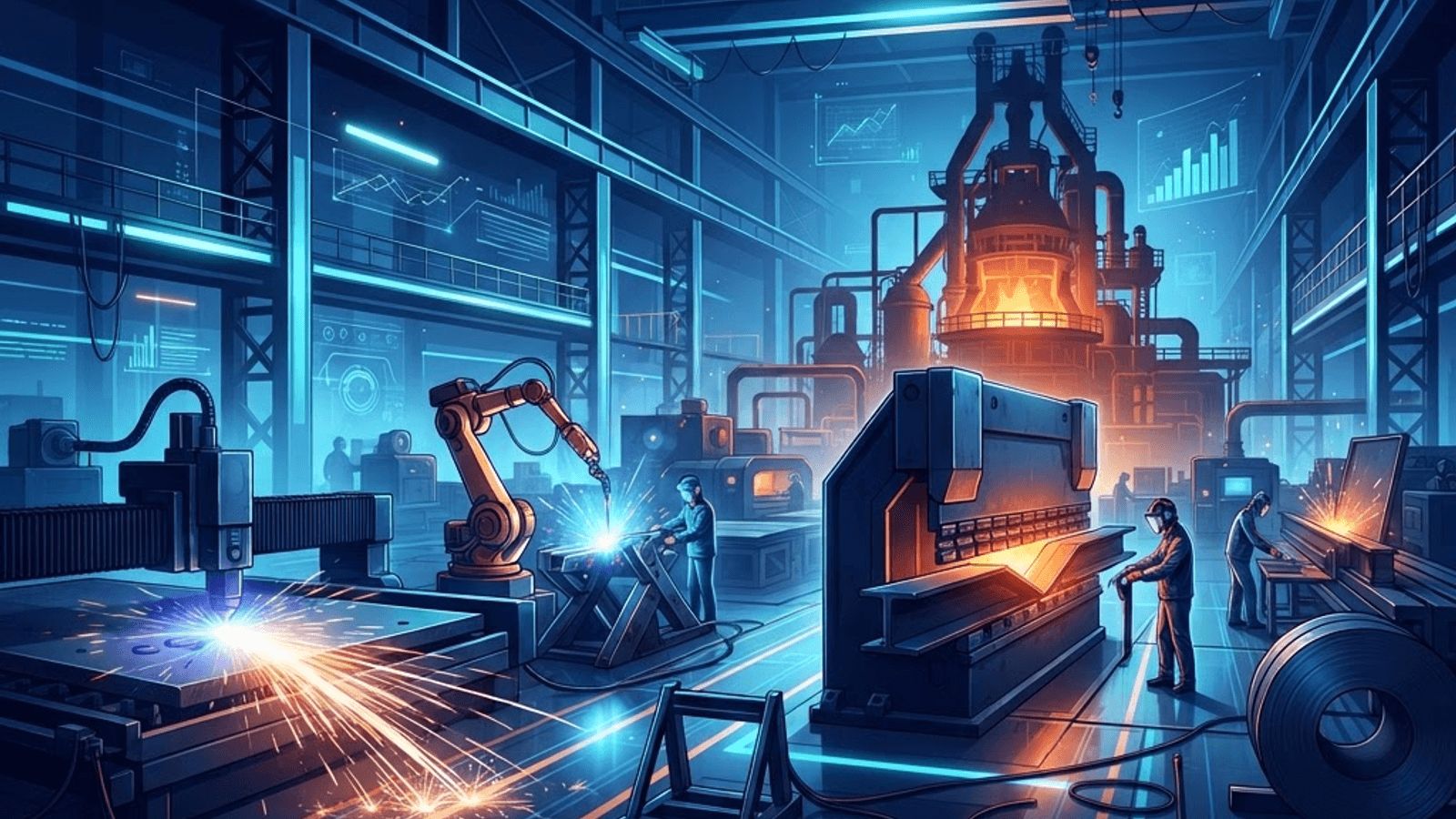
Understanding the toolkit helps you brief a supplier well. Laser cutting delivers fast, accurate profiles in sheet and plate with a clean edge, and fibre lasers handle reflective materials such as aluminium, copper and brass efficiently. Plasma cutting suits thicker plate at lower cost with a slightly rougher edge. Waterjet cuts almost any material without heat, which matters for hardened or heat-sensitive materials and very thick sections.
Press brake forming bends sheet into flanges, boxes and profiles, with tooling and bend radius determining what geometry is achievable. Rolling produces cylinders and curved sections. Punching remains efficient for repetitive holes and louvres.
Welding divides into MIG for speed on steel, TIG for precision and cosmetic quality especially on stainless and aluminium, and MMA for site work in awkward conditions. Coded welding to recognised procedure specifications is mandatory for structural and pressure work, and any fabricator quoting on structural steelwork should hold factory production control certification with a declared execution class.
Finishing matters as much as forming. Shot blasting, galvanising, powder coating, wet painting, passivation and electropolishing each suit different environments. In coastal Swansea, galvanising followed by powder coat, or the use of appropriate stainless grades, materially extends service life compared with painted mild steel.
1. Copperopolis Steel Fabrication
Copperopolis Steel Fabrication delivers structural steelwork for commercial, industrial and residential projects: frames, beams, columns, mezzanines and staircases. The company works from engineers' drawings through detailing to erection, and its site teams handle installation, which removes the interface risk that arises when fabrication and erection are split between contractors.
2. Tawe Precision Sheet Metal
Tawe Precision Sheet Metal produces enclosures, panels, brackets, chassis and cabinets using laser cutting, punching, forming and welding. Nesting efficiency and accurate flat pattern development keep material use and cost low, and the firm's in-house powder coating shortens lead times on finished assemblies.
3. Gower Architectural Metalwork
Gower Architectural Metalwork creates balustrades, staircases, gates, canopies, railings and feature screens for architects, developers and homeowners. Compliance with loading and guarding requirements sits alongside aesthetics in this work, and the company details its designs to satisfy both. Coastal projects are specified in marine-grade stainless or hot-dip galvanised steel as appropriate.
4. Swansea Bay Laser Cutting Services
Swansea Bay Laser Cutting Services operates as a cutting bureau for other fabricators, engineers and designers, offering fast turnaround on profiles in steel, stainless and aluminium. Accepting a broad range of file formats and providing design feedback on features that will not cut cleanly, such as excessively small holes in thick plate, makes it easy to work with.
5. Llansamlet Stainless Fabrications
This specialist works exclusively in stainless steel for food processing, pharmaceutical and hygienic applications, producing tanks, tables, hoppers, hoods and pipework. Hygienic fabrication demands crevice-free welds, correct pickling and passivation, and controlled surface finish, and separating stainless work from carbon steel to prevent cross-contamination is essential. This company's dedicated facility addresses that directly.
6. Baglan Heavy Engineering
Baglan Heavy Engineering handles thick plate work, heavy weldments, pressure components and large machine bases, supported by substantial lifting capacity and machining for finished faces and bores. Energy, marine and process industries around Swansea Bay rely on this class of capability, which few workshops can offer.
7. Mumbles Marine Metal Services
Mumbles Marine Metal Services fabricates and repairs metalwork for boats, pontoons, harbour infrastructure and coastal installations: railings, davits, brackets, ladders and custom stainless fittings. Salt water is unforgiving, and the firm's material selection and attention to galvanic isolation between dissimilar metals reflect hard-earned experience.
8. Kingsway CNC Machining
Kingsway CNC Machining provides turning, milling and multi-axis work for components requiring tight tolerances and specified surface finishes. Working across steels, stainless, aluminium and engineering plastics, it supports both prototype and production quantities, with in-house inspection and reporting for customers who require documented dimensional evidence.
9. Landore Powder Coating and Finishing
Landore Powder Coating and Finishing offers shot blasting, pre-treatment, powder coating and wet spray for fabricators and manufacturers. Correct pre-treatment is where coating life is won or lost, and the company's process discipline is the reason its work holds up in exposed coastal locations. A wide colour and texture range supports architectural specification.
10. Clyne Forge and Blacksmiths
Clyne Forge and Blacksmiths produces hand-forged ironwork: gates, hinges, brackets, fire surrounds, restoration pieces and sculptural commissions. Traditional forge work retains an aesthetic quality that machine fabrication cannot replicate, and the workshop is regularly engaged on heritage repairs where authenticity of technique matters to conservation officers.
Trends Reshaping Metalwork
Digitalisation has transformed the sector. 3D modelling, automated nesting and direct machine programming have cut lead times and reduced errors, while robotic welding brings consistency to repetitive assemblies. Fibre laser technology has expanded what can be cut economically, particularly in thinner reflective materials.
Sustainability is a genuine strength for metal, since steel and aluminium are among the most recycled materials in the world and can be reprocessed indefinitely without losing properties. Attention has therefore shifted to production energy, material efficiency through better nesting and the reuse of structural steel sections recovered from demolition, a practice gaining traction as embodied carbon targets tighten.
Skills remain the binding constraint. Coded welders, setters and detailers are in demand nationally, and the Swansea firms investing in apprenticeships are the ones best placed to grow.
How to Brief a Metalwork Supplier
Provide dimensioned drawings or 3D models where possible, and state material grade, finish, tolerance and quantity explicitly. Where a tolerance is not critical, say so, because unnecessary precision adds cost. Specify the environment the part will live in so the fabricator can advise on grade and coating.
Discuss transport and installation early. Large fabrications must fit through doors, around corners and onto lorries, and splitting an assembly into bolted sections is far cheaper than discovering the problem on site.
Finally, visit the workshop. Cleanliness, organisation and the condition of equipment tell you a great deal, and the fabricator who asks awkward questions about your drawing is usually the one who will deliver something that fits first time.
Want your brand featured in front of decision-makers? Publish a guest post or get a link insertion in our guides through AAMAX's guest post and link insertion service.
Helpful Links
 SponsoredAAMAX — Full-Service Digital Agency
Write for Us
Share your expertise with our readers. We welcome guest contributions from industry specialists.
Pitch your idea