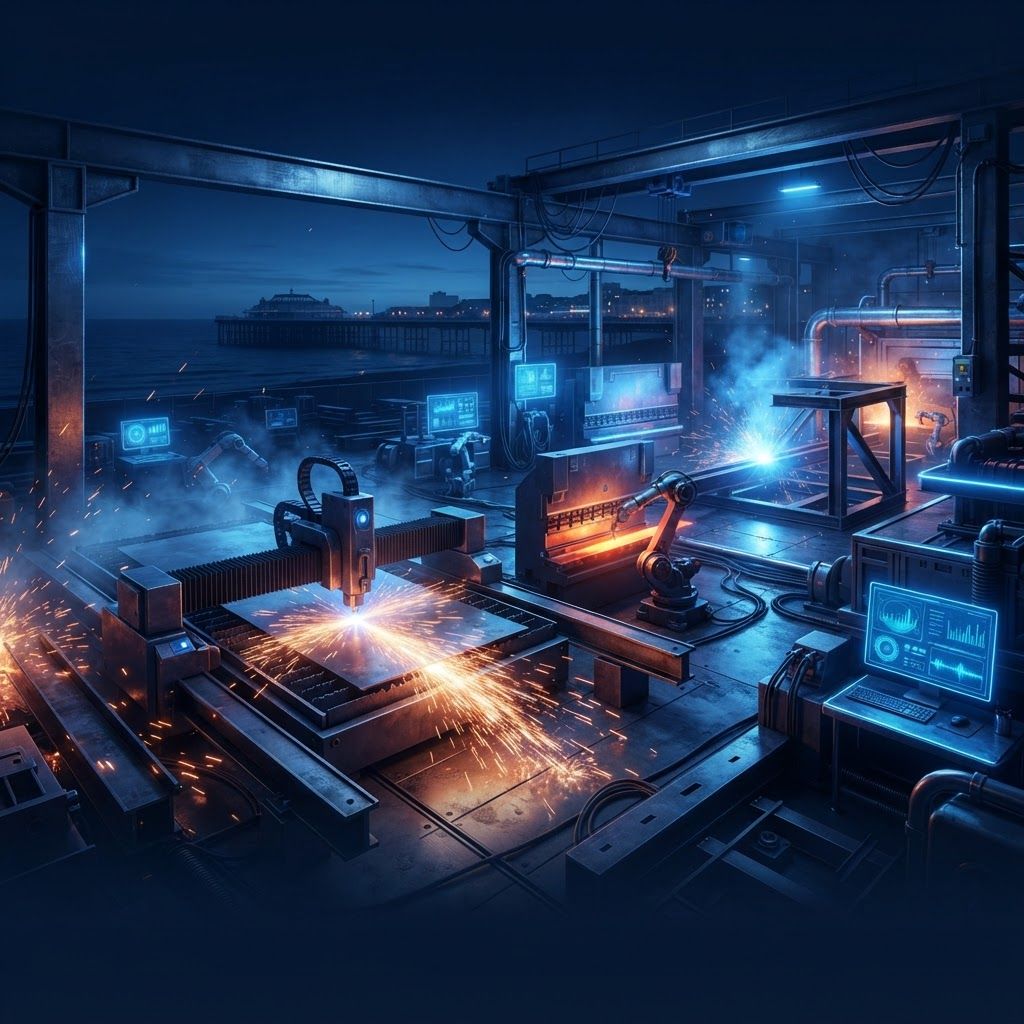
Metalworking in Southend-on-Sea: A Quiet Industrial Strength
Southend-on-Sea is best known for its seafront, its pier and its role as a commuter town on the Thames Estuary, but behind the leisure economy sits a genuinely capable engineering base. Metalworks businesses operate from industrial estates and light industrial units across the borough and the surrounding south Essex corridor, serving customers in construction, marine, transport, food processing, aviation and architectural design. Their work rarely attracts attention, yet it is present everywhere: in balustrades along coastal walkways, in the structural steel of new apartment blocks, in bespoke shopfronts on the High Street, and in the repaired components that keep local machinery running.
The sector spans a wide range of disciplines. Structural steel fabricators produce beams, columns, portal frames and connection plates for building projects. Sheet metal specialists cut, punch, bend and form panels for enclosures, ductwork, cladding and equipment housings. Precision machinists turn and mill components to tight tolerances for industrial clients. Welding and mobile repair firms handle on-site work where taking a component away is impractical. Architectural metalworkers create staircases, railings, gates, canopies and decorative features. Finishing specialists apply powder coating, galvanising, anodising and polishing.
What Local Metalworks Companies Typically Offer
Most established metalworks firms in the Southend area combine several capabilities under one roof, which reduces handling and shortens lead times. Common services include laser and plasma profile cutting, CNC press brake folding, MIG, TIG and spot welding, tube bending and rolling, CNC turning and milling, drilling and tapping, assembly, and surface finishing. Many also offer design assistance, converting a sketch, sample part or set of dimensions into manufacturable drawings.
Materials handled usually include mild steel, stainless steel in various grades, aluminium, brass and copper. Grade selection matters considerably in a coastal town. Salt-laden air accelerates corrosion, so marine-grade stainless steel, hot-dip galvanised finishes and marine-grade aluminium alloys are frequently specified for anything exposed to the estuary environment. A knowledgeable local fabricator will raise this early rather than simply quoting the cheapest material.
Industries Driving Demand Locally
Construction is the largest single driver. Residential development, extensions to Southend's older housing stock, commercial refurbishment and public sector building all generate steady demand for structural steelwork, lintels, beams, brackets and balustrading. Building regulations and structural engineer specifications mean much of this work must be produced to documented standards with traceable materials.
The marine and boating sector is a distinctive local factor. With the Thames Estuary, Leigh-on-Sea's fishing heritage and numerous private craft moored nearby, there is consistent work in stainless fittings, rails, cleats, brackets, davits, trailer repairs and custom fabrication for vessels. Nearby London Southend Airport supports aviation-related engineering, ground support equipment and tooling requirements.
Hospitality is another significant customer base. Southend's restaurants, cafes, bars and takeaways require stainless steel worktops, splashbacks, extraction canopies, ductwork, shelving and equipment stands. This work demands hygienic finishes, smooth welds and compliance with food safety expectations. Retail and signage projects add shopfront frames, brackets and mounting systems.
Trends Shaping the Metalworking Sector
Digital manufacturing has changed the economics of small-batch metalwork. Fibre laser cutting, CNC punching and offline-programmed press brakes mean a one-off bracket or a run of fifty panels can be produced accurately from a CAD file without expensive tooling. Customers increasingly submit designs as DXF or STEP files, and fabricators nest parts efficiently to reduce material waste.
Sustainability has become a practical commercial issue rather than a marketing point. Steel and aluminium are highly recyclable, and reputable firms segregate offcuts for recovery. Energy costs have pushed workshops toward efficient plant, LED lighting and better extraction systems. Some businesses now provide material origin information and recycled content details to help clients with their own environmental reporting.
Skills remain the sector's central challenge. Coded welding, precision machining and fabrication setting are demanding trades, and experienced practitioners are in short supply nationally. The better local employers have responded with apprenticeships and links to further education providers in south Essex, building capability internally rather than competing for a limited pool of ready-trained staff.
Quality, Standards and Certification
For structural work, the relevant framework is the CE or UKCA marking regime for fabricated structural steelwork, supported by factory production control and execution class requirements. Fabricators working on building projects should be able to explain their execution class capability and provide declarations of performance where required. Welding procedures and welder qualifications matter: coded welders working to recognised procedure specifications provide assurance that joints will perform as designed.
Quality management systems, material test certificates, dimensional inspection records and non-destructive testing arrangements are all reasonable things to ask about on anything safety critical. For decorative and general fabrication the requirements are lighter, but consistency of finish, accurate dimensions and clean weld preparation still separate good workshops from poor ones.
How to Choose a Metalworks Company
Start by matching capability to your actual requirement. A workshop geared toward heavy structural steel is not necessarily the best choice for thin-gauge stainless catering equipment, and a precision machining business may not want a large fabrication job. Ask directly what proportion of their work resembles yours and request examples.
Assess the drawing and design stage. A firm that reviews your concept, questions unclear dimensions and suggests improvements will usually deliver a better result than one that simply quotes and builds. Clarify tolerances in writing, particularly where parts must fit existing structures.
Discuss finishing before manufacture begins. Galvanising, powder coating and passivation each impose design considerations such as drainage holes, hanging points and masking. Retrofitting these decisions causes delay and cost.
Confirm logistics and installation. Fabricated steel is heavy and awkward, and coastal sites can have restricted access, tidal considerations and limited parking. A supplier that surveys the site, plans lifting and offers installation removes considerable risk.
Finally, look at communication and record keeping. Clear quotations that itemise material, fabrication, finishing and delivery, realistic lead times, documented change control and prompt responses to queries are strong indicators of a well-run business. In a trade where much of the value is invisible once installed, reliability and transparency are the qualities worth paying for.
Conclusion
Metalworking in Southend-on-Sea supports construction, marine activity, hospitality, retail and general engineering with a depth of capability that surprises many newcomers to the area. Whether the requirement is a coded structural connection, a run of stainless panels, a bespoke staircase or an urgent on-site repair, the local market offers specialists across the full range. Choosing well comes down to matching capability to the job, insisting on appropriate materials for the coastal environment, agreeing tolerances and finishes clearly, and working with firms that document what they do.
Want your brand featured in front of decision-makers? Publish a guest post or get a link insertion in our guides through AAMAX's guest post and link insertion service.
Helpful Links
 SponsoredAAMAX — Full-Service Digital Agency
Write for Us
Share your expertise with our readers. We welcome guest contributions from industry specialists.
Pitch your idea