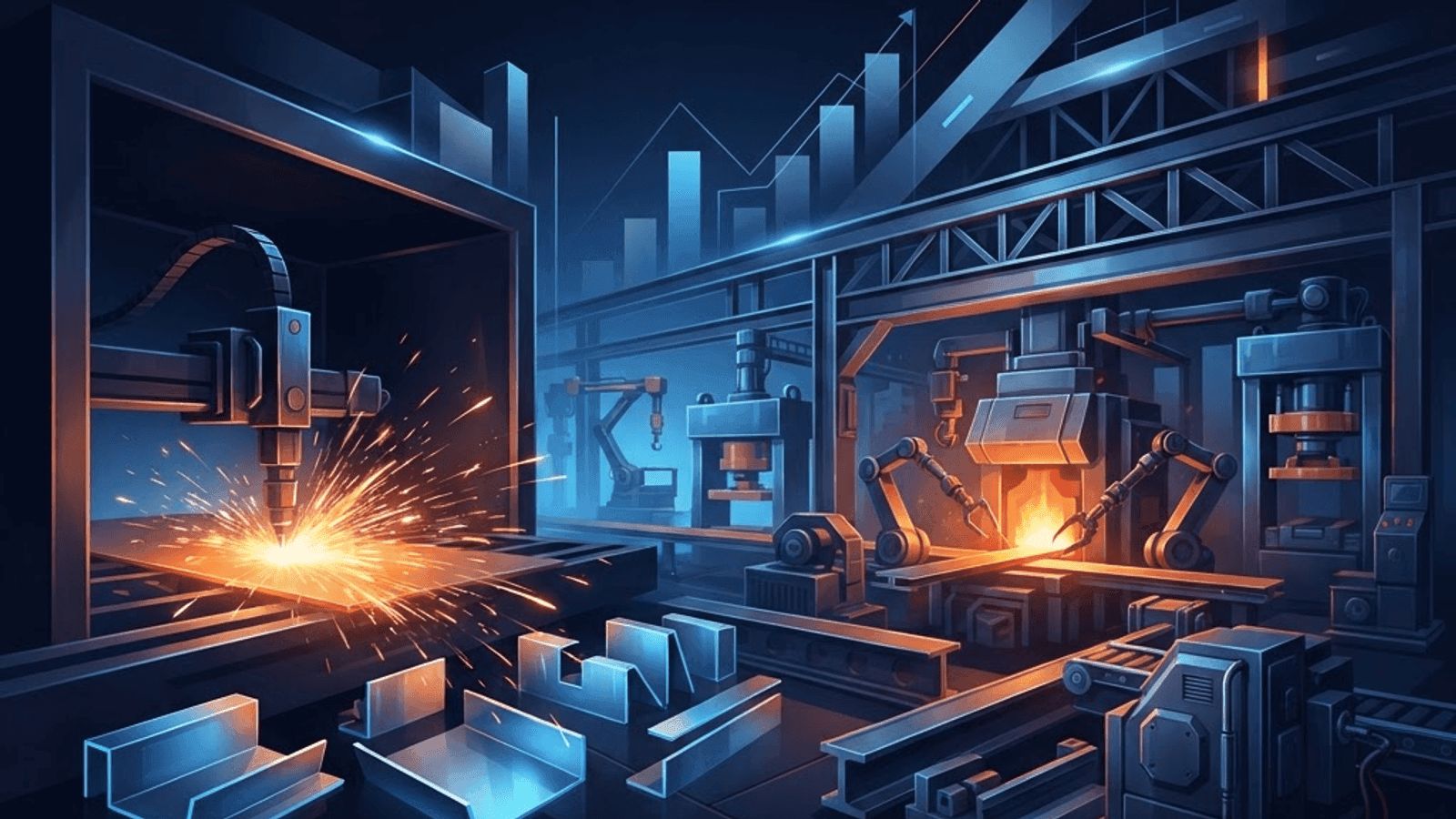
The Metal Heart of the Midlands
Few places in Britain have a stronger metalworking inheritance than the area around South Staffordshire. The neighbouring Black Country built its name on iron, chain, lock and tube manufacture, and that skills base never fully dispersed. Today it survives and thrives in a different form: precision CNC machining, laser cutting, structural steel fabrication, sheet metal work, surface finishing and architectural metalwork.
What makes the area distinctive is not any single company but the density of the supply chain. A fabricator can have plate laser cut in the morning, folded in the afternoon, welded the next day, powder coated locally and delivered within the week. Very few regions in Europe offer that level of vertical availability within a twenty mile radius.
The Core Metalworking Processes
Buyers benefit from understanding what each process does well. Laser cutting delivers fast, accurate profiles in sheet and plate with excellent edge quality. Waterjet handles thicker material and heat-sensitive alloys without a heat-affected zone. Press braking forms sheet into three-dimensional parts, with accuracy depending heavily on tooling and operator skill.
Welding divides into MIG for speed on thicker steel, TIG for precision and appearance particularly on stainless and aluminium, and spot welding for high-volume sheet assemblies. CNC machining covers turning and milling to tight tolerance, while surface finishing includes powder coating, galvanising, anodising, electroplating and passivation, each suited to different environments and aesthetics.
1. Hadley Group
Hadley Group is a leading cold roll formed steel manufacturer producing profiles and sections for construction, automotive and industrial applications. Its engineering approach to section design, optimising strength while minimising material, has made it influential well beyond the region. Consistency across very long production runs is its hallmark.
2. Barrett Steel
One of the largest independent steel stockholders in Britain, Barrett Steel supplies sections, plate, tube and bar with processing services including cutting, drilling and shot blasting. For Midlands fabricators, having a stockholder that can deliver pre-processed material dramatically reduces workshop time and waste.
3. William Hughes
Specialising in springs, wire forms and formed tube, William Hughes serves automotive, furniture and industrial customers. Its capability in complex wire bending and heat treatment gives designers considerable freedom, and its quality systems meet the demanding requirements of automotive supply.
4. Brandauer
Brandauer is a precision stamping and tooling specialist with a long Birmingham heritage, producing high-volume pressed components to extremely tight tolerance. Its in-house toolroom designs and maintains progression tools, giving it control over quality that outsourced tooling cannot match. Electrical, medical and automotive sectors are core markets.
5. Pressmark Pressings
Combining pressing, welding and assembly, Pressmark delivers finished metal sub-assemblies rather than loose components. That value-added approach removes assembly burden from customers and reduces the number of suppliers they must manage, which is increasingly attractive to lean manufacturers.
6. Cannock Sheet Metal Fabrication
General sheet metal fabricators form the workhorse layer of the regional metalworking economy, producing enclosures, guards, brackets, ducting and panels. Their combination of laser cutting, folding, welding and finishing under one roof suits machine builders and equipment manufacturers needing complete fabricated assemblies.
7. Staffordshire Structural Steel
Structural steelwork contractors design, fabricate and erect frames for industrial buildings, mezzanines and extensions. CE marking and execution class compliance are mandatory in this sector, and reputable firms maintain factory production control certification that gives clients and building control confidence.
8. Wolverhampton Precision Machining
Subcontract machinists operating multi-axis CNC mills and turning centres serve aerospace, automotive, hydraulics and general engineering customers. Their differentiators are tolerance capability, in-house metrology including coordinate measuring machines, and the ability to hold traceable material certification for regulated sectors.
9. Black Country Architectural Metalwork
Architectural metalworkers produce balustrades, staircases, gates, railings, canopies and decorative features in steel, stainless steel and bronze. Combining structural competence with finish quality, they serve architects and developers working on both contemporary buildings and heritage restoration across Staffordshire.
10. Midland Surface Finishing
Finishing houses providing powder coating, galvanising, electroplating and shot blasting complete the regional metalworking chain. Their environmental compliance and colour consistency directly determine the appearance and corrosion life of finished products, making them a critical though often overlooked link.
Technology Changing the Workshop
Fibre laser cutting has replaced CO2 systems in most modern shops, offering faster cutting on thin material and lower running cost. Automated bending cells with robotic part handling are appearing in higher-volume operations. Additive manufacturing in metal has moved from curiosity to production reality for complex, low-volume aerospace and medical components.
Software has changed just as much. Nesting software minimises material waste across a cutting sheet, quoting systems generate accurate prices from CAD models in minutes, and workshop scheduling systems track jobs through every process. Customers increasingly expect digital order tracking as standard.
Briefing a Metalworks Supplier Well
Supply proper drawings. A dimensioned drawing with tolerances, material specification, finish requirement and weld symbols will get an accurate price and a correct part. A sketch on a scrap of paper will get a cautious price and a part that may not fit. Where possible supply a 3D model alongside the drawing.
Be realistic about tolerances. Specifying a tenth of a millimetre on a bracket that bolts to a slotted hole adds cost without benefit, and experienced fabricators will quietly add contingency to cover an unnecessarily tight specification. Discuss quantity and repeat likelihood, as a supplier will invest in fixtures for repeat work.
Finally, visit the workshop. A tidy shop with organised material racking, calibrated equipment and visible quality documentation almost always produces better parts than a chaotic one, and twenty minutes on the floor tells you more than any quotation comparison.
Want your brand featured in front of decision-makers? Publish a guest post or get a link insertion in our guides through AAMAX's guest post and link insertion service.
Helpful Links
 SponsoredAAMAX — Full-Service Digital Agency
Write for Us
Share your expertise with our readers. We welcome guest contributions from industry specialists.
Pitch your idea