

Metalwork Is Peterborough's Industrial Backbone
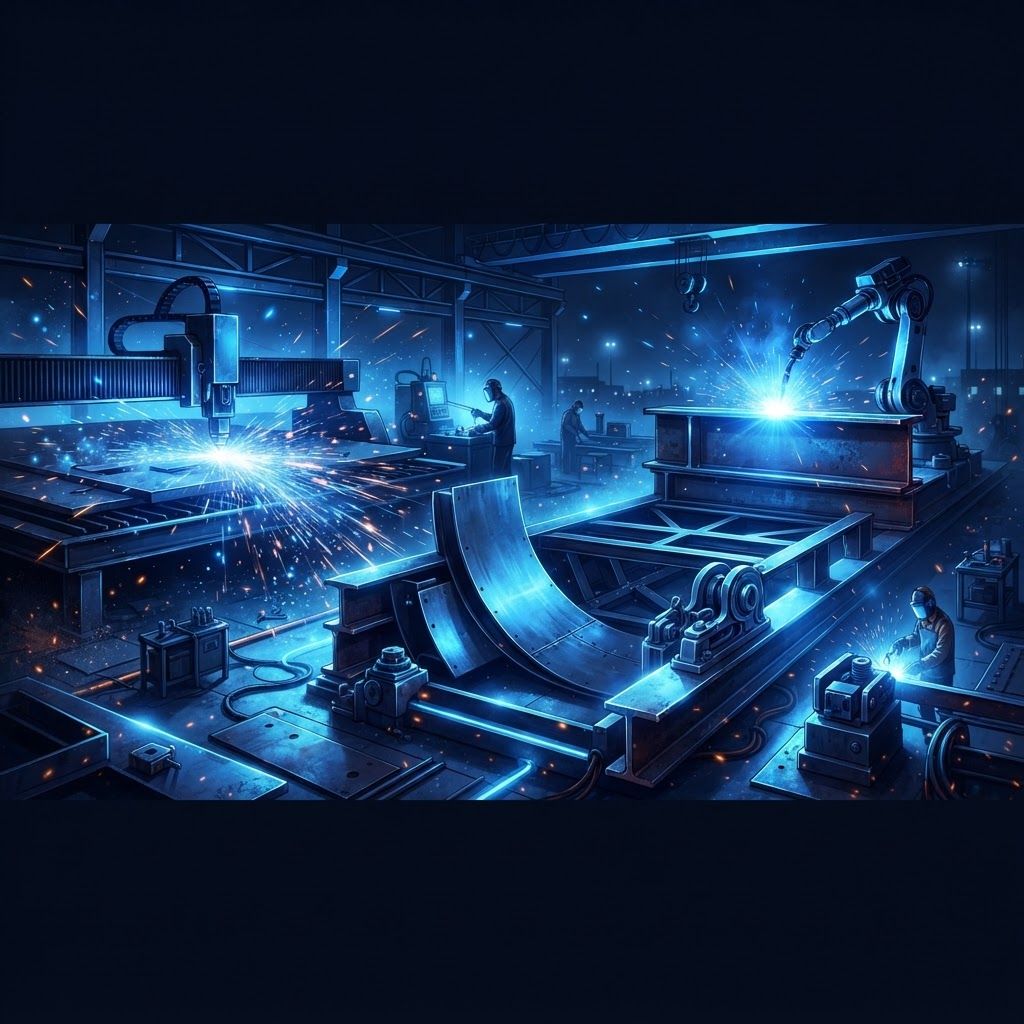
If machinery is Peterborough's most famous industry, metalwork is its foundation. Every engine, conveyor, agricultural implement and factory building in the region depends on someone cutting, forming, welding and finishing metal accurately. The city's metalworks sector is unusually broad, ranging from heavy structural steelwork fabricators to precision toolrooms measuring in microns.
This breadth is a direct legacy of the city's engineering history. Large manufacturers trained thousands of welders, fitters, sheet metal workers and machinists. Many of those people established their own businesses, and today's metalworks landscape reflects that entrepreneurial spread across Fengate, Woodston, Orton Southgate and the surrounding market towns.
Understanding Metalworks Capabilities
Metalworking is not a single trade, and choosing the wrong type of supplier wastes time for everyone. Structural steel fabrication concerns beams, columns, portal frames and heavy plate, governed by execution class requirements and factory production control. Precision sheet metal covers laser cutting, punching, press braking and welding of thinner gauge material into enclosures, panels and brackets. CNC machining removes material from solid billet or castings to achieve tight tolerances and fine surface finishes.
Beyond these, specialisms include tube manipulation and bending, spinning and press forming, waterjet and plasma profiling, stainless fabrication for hygienic environments, and architectural metalwork requiring visual perfection. Finishing is a discipline of its own: galvanising, powder coating, anodising, electroplating, passivation and wet spray each suit different service conditions.
The Ten Metalworks Companies and Specialisms Leading in Peterborough
1. Structural steel fabricators. Serving Peterborough's continuous construction pipeline, structural fabricators produce and erect frames for warehouses, industrial units, mezzanines and commercial buildings. Look for appropriate factory production control certification, welder qualifications and in-house detailing using 3D modelling, which dramatically reduces on-site clashes.
2. Precision sheet metal fabricators. Equipped with fibre laser cutters, CNC punch presses and automated press brakes, these companies produce enclosures, chassis, guarding, brackets and panels. Their advantage is repeatability and speed, particularly when supported by in-house powder coating and assembly.
3. CNC machining specialists. Multi-axis milling and CNC turning businesses serve off-highway, aerospace, motorsport, medical and instrumentation customers. The strongest operate lights-out production, use coordinate measuring machines for inspection and provide full dimensional reporting with every batch.
4. Welding and site engineering companies. Mobile welding and maintenance engineering firms repair plant, modify machinery and undertake structural alterations on site. Coded welders and appropriate procedure qualifications are essential in this category, especially for pressure equipment or load-bearing repairs.
5. Stainless steel and hygienic fabricators. The regional food and pharmaceutical sectors sustain fabricators specialising in stainless tanks, hoppers, pipework, tables, guarding and platforms. Crevice-free welding, controlled surface finishes and correct passivation distinguish genuine hygienic fabrication from ordinary stainless work.
6. Architectural metalwork studios. Producing balustrades, staircases, gates, railings, canopies, screens and shopfront elements, architectural metalworkers combine structural competence with visual craftsmanship. Their work is inspected at arm's length by end users, so weld dressing and finish consistency matter enormously.
7. Toolmakers, press tool and jig manufacturers. These businesses build the tooling that other manufacturers rely on, including press tools, fixtures, gauges and welding jigs. Their contribution is invisible in the final product yet decisive for quality and cycle time.
8. Metal finishing and coating companies. Powder coaters, galvanisers, anodisers and platers protect and decorate fabricated components. Local availability of finishing is a real competitive advantage for Peterborough fabricators because it removes days of transport from the production schedule.
9. Metal stockholders and profiling services. Stockholders supply sheet, plate, bar, tube and sections, frequently with cutting, sawing and profiling services. For smaller workshops, buying pre-cut material reduces waste and handling significantly.
10. Metal recycling and processing companies. Scrap processors and recyclers close the loop, recovering ferrous and non-ferrous material for remelting. As embodied carbon becomes a specification issue, documented recycled content and local recovery routes are increasingly valuable to fabricators.
Technology and Skills Trends
Automation is the defining change. Fibre laser cutting has replaced older CO2 systems with faster, more energy-efficient processing. Robotic welding cells handle repetitive fabrication with consistent penetration and minimal distortion. Offline programming and nesting software squeeze more parts from every sheet, reducing both cost and waste.
Skills remain the sector's binding constraint. Experienced coded welders, toolmakers and CNC setters are in high demand, and the most successful Peterborough metalworks companies are those investing seriously in apprenticeships. Buyers should view a visible apprentice programme as a positive indicator of long-term stability, not merely good corporate citizenship.
How to Select a Metalworks Partner
Provide complete information: 3D models where possible, tolerances that reflect genuine function rather than blanket precision, material specifications, finish requirements and quantities. Over-specifying tolerances is one of the most common and expensive mistakes in metal purchasing.
Visit the workshop. Cleanliness, organisation, calibration records and the condition of machinery tell you more in twenty minutes than any brochure. Ask how they handle non-conformance, because every fabricator occasionally makes mistakes and the good ones have a clear, documented process for identifying and correcting them.
Peterborough's metalworks sector offers a rare combination of heavy capability, precision capacity and local finishing. For manufacturers and construction clients alike, that proximity translates directly into shorter lead times, easier problem solving and better control over quality.
Want your brand featured in front of decision-makers? Publish a guest post or get a link insertion in our guides through AAMAX's guest post and link insertion service.
Helpful Links
 SponsoredAAMAX — Full-Service Digital Agency
Write for Us
Share your expertise with our readers. We welcome guest contributions from industry specialists.
Pitch your idea

