

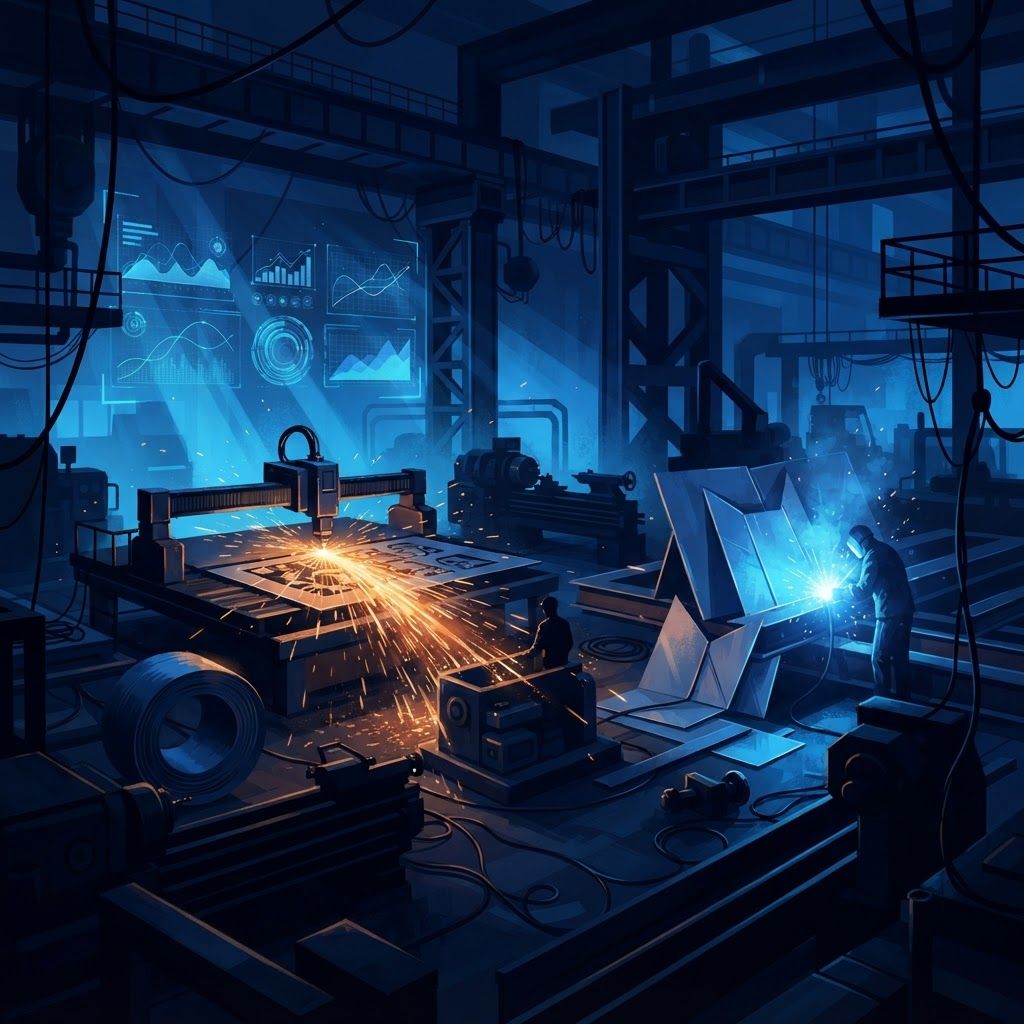
Metalworking in Ipswich: A Living Industrial Tradition
Metalworking has been part of Ipswich's economic identity for generations. The engineering works that once built agricultural machinery, cranes and industrial equipment established a deep pool of skills in fabrication, welding, machining and finishing. While the ownership and scale of the industry have changed dramatically, that underlying capability persists and continues to serve customers across construction, agriculture, marine, food processing and general manufacturing.
The modern sector looks quite different from its predecessors. Laser cutting has replaced much of the manual profiling work, press brakes are computer-controlled, robotic welding cells handle repeat production, and design happens in three dimensions before any metal is cut. But the fundamental value proposition remains unchanged: taking raw steel, aluminium or stainless sheet and turning it into something precisely shaped, structurally sound and fit for a specific purpose.
Ten Leading Metalworks Companies in Ipswich
1. Orwell Sheet Metal Fabrication is the most comprehensively equipped fabricator in the area, combining fibre laser cutting, CNC punching, press braking, welding and powder coating under one roof. Single-site capability from flat sheet to finished painted assembly removes the delays and quality risks of moving parts between subcontractors. The company handles mild steel, stainless and aluminium, and supports customers from prototype through to production runs.
2. Suffolk Structural Steel designs, fabricates and erects structural steelwork for commercial buildings, agricultural structures, mezzanine floors and industrial plant. Structural work carries significant regulatory weight, and the company operates under the execution class requirements of the relevant European standards with full welder qualification and factory production control. In-house detailing software produces the fabrication drawings that keep site erection straightforward.
3. Gipping Precision Machining focuses on CNC turning and milling to tight tolerances. Multi-axis machining centres allow complex components to be produced in fewer setups, improving both accuracy and lead time. The company serves instrumentation, hydraulics, marine and defence customers, and maintains a temperature-controlled inspection room with coordinate measuring capability for verification.
4. Deben Stainless Fabrication specialises in stainless steel work for food, beverage, pharmaceutical and laboratory environments. Hygienic fabrication has its own demanding rules around weld penetration, crevice elimination, surface finish and passivation, and the company's documentation and material certification satisfy the audit requirements that food manufacturers face routinely.
5. Anglia Architectural Metalwork produces balustrades, staircases, gates, railings, canopies and decorative metal features. This work sits between engineering and craft, requiring both structural competence and a good eye. The company works from architects' drawings and also develops designs directly with private clients, covering everything from contemporary glass-and-steel installations to traditional wrought ironwork for period properties.
6. Stour Valley Welding Services offers mobile and workshop welding across a range of processes and materials, including specialist work in aluminium and exotic alloys. Coded welders, documented procedures and non-destructive testing support work on pressure-retaining and safety-critical components. On-site repair capability keeps agricultural and industrial operators running when equipment fails mid-season.
7. Ransomes Metal Finishing provides powder coating, wet spraying, shot blasting, galvanising preparation and electroplating. Finishing determines how long a metal product survives in service, particularly in the salt-laden coastal air of East Anglia, and the company's surface preparation discipline is what separates a coating that lasts twenty years from one that fails in three.
8. Felixstowe Road Heavy Fabrication handles large-scale fabrication including tanks, pressure vessels, frames, skids and port-related equipment. Overhead crane capacity and generous floor space allow the company to take on work that smaller shops physically cannot accommodate, and proximity to the port supports both the handling equipment sector and marine customers.
9. Ipswich Tube and Profile Bending specialises in bending, rolling and forming tube, box section and plate. Roll-bending curved steel accurately without kinking or flattening requires both the right equipment and considerable operator judgement, and the company supplies curved components to fabricators, shopfitters and architectural metalworkers across the region.
10. Waveney Toolmaking and Jig Manufacture produces press tools, jigs, fixtures and gauges. Toolmaking is the discipline that underpins repeatable manufacturing, and good fixture design frequently delivers greater productivity improvement than new machinery would. The company works closely with customers' production engineers to eliminate setup time and reduce variability.
Technology and Trends in Metalworking
Fibre laser cutting has transformed the economics of the sector, cutting faster, using less energy and handling reflective materials that older carbon dioxide lasers struggled with. Combined with nesting software that maximises sheet utilisation, it has reduced both cost and material waste substantially.
Automation is spreading beyond cutting into bending and welding. Robotic welding cells now make economic sense at much lower volumes than a decade ago, and automated press brake tool changing has reduced setup times dramatically. This matters particularly given the persistent shortage of experienced welders and setters across UK industry.
Digital integration is the third shift. Customers increasingly supply three-dimensional models rather than two-dimensional drawings, allowing direct programming and reducing interpretation errors. Some fabricators now offer instant online quoting from uploaded models, compressing a process that once took days into minutes.
Sustainability has arrived here too. Steel is already among the most recycled materials in the world, and fabricators are focusing on reducing offcut waste, switching to lower-energy processes and offering powder coating in place of solvent-based wet paint.
How to Choose a Metalworks Partner
Start by matching capability to requirement. A precision machining shop and a heavy structural fabricator are entirely different businesses, and asking either to do the other's work produces poor results. Verify welding qualifications and procedures for any structural or pressure application. Look at finishing capability, because a beautifully fabricated part with inadequate surface preparation will fail prematurely. Ask about design input, since experienced fabricators routinely identify small geometry changes that cut cost significantly. Visit the workshop if possible; the organisation of a fabrication shop floor tells you a great deal about the quality you can expect.
Conclusion
Metalworks companies in Ipswich combine genuine heritage skill with modern equipment and digital workflows. For buyers across construction, food production, agriculture and marine sectors, the town offers a depth of fabrication and machining capability that is unusual for a settlement of its size, and one that continues to reward local sourcing.
Want your brand featured in front of decision-makers? Publish a guest post or get a link insertion in our guides through AAMAX's guest post and link insertion service.
Helpful Links
 SponsoredAAMAX — Full-Service Digital Agency
Write for Us
Share your expertise with our readers. We welcome guest contributions from industry specialists.
Pitch your idea

