

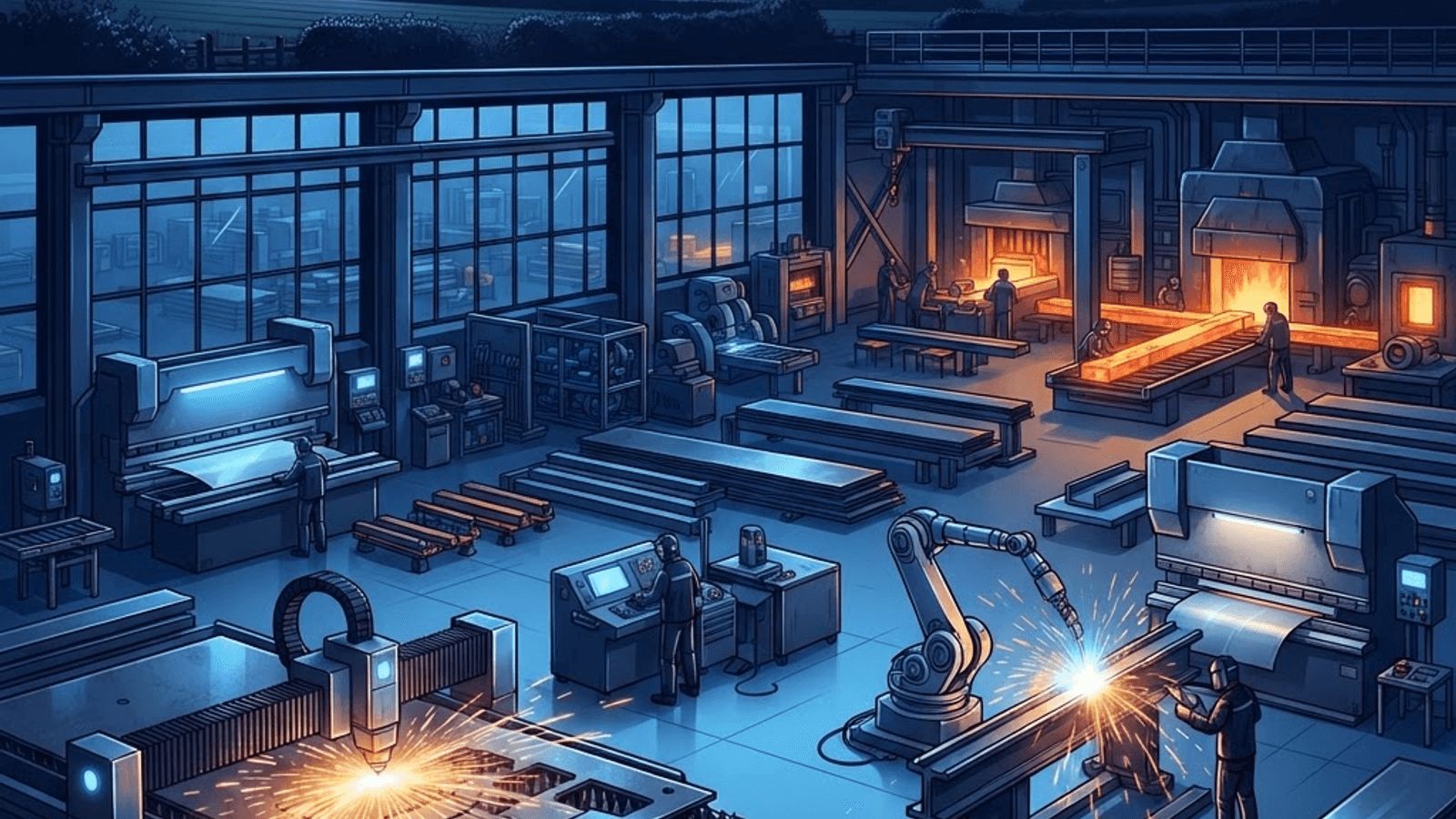
Metalworking: Herefordshire's Industrial Backbone
If Herefordshire has an industrial signature, it is metal. The county's manufacturing base is dominated by companies that cut, form, weld, machine and finish steel, aluminium, stainless and specialist alloys. Some serve aerospace and defence to exacting standards. Others build the trailers, gates, handling equipment and structural frames that keep a rural economy moving. Between them they employ a significant share of the county's skilled workforce and support supply chains far beyond the Marches.
This strength has deep roots. The presence of a major nickel alloy producer in Hereford created decades of local expertise in difficult-to-machine materials, heat treatment and metallurgical quality control. Defence and aerospace work in the wider region reinforced a culture of documentation, traceability and process discipline. Meanwhile agriculture demanded robust, repairable fabrication delivered fast. That combination of precision and practicality is exactly what Herefordshire metalworkers offer today.
The Top 10 Metalworks Companies in Herefordshire
1. Special Metals Wiggin, Hereford
The county's landmark metals business, producing high-performance nickel-based superalloys in bar, plate, sheet, wire and welding product form. Its melting, forging, rolling and finishing operations serve aerospace, energy, oil and gas and chemical processing worldwide. The site's metallurgical laboratories and quality approvals set the technical tone for engineering across Herefordshire.
2. Rotherwas Precision Engineering, Hereford
A subcontract machining specialist offering CNC turning, three, four and five-axis milling, and full inspection with CMM verification. It works in aluminium, stainless, titanium and exotic alloys for aerospace, defence and medical customers, supported by quality management and traceability systems appropriate to regulated sectors.
3. Marches Structural Steel, Leominster
This fabricator produces structural frames, portal buildings, mezzanines, staircases and balustrades. Capability includes beam line processing, plate profiling, welding to recognised execution classes and shot blasting with intumescent or protective coating. Agricultural buildings, industrial units and commercial developments across the Marches use its steelwork.
4. Wye Valley Laser and Sheet Metal, Ross-on-Wye
Fibre laser cutting, CNC punching, press braking and welding are the core services, producing enclosures, brackets, panels, guarding and decorative screens. Fast quotation from customer CAD files and short lead times on prototypes make it a first call for product designers and machine builders.
5. Hereford Welding and Fabrication
A general fabrication business with coded welders working in MIG, TIG and MMA processes across carbon steel, stainless and aluminium. Output ranges from pressure-retaining components and pipework to bespoke frames and repairs. On-site welding teams support breakdown work at food factories, quarries and farms.
6. Bromyard Agricultural Metalworks
Purpose-built for farming customers, this workshop manufactures gates, cattle handling systems, feed barriers, trailer bodies and bespoke implement attachments. Galvanising is arranged as standard for long outdoor service life, and the team's field repair capability limits downtime during silage and harvest.
7. Golden Valley Architectural Metalwork
Specialising in visible metal, this business produces staircases, balustrades, railings, canopies, gates and sculptural features in mild steel, stainless, brass and Corten. Architects value its detailing and finish quality, and the company works comfortably with conservation requirements on listed properties.
8. Ledbury Toolmaking and Jigs
Toolmaking is the discipline behind repeatable manufacturing, and this business builds press tools, moulds, fixtures, jigs and gauges. Reverse engineering of obsolete tooling is a notable service, allowing manufacturers to keep legacy products in production when original toolmakers no longer exist.
9. Severnside Metal Finishing, Herefordshire
Providing shot blasting, powder coating, wet spraying and passivation, this finisher completes the value chain for local fabricators. Colour matching, pre-treatment control and coating thickness verification are handled in-house, and the company advises on specification for coastal, agricultural and chemical exposure environments.
10. Kington Stainless Fabrications
Focused on hygienic stainless steel work for food, drink and pharmaceutical clients, this fabricator produces tanks, tables, hoppers, ductwork and orbital-welded pipework. Weld finish standards, crevice-free design and documented material certification are central to its offer, reflecting the demands of food safety audits.
Certification, Materials and Quality
Metalwork is a sector where paperwork genuinely matters. For structural steel, CE or UKCA marking under the relevant execution class is a legal requirement, and factory production control must be certified. Welding procedures and welder qualifications should be documented to recognised standards. For aerospace, defence and medical work, expect quality management certification with full material traceability from mill certificate to finished part.
Material selection deserves careful thought. Carbon steel is economical and easily welded but requires protective coating. Stainless grades differ markedly in corrosion resistance and machinability, and specifying the wrong grade in a chlorinated or agricultural environment leads to premature pitting. Aluminium reduces weight but has different fatigue behaviour and needs appropriate joint design. Herefordshire's better metalworkers will challenge a questionable material choice before quoting, which is a good sign rather than an inconvenience.
How to Specify Fabrication Work
Supply drawings with tolerances that reflect function. Blanket tight tolerances on every dimension inflate cost without improving performance, whereas identifying the two or three critical features focuses effort where it matters. Indicate weld types, sizes and finish requirements explicitly, particularly where welds are visible or must be ground flush. Specify surface finish and coating system, including any pre-treatment, dry film thickness and colour reference.
Discuss logistics early. Large fabrications may need splitting for transport, and lifting points, centre of gravity and site access should be designed in rather than improvised. Agree inspection and acceptance criteria, including whether non-destructive testing is required. Where volumes will repeat, invest in proper jigs and fixtures; the cost is recovered quickly through reduced rework. Finally, treat lead time honestly, since steel and coating capacity fluctuate and a supplier who quotes an impossible date rarely delivers one.
Final Thoughts
From superalloy production and five-axis precision machining to cattle handling systems and architectural staircases, Herefordshire's metalworks companies span an extraordinary range. The county offers technical rigour where it is needed and practical speed where that matters more, backed by a skilled workforce and a culture of doing the job properly.
Want your brand featured in front of decision-makers? Publish a guest post or get a link insertion in our guides through AAMAX's guest post and link insertion service.
Helpful Links
 SponsoredAAMAX — Full-Service Digital Agency
Write for Us
Share your expertise with our readers. We welcome guest contributions from industry specialists.
Pitch your idea

