

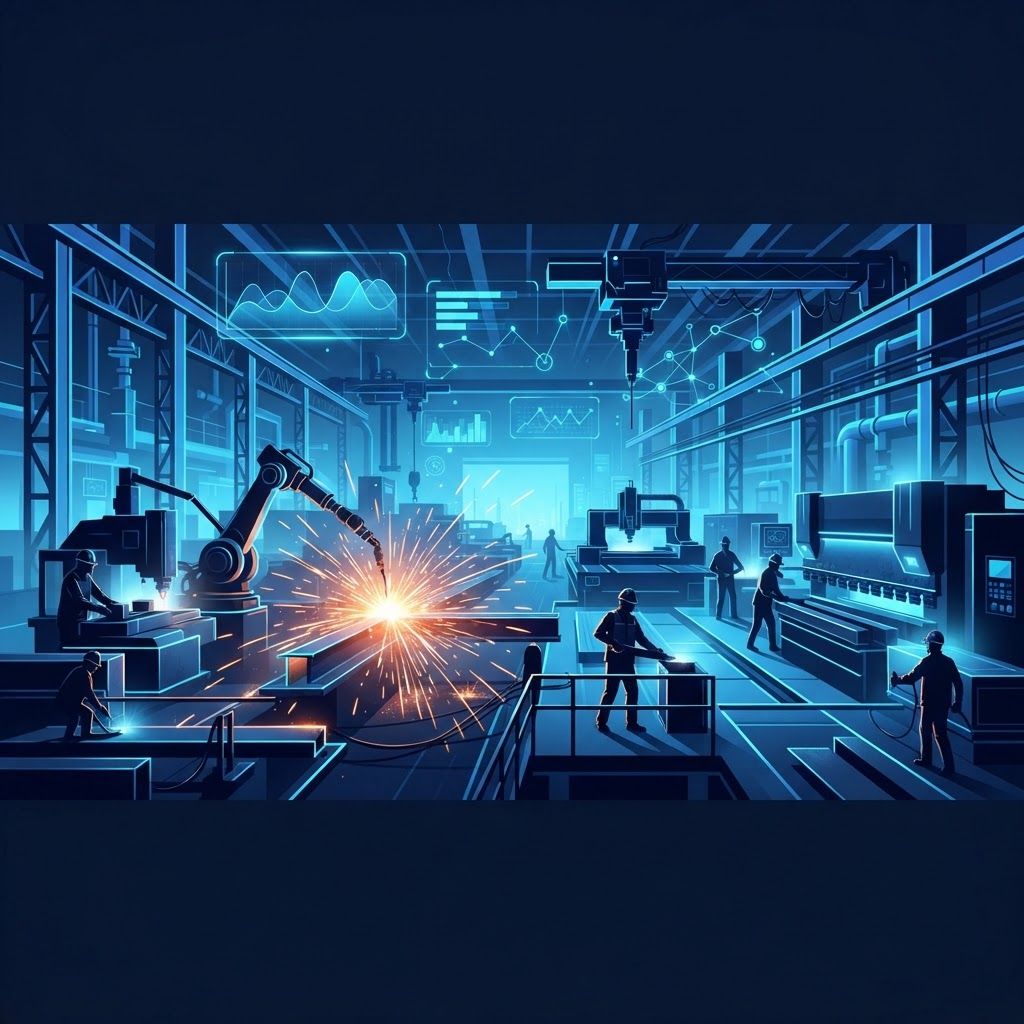
Why Gloucester Remains a Metalworking Stronghold
Gloucester has been shaping metal for well over two centuries. The city's position at the head of the Gloucester and Sharpness Canal, combined with its Victorian railway carriage and wagon works, established a deep pool of engineering talent that never fully dispersed. Today that legacy survives in a dense cluster of fabricators, machinists, foundries and finishing specialists spread across the Quedgeley, Hempsted, Barnwood and Eastern Avenue industrial estates.
What makes the local sector distinctive is its breadth. Within a fifteen-minute drive of the docks you can find laser cutting, press braking, tube manipulation, structural steelwork, powder coating, precision CNC turning and specialist aerospace subcontract machining. That density means Gloucester businesses rarely need to look outside the county for a supply chain partner, and it keeps lead times competitive against larger Midlands centres.
What to Look For in a Metalworks Partner
Choosing a fabricator is rarely just about price per part. The best Gloucester metalworks companies are judged on a combination of accreditation, capability envelope, design support and communication. Look for firms holding ISO 9001 as a baseline, with CE marking under BS EN 1090 for structural steel and AS9100 where aerospace work is involved. Coded welders certified to BS EN ISO 9606 matter enormously for pressure and load-bearing applications.
Equally important is early design involvement. A fabricator that reviews your drawings before quoting will frequently identify a bend sequence, material substitution or tolerance relaxation that cuts cost without compromising function. This design-for-manufacture input is where experienced Gloucester firms consistently add value beyond the machine hour rate.
Leading Metalworks Companies Serving Gloucester
Gloucester Fabrications has built a reputation for heavy structural steelwork and bespoke architectural metalwork. The firm handles staircases, balustrades, mezzanine floors and industrial platforms, with in-house detailing that shortens the gap between concept and site delivery.
Severnside Engineering focuses on precision CNC machining for hydraulic, automotive and defence customers. Multi-axis turning centres and a well-equipped inspection room allow the company to hold tight tolerances on small and medium batch runs.
Quedgeley Sheet Metal specialises in laser cutting, punching and folding of mild steel, stainless and aluminium. Fast turnaround on prototype panels and enclosures has made it a favourite with local electronics and equipment manufacturers.
Cotswold Welding Services provides mobile and workshop-based coded welding across MIG, TIG and arc processes. The company is frequently called into breakdown situations at food processing plants and quarries where downtime costs are severe.
Docks Metal Craft serves the architectural and heritage market, producing ornamental ironwork, gates, railings and restoration components that sit comfortably alongside Gloucester's listed buildings and conservation-area properties.
Vale Precision Components operates sliding-head and fixed-head lathes for high-volume small turned parts, supplying fastener, connector and instrumentation customers with consistent repeatability.
Hempsted Steel Supplies combines stockholding with a processing service, offering cut-to-length, saw cutting and profiling so customers can buy material already prepared for assembly.
Westgate Fabrication works extensively in stainless steel for the food, brewing and pharmaceutical sectors, where hygienic weld finishes and passivation are non-negotiable requirements.
Barnwood Toolmaking designs and manufactures jigs, fixtures, press tools and moulds, supporting manufacturers who need repeatable production aids rather than one-off components.
Severn Powder Coating and Finishing completes the local ecosystem with shot blasting, galvanising coordination, powder coating and wet spray, allowing fabricated assemblies to leave the county fully finished.
Technology Trends Reshaping Local Fabrication
Fibre laser cutting has largely displaced older CO2 systems across Gloucester workshops, delivering faster cut speeds on thin gauge material and far lower running costs. Alongside this, offline programming and nesting software has reduced material waste, which matters more than ever with volatile steel pricing.
Robotic welding cells are appearing in the larger local operations, particularly for repeat batch work where consistency and cycle time outweigh the flexibility of a manual welder. Meanwhile additive manufacturing is finding a niche in tooling and fixture production rather than end-use parts, letting toolrooms produce complex locating features quickly.
Digital quoting portals and online drawing upload have also changed buyer expectations. Companies that respond within twenty-four hours with a firm price and lead time win a disproportionate share of enquiries, especially from smaller customers placing repeat orders.
Sustainability and Material Sourcing
Steel is one of the most recycled materials in the world, and Gloucester fabricators are increasingly asked to demonstrate that credential. Buyers in construction and public sector projects now request environmental product declarations and evidence of responsible sourcing under BES 6001. Several local firms have invested in energy monitoring, LED workshop lighting, solar arrays on unit roofs and heat recovery from compressors.
Scrap segregation is another quiet win. Separating stainless, aluminium and mild steel offcuts at source raises recycling value and reduces waste collection costs, and progressive fabricators pass part of that saving back through competitive pricing.
Skills, Apprenticeships and the Local Talent Pipeline
The most persistent challenge facing Gloucester metalworks companies is skills. Experienced coded welders and CNC setter-operators are in short supply nationally, and the city is no exception. In response, many firms partner with Gloucestershire College and local training providers to run engineering apprenticeships, taking on school leavers and developing them through welding, fabrication and machining pathways.
Buyers should view apprenticeship investment as a positive signal. A company training its own workforce is planning for long-term capacity rather than chasing short-term contracts, and that stability translates into more reliable delivery performance for customers.
How to Approach Your First Enquiry
Give fabricators the information they need to quote accurately. Supply dimensioned drawings or STEP files, specify material grade and finish, state quantities and any batch call-off schedule, and flag critical tolerances explicitly. Ambiguity forces suppliers to price in risk, which inflates your cost.
It is also worth visiting the workshop. A well-organised shop floor with calibrated equipment, clear material traceability and tidy storage tells you more about likely quality outcomes than any brochure. Gloucester firms are generally happy to host prospective customers, and an hour on site often clarifies which supplier genuinely fits your requirement.
Final Thoughts
Gloucester's metalworking community is compact, capable and genuinely varied. Whether you need a single architectural balustrade, a run of precision turned components or a full structural steel package, there is a local firm equipped to handle it. Prioritise accreditation, design input and communication over headline price, and the city's fabricators will reward you with the kind of long-term partnership that keeps projects moving.
Want your brand featured in front of decision-makers? Publish a guest post or get a link insertion in our guides through AAMAX's guest post and link insertion service.
Helpful Links
 SponsoredAAMAX — Full-Service Digital Agency
Write for Us
Share your expertise with our readers. We welcome guest contributions from industry specialists.
Pitch your idea

