Metalworking: Gedling's Engineering Backbone
If you were to trace the industrial history of Gedling, metalworking would run through every chapter. Colliery machinery, railway infrastructure, textile equipment and general engineering all demanded skilled fabricators, welders and machinists, and while the industries those workshops originally served have largely gone, the capability they created has endured and evolved.
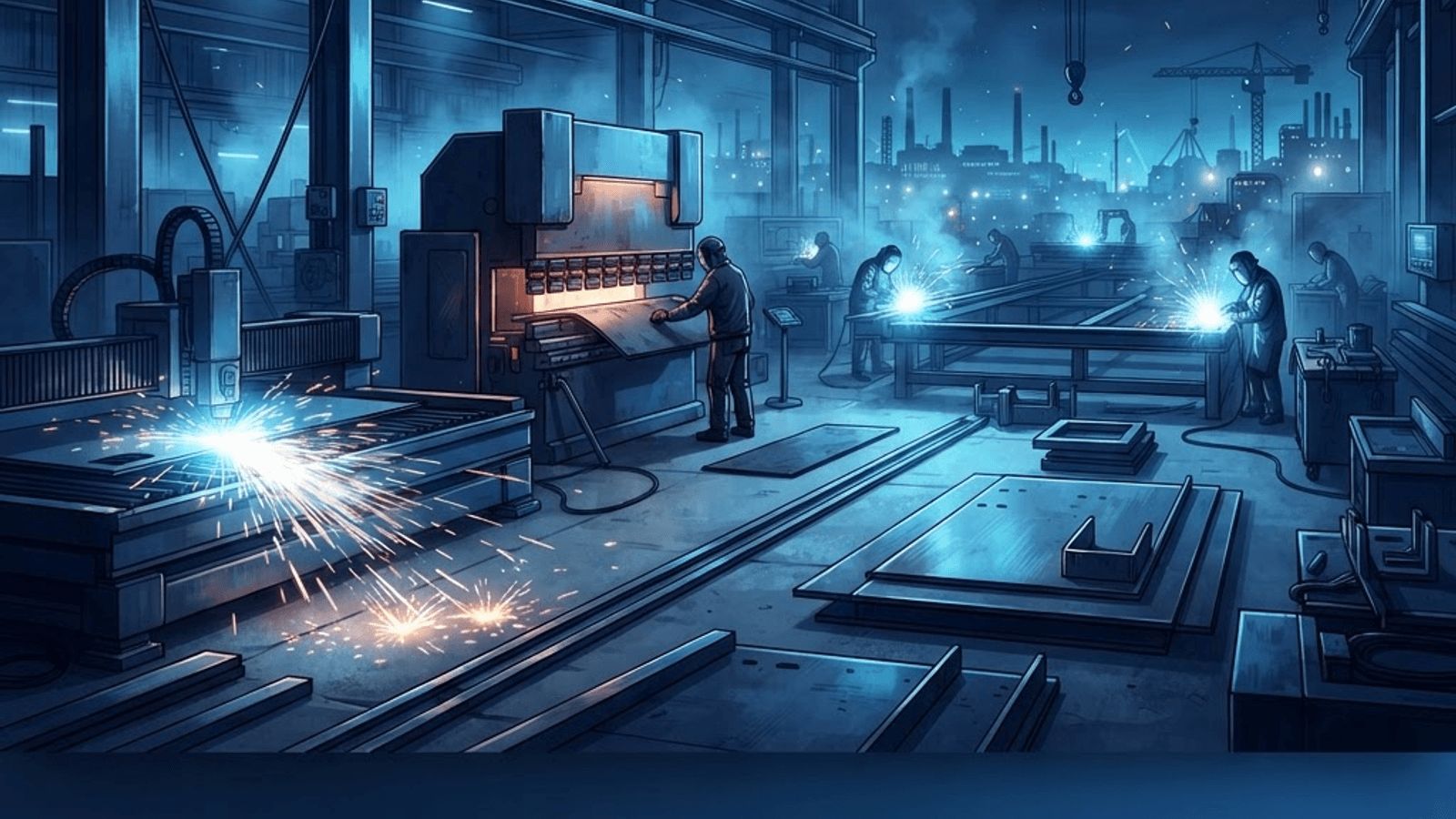
Modern metalworks companies in the borough operate fibre laser cutters, CNC press brakes, robotic welders and multi-axis machining centres alongside the traditional skills of hand fitting and coded welding. They serve construction, agriculture, rail, food processing, architecture, renewable energy and general manufacturing, and they range from two-person workshops to organised facilities employing dozens.
Processes and Capabilities
Profiling covers laser, plasma and waterjet cutting of sheet and plate, and is usually the starting point for fabricated products. Fibre laser cutting has largely displaced older technologies for thinner materials due to its speed, accuracy and edge quality.
Forming includes press brake bending, rolling and swaging, converting flat profiles into three-dimensional shapes. Welding covers MIG, TIG and spot processes, with coded welding to recognised standards required for structural and pressure applications. Machining encompasses turning, milling and grinding to close tolerances. Finishing includes linishing, polishing, shot blasting, galvanising, powder coating and wet painting.
Many local firms combine several of these, offering a single point of responsibility from raw plate to finished, coated assembly. That integration is genuinely valuable because it removes the handover risks that arise when a job passes between multiple sub-contractors.
The Top 10 Metalworks Companies Serving Gedling
1. Gedling Sheet Metal Works
Combines fibre laser cutting, CNC folding and welding to produce enclosures, panels, brackets and fabricated assemblies, with quick turnaround on prototype and production quantities alike.
2. Colwick Structural Steel
Fabricates structural steelwork including beams, columns, portal frames and staircases, working to construction execution standards with factory production control certification.
3. Netherfield Precision Machining
A CNC machining shop producing turned and milled components to tight tolerances, serving hydraulics, automotive and instrumentation customers with full inspection reporting.
4. Arnold Stainless Fabrication
Specialists in stainless steel for food, pharmaceutical and laboratory environments, producing hygienic tables, tanks, guarding and pipework with high-quality weld finishing.
5. Carlton Architectural Metalwork
Produces balustrades, staircases, gates, railings, canopies and feature screens, working with architects and homeowners on both contemporary and traditional designs.
6. Mapperley Welding Services
Provides coded welding, on-site repair and mobile fabrication, frequently called for breakdown work where equipment cannot be moved to a workshop.
7. Burton Joyce Heavy Fabrication
Handles large plate work, tanks, hoppers, frames and heavy structures, with overhead cranage and rolling capacity for substantial assemblies.
8. Lambley Surface Finishing
Offers shot blasting, powder coating and wet spray finishing, acting as the finishing partner to many other fabricators in the borough.
9. Ravenshead Blacksmiths and Forgework
Traditional forge work producing hand-forged ironwork, restoration pieces, decorative gates and bespoke architectural features using heritage techniques.
10. Gedling Metal Recycling and Stockholding
Supplies sheet, plate, bar, tube and section from stock, and processes scrap from local fabricators, providing both the input and the outlet for the borough's metalworking industry.
Quality, Standards and Certification
Metalwork intended for structural use in construction must comply with the relevant execution standards, requiring the fabricator to hold factory production control certification and to declare an execution class appropriate to the structure. This is a legal requirement, not a preference, and buyers should verify it explicitly.
Welding quality is governed by welder qualification and welding procedure specifications. A coded welder has been tested to demonstrate competence in a specific process, material, thickness and position. For critical joints, ask which code applies and request evidence of current qualification.
Dimensional inspection matters for machined work. Coordinate measuring machines produce objective reports, and for precision components an inspection report should accompany delivery as standard.
Material Selection Considerations
Mild steel is economical and easily worked but requires protective coating outdoors. Galvanising provides long-term corrosion protection and suits exposed structural items. Stainless steel resists corrosion inherently, with grade selection mattering considerably; 304 suits general and food applications, while 316 offers better resistance in marine, chemical and high-chloride environments.
Aluminium offers light weight and corrosion resistance, valuable for access equipment, transport and architectural applications, though it requires different welding expertise and behaves differently under load. Brass, copper and bronze appear in decorative, plumbing and electrical applications.
Discussing material choice openly with a fabricator usually produces better outcomes than specifying a grade without explaining the environment and loading the part will experience.
Choosing a Metalworks Partner
Provide complete information. Drawings with tolerances, material grade, finish specification, quantity and any applicable standards allow accurate quoting. Vague enquiries produce padded prices because suppliers must price the risk of the unknown.
Consider design for manufacture. Small changes such as standardising bend radii, using nesting-friendly geometry or reducing the number of separate parts can cut cost substantially. Experienced fabricators will suggest these if asked.
Assess capacity and lead time honestly, especially for construction programmes where late steel delays everything downstream.
Visit the workshop. Organisation, material segregation, calibration records and the condition of the welding bays reveal a great deal about the quality you can expect.
Outlook for Metalworking in Gedling
Demand from construction, renewable energy infrastructure, agriculture and food processing remains solid, and reshoring has brought some previously offshored fabrication back to UK workshops. Investment in automation, particularly robotic welding and automated material handling, is helping local firms compete on cost while retaining the flexibility that overseas suppliers cannot match. Gedling's metalworking tradition looks set to continue well into the future.
Want your brand featured in front of decision-makers? Publish a guest post or get a link insertion in our guides through AAMAX's guest post and link insertion service.
Helpful Links
 SponsoredAAMAX — Full-Service Digital Agency
Write for Us
Share your expertise with our readers. We welcome guest contributions from industry specialists.
Pitch your idea