

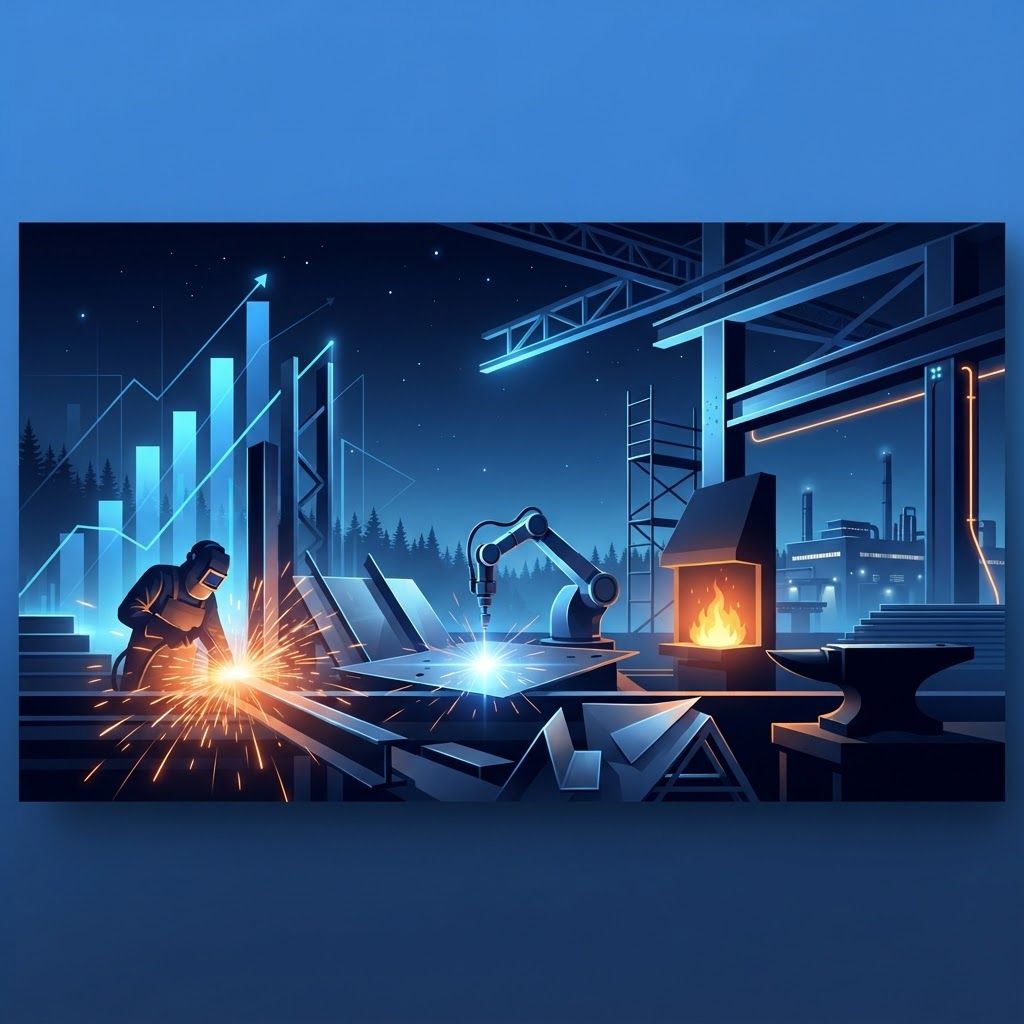
Metalworking in the Epping Forest District
Metal fabrication underpins construction, manufacturing and infrastructure across the region, and the Epping Forest district hosts a substantial concentration of metalworking businesses. They operate from industrial units around Waltham Abbey, North Weald, the Lee Valley corridor and the smaller estates near Epping and Ongar, serving clients ranging from major contractors to individual homeowners commissioning a set of railings.
The district's position matters. Structural steel and fabricated assemblies are heavy and awkward to transport, so proximity to London construction sites gives local fabricators a real advantage. Combined with premises costs well below inner London, this has sustained a healthy sector through periods when metalworking declined elsewhere.
The Range of Metalworking Services
Structural steelwork forms the largest category by value, producing beams, columns, portal frames and staircases for construction projects. This work requires design calculations, certified welding, protective treatment and coordinated site installation.
Sheet metal fabrication covers enclosures, ductwork, panels, brackets and housings, typically using laser or plasma cutting followed by press braking and welding. Precision machining produces components to close tolerances using turning, milling and grinding. Architectural metalwork encompasses gates, railings, balustrades, staircases, canopies and decorative features. Welding and repair services support maintenance across industry, agriculture and transport.
Ten Metalworking Businesses in the District
1. Forest Steel Fabrication manufactures structural steelwork for construction projects, offering design support, workshop fabrication, protective coating and site erection as an integrated service.
2. Abbey Precision Engineering provides machining services including multi-axis milling and turning, producing components to tight tolerances for manufacturing and maintenance clients.
3. Lee Valley Sheet Metal operates laser cutting, punching and press braking equipment, producing enclosures, panels and brackets in steel, stainless steel and aluminium.
4. North Weald Architectural Metalwork designs and fabricates gates, railings, balustrades and decorative ironwork, combining traditional blacksmithing techniques with modern fabrication.
5. Epping Welding Services offers mobile and workshop welding across a range of processes and materials, including coded welding for applications requiring certification.
6. Roding Stainless Fabrication specialises in stainless steel work for food, pharmaceutical and laboratory environments, producing hygienic tanks, benches, pipework and guarding.
7. Chigwell Metal Finishing provides surface treatment including powder coating, galvanising coordination, polishing and painting, serving other fabricators as well as direct clients.
8. Theydon Aluminium Systems fabricates aluminium framework, glazing systems and lightweight structures, working extensively with construction and display clients.
9. Waltham Forge and Blacksmiths undertakes traditional hot forging and restoration of historic ironwork, supporting conservation projects and bespoke commissions.
10. Ongar Industrial Fabrication produces heavy fabricated assemblies, machine frames, platforms and access structures for industrial and agricultural clients.
Materials and Their Applications
Material choice drives cost, performance and appearance. Mild steel is strong, weldable and economical, but requires protective treatment against corrosion. Galvanising provides excellent long-term protection for exterior applications, while powder coating adds colour and a further barrier.
Stainless steel resists corrosion inherently and is essential in food, medical and marine environments, though it costs considerably more and requires different welding techniques and consumables to avoid contamination. Aluminium is light, corrosion resistant and attractive for architectural work, but it is weaker than steel for a given section and needs specific welding expertise.
Specifying stainless where galvanised mild steel would perform adequately wastes money, while under-specifying in a corrosive environment produces premature failure. Good fabricators advise honestly on this balance.
Certification and Structural Work
Structural steelwork placed into buildings is subject to strict requirements. Fabricators must operate under recognised factory production control systems and hold appropriate certification to declare conformity for structural components. Execution classes define the rigour of procedures, inspection and documentation required, scaling with the consequences of failure.
Welder qualification is central to this. Coded welders are tested against specific procedures, materials and positions, and their qualifications must remain current. For any load-bearing or safety-critical work, verifying a fabricator's certification and welder qualifications is essential rather than optional.
Technology in Modern Fabrication
Metalworking has absorbed considerable technology. Laser cutting delivers precision and speed on sheet materials, with fibre lasers handling reflective metals that older systems struggled with. Computer-controlled press brakes produce consistent bends with minimal setup. Robotic welding improves consistency on repeat work, though skilled manual welding remains essential for one-off and complex geometry.
Three-dimensional modelling and building information modelling have changed how structural steel is delivered. Fabrication drawings generate directly from coordinated models, reducing clashes discovered on site and allowing much higher precision in connection detailing.
Commissioning Metalwork
Clear information produces good outcomes. For structural work, supply engineer drawings and load information. For architectural work, discuss finish expectations explicitly, since the difference between an industrial and a decorative standard of weld dressing is substantial and affects cost significantly.
Site measurement is critical. Steelwork fabricated to drawing dimensions will not fit if the building as constructed differs, so a survey before fabrication prevents expensive rework. Discuss installation access early, as craneage, road closures and working hours can materially affect programme and price.
Lead times depend on material availability, workshop loading and any coating processes, which are often subcontracted and add days to the schedule. Building realistic allowances into project programmes avoids pressure that compromises quality.
Final Thoughts
Metalworking companies in Epping Forest deliver a wide spectrum of capability, from heavy structural steel through to finely crafted architectural ironwork. The sector combines certified engineering rigour with genuine craft skill, and its proximity to London construction and manufacturing keeps it busy. Selecting a fabricator whose experience matches the specific work, and engaging them early enough to influence detailing, consistently produces better results than treating fabrication as a late-stage procurement exercise.
Want your brand featured in front of decision-makers? Publish a guest post or get a link insertion in our guides through AAMAX's guest post and link insertion service.
Helpful Links
 SponsoredAAMAX — Full-Service Digital Agency
Write for Us
Share your expertise with our readers. We welcome guest contributions from industry specialists.
Pitch your idea

