

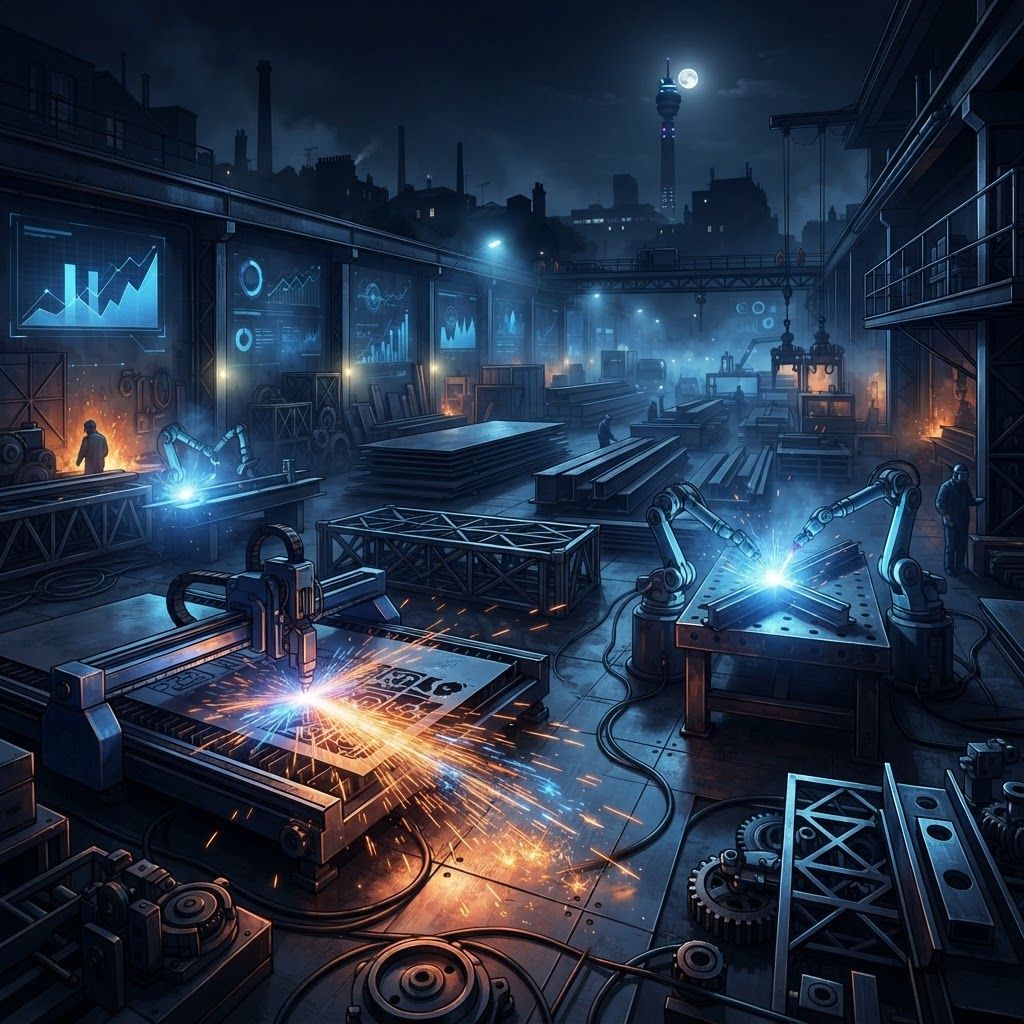
An Industrial Skill That Never Left Camden
Metalworking is one of the oldest trades still practised in Camden, and it has survived because it is needed. The borough's Victorian and Georgian buildings rely on iron railings, balconies, gates, staircases and rainwater goods that require repair or replication. Its contemporary development requires structural steel, secondary steelwork, architectural metalwork and cladding support systems. Its restaurants, bars and retail interiors demand bar tops, shopfronts, screens and bespoke fittings. Its research institutions and film production facilities need one-off fabricated rigs and precision components at short notice.
What distinguishes Camden metalwork is the mixture of scales. A workshop may complete a heritage railing restoration one week and a stainless steel commercial kitchen installation the next. That versatility is only possible where welding, machining, forming, finishing and installation skills sit close together, which is why the borough's fabricators tend to be broad in capability and pragmatic in approach.
Processes and What They Are For
Structural fabrication produces beams, columns, connections and frames, and requires the relevant execution class certification for construction use. Sheet metal fabrication covers laser or plasma cutting, folding, punching and welding to produce enclosures, panels, ducting and trays. CNC machining removes material to precise tolerances, essential for engineering components and mechanical assemblies. Forging and blacksmithing shape hot metal by hand or power hammer, which is how authentic heritage ironwork is produced. Casting reproduces complex forms, often used for decorative replacements. Welding processes differ significantly, with MIG suited to speed and thicker material, TIG preferred for stainless steel, aluminium and visible seams, and stick welding retained for site conditions.
Finishing determines both appearance and lifespan. Hot dip galvanising provides the strongest corrosion protection for external steel. Powder coating offers colour and a durable surface, ideally over a galvanised or primed substrate outdoors. Wet spray systems suit large or already-installed items. Polishing and brushing define stainless steel aesthetics, while patination and traditional paint systems suit heritage ironwork.
Ten Metalworks Companies Serving Camden
Camden Steel Fabrication Works handles structural steelwork for residential extensions, basements and commercial refurbishment, providing connection design coordination and site installation.
Kentish Town Architectural Metalwork specialises in staircases, balustrades, canopies and screens, working closely with architects on detailing and finish samples.
Camden Heritage Ironworks restores and replicates railings, gates, balconies and boot scrapers using traditional forge techniques, and is frequently engaged where conservation consent requires like-for-like reinstatement.
Kings Cross Precision Engineering provides CNC turning and milling for instrumentation, research and mechanical assemblies, supported by inspection and material certification.
Regents Sheet Metal Company covers laser cutting, folding and welded enclosures for facilities, retail and audio-visual installations, offering quick turnaround on prototypes.
Camden Stainless and Hygiene Fabrication produces commercial kitchen counters, sinks, splashbacks and shelving to hygienic design standards for the borough's extensive hospitality sector.
Somers Town Welding Services operates as a mobile and workshop welding contractor, valued for maintenance, repair and site remedial work across property portfolios.
North London Aluminium Systems fabricates window, door, curtain walling and louvre systems, along with thermally broken profiles for retrofit glazing upgrades.
Camden Metal Finishing Company concentrates on preparation, blasting, powder coating and specialist finishes, acting as a downstream partner for smaller fabricators without in-house coating.
Camden Circular Steel Reuse recovers, tests and re-certifies structural steel from demolition for reuse, an approach gaining traction as embodied carbon targets tighten.
Standards, Safety and Verification
Structural steelwork is a regulated product, and buyers should confirm the fabricator holds the appropriate factory production control certification and can issue a declaration of performance. Welder qualifications should be current and appropriate to the process and material. For work at height, lifting or hot works on occupied premises, method statements and risk assessments are expected as standard.
Material traceability is equally important. Mill certificates should be available for structural sections, and stainless steel grade should be confirmed in writing, since substituting a lower grade in an external or marine-adjacent environment causes visible corrosion within a short period. For architectural metalwork, agree tolerance and finish expectations before fabrication, because acceptable variation on structural steel is far greater than on a polished handrail.
Trends in the Sector
Digital fabrication has raised accuracy expectations. Laser cutting from three-dimensional models allows complex assemblies to be produced with minimal on-site adjustment, which matters where access is difficult. Offsite fabrication and modular assemblies reduce disruption in dense residential streets. Steel reuse and lower-carbon steel sourcing are moving from pilot projects to mainstream specification. Meanwhile skills shortages in welding and blacksmithing have encouraged several Camden workshops to run apprenticeships, which is a useful signal of long-term stability when selecting a partner.
How to Get an Accurate Quotation
Provide drawings or a clear sketch with dimensions, material and finish. State whether design responsibility sits with you or the fabricator, since fabricator-designed connections change price and liability. Confirm access, working hours, protection requirements for occupied buildings and whether installation is included. Ask for a finish sample on the actual substrate rather than a colour chart. Agree a survey stage for anything fitting into existing openings, as period buildings are rarely square and site measurement prevents costly rework.
Final Thoughts
Camden's metalworks companies span heavy structural capability, refined architectural work and genuine heritage craft. That range is a considerable advantage for anyone working in the borough, provided the fabricator is matched to the task and certification is verified rather than assumed. Clear drawings, agreed finishes and a site survey turn metalwork from a project risk into one of its most durable and satisfying elements.
Want your brand featured in front of decision-makers? Publish a guest post or get a link insertion in our guides through AAMAX's guest post and link insertion service.
Helpful Links
 SponsoredAAMAX — Full-Service Digital Agency
Write for Us
Share your expertise with our readers. We welcome guest contributions from industry specialists.
Pitch your idea

