

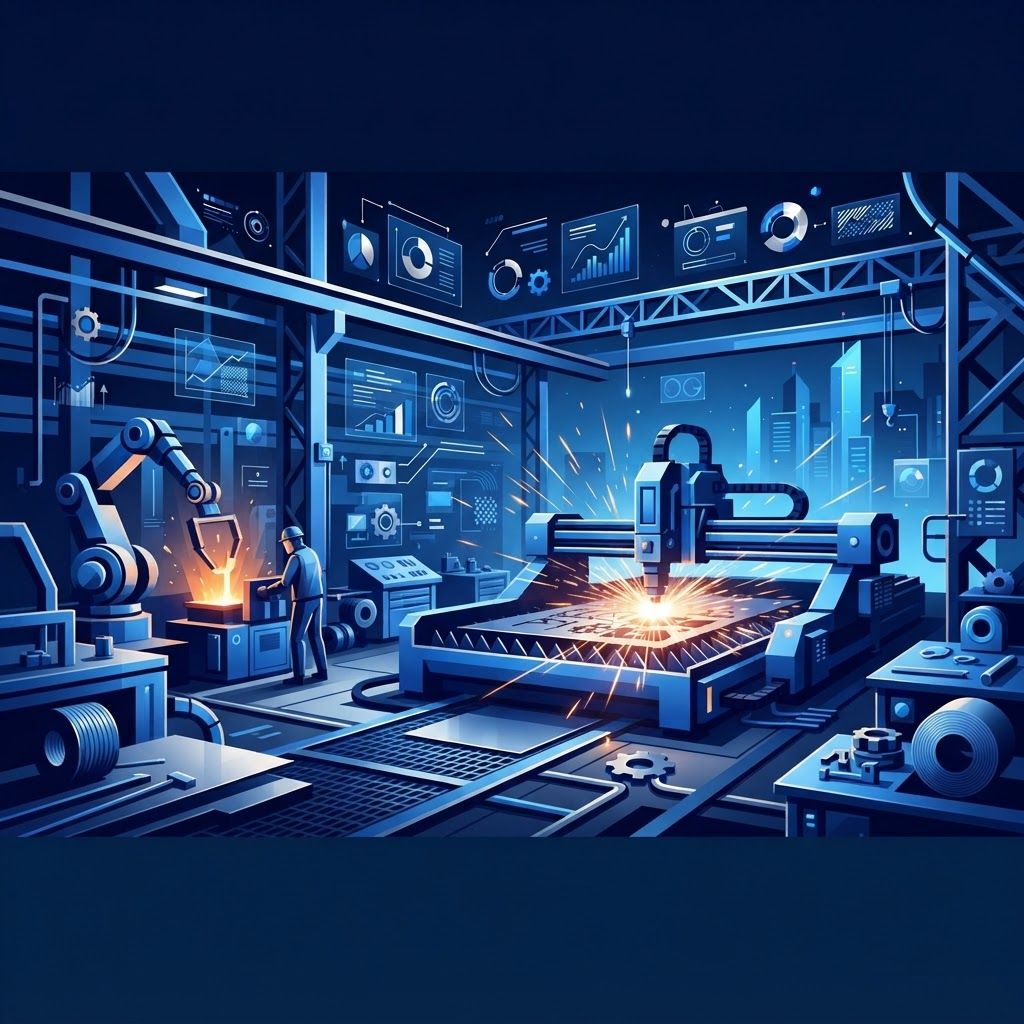
A Strong Engineering Tradition in Eastern Norfolk
Metalworking in Broadland has deep roots. The district's engineering base grew from agricultural machinery repair, boatbuilding on the Broads and the industrial activity of the Norwich fringe, then expanded significantly as the southern North Sea energy sector created demand for fabrication, welding and precision machining. Today the sector spans small family workshops producing bespoke architectural ironwork through to well-equipped fabrication halls supplying structural steel and pressure-rated assemblies.
Clusters of metalworking activity are found around Rackheath, Hellesdon, Horstead, Acle and Blofield, with strong links to Great Yarmouth's energy supply chain and to the agricultural machinery dealerships that serve the surrounding farmland. This proximity to both offshore energy and agriculture gives Broadland fabricators an unusual breadth of experience.
The Ten Core Specialisms in Broadland Metalworking
Structural steel fabrication is the largest single category. These companies design, fabricate and erect portal frames, mezzanine floors, beams, columns and staircases for industrial buildings, agricultural sheds and commercial developments. Compliance with the CE and UKCA execution classes under BS EN 1090 is essential, and reputable fabricators maintain factory production control certification to prove it.
Precision CNC machining forms the second specialism. Multi-axis milling and turning centres produce components to tolerances measured in hundredths of a millimetre for the energy, medical, food processing and automotive sectors. The best machine shops combine CAD/CAM programming with in-house metrology, using coordinate measuring machines to verify parts against drawings.
Sheet metal fabrication is the third area. Laser cutting, CNC punching, press braking and robotic welding turn flat sheet into enclosures, brackets, guarding, ductwork and panels. Fibre laser technology has transformed this field, cutting faster and more cleanly than older CO2 systems and handling reflective materials such as copper and brass that were previously difficult.
Architectural and ornamental metalwork represents a fourth and very visible specialism. Norfolk's mix of period property and contemporary design supports demand for bespoke balustrades, gates, railings, canopies, staircases and feature screens in steel, stainless, brass and corten. Craftsmanship matters here as much as engineering, particularly on heritage restoration work.
Remaining specialisms include agricultural engineering and machinery fabrication, marine and boatyard metalwork serving the Broads fleet, pipework and pressure systems fabrication, welding and on-site mobile repair services, surface finishing such as galvanising, powder coating and shot blasting, and toolmaking and jig manufacture supporting other local manufacturers.
Technology Driving the Sector Forward
The technological gap between a well-invested Broadland fabricator and a basic workshop is now substantial. Fibre laser cutters with automated sheet loading run largely unattended, improving both throughput and consistency. Robotic welding cells deliver repeatable weld quality on production batches, while cobots make automation viable for smaller runs that would once have been entirely manual.
Three-dimensional modelling has changed workflow just as much. Steel detailing software produces fabrication drawings, cutting lists and CNC files directly from a structural model, eliminating transcription errors and allowing clash detection before any steel is cut. For clients, this means fewer surprises during erection.
Additive manufacturing is beginning to appear in the metalworking supply chain too, mainly for tooling, fixtures and low-volume complex components. It has not displaced conventional machining, but it has expanded what smaller firms can offer in prototyping.
Quality, Certification and Safety
Buyers should treat certification as a baseline filter. BS EN 1090 execution class certification is a legal requirement for structural steelwork placed on the market. Welder qualifications to BS EN ISO 9606 confirm that individual welders have been tested on the relevant process, material and position. Welding procedure specifications document how a joint is to be made, and independent non-destructive testing, including dye penetrant, magnetic particle and ultrasonic inspection, verifies that it was made correctly.
ISO 9001 quality management provides broader assurance about traceability and process control. For work in the energy sector, additional client-specific approvals and safety schemes often apply. Reputable Broadland fabricators will produce this documentation without hesitation, along with material test certificates confirming the grade and origin of the steel used.
Serving the Energy and Agricultural Sectors
The southern North Sea offshore wind industry has been a significant growth driver for Norfolk metalworking. Fabricators supply access platforms, ladders, cable protection components, lifting frames and maintenance spares, often working to demanding corrosion protection specifications involving thermal spray and multi-coat paint systems. The discipline required by offshore work tends to raise standards across a fabricator's entire operation.
Agriculture provides a complementary, counter-cyclical workload. Grain handling equipment, trailers, livestock handling systems, machinery modifications and urgent harvest-season repairs keep local engineering firms busy. Mobile welding units that can attend a farm at short notice are highly valued, because machinery downtime during a narrow harvest window carries enormous cost.
How to Choose a Metalworking Partner
Begin by matching the fabricator's equipment to your requirement. A shop equipped for heavy structural work is not the right choice for thin-gauge stainless enclosures, and a precision machine shop will struggle with large weldments. Ask directly about machine capacities, maximum plate thickness, bed sizes and crane lifting limits.
Request examples of comparable completed work and, where possible, visit the workshop. A well-organised shop floor with controlled material storage, clean welding bays and visible inspection stations is a reliable indicator of quality culture. Disorganisation usually shows up later as rework.
Discuss finishing early. Galvanising and powder coating are often subcontracted, and the logistics of moving fabricated assemblies to a coating plant can significantly affect lead time. Fabricators with established finishing partners manage this smoothly.
Clarify design responsibility. Some clients supply fully detailed drawings; others need the fabricator to take design responsibility, which requires appropriate professional indemnity insurance and structural engineering input. Confusion on this point is one of the most common causes of dispute.
The Outlook for Metalworking in Broadland
The medium-term picture is encouraging. Offshore wind expansion in the southern North Sea, continued industrial and agricultural building, and the reshoring of some component manufacturing all support demand. The principal constraint is skills: experienced coded welders, CNC programmers and steel detailers are scarce nationally, and Broadland firms compete for them with the energy sector.
The response has been sustained investment in apprenticeships and in automation that reduces reliance on scarce manual skills. For buyers, the practical implication is to build relationships with capable fabricators early and to plan work with realistic lead times. The engineering capability in Broadland is genuinely strong, but the best firms fill their order books well in advance.
Want your brand featured in front of decision-makers? Publish a guest post or get a link insertion in our guides through AAMAX's guest post and link insertion service.
Helpful Links
 SponsoredAAMAX — Full-Service Digital Agency
Write for Us
Share your expertise with our readers. We welcome guest contributions from industry specialists.
Pitch your idea

