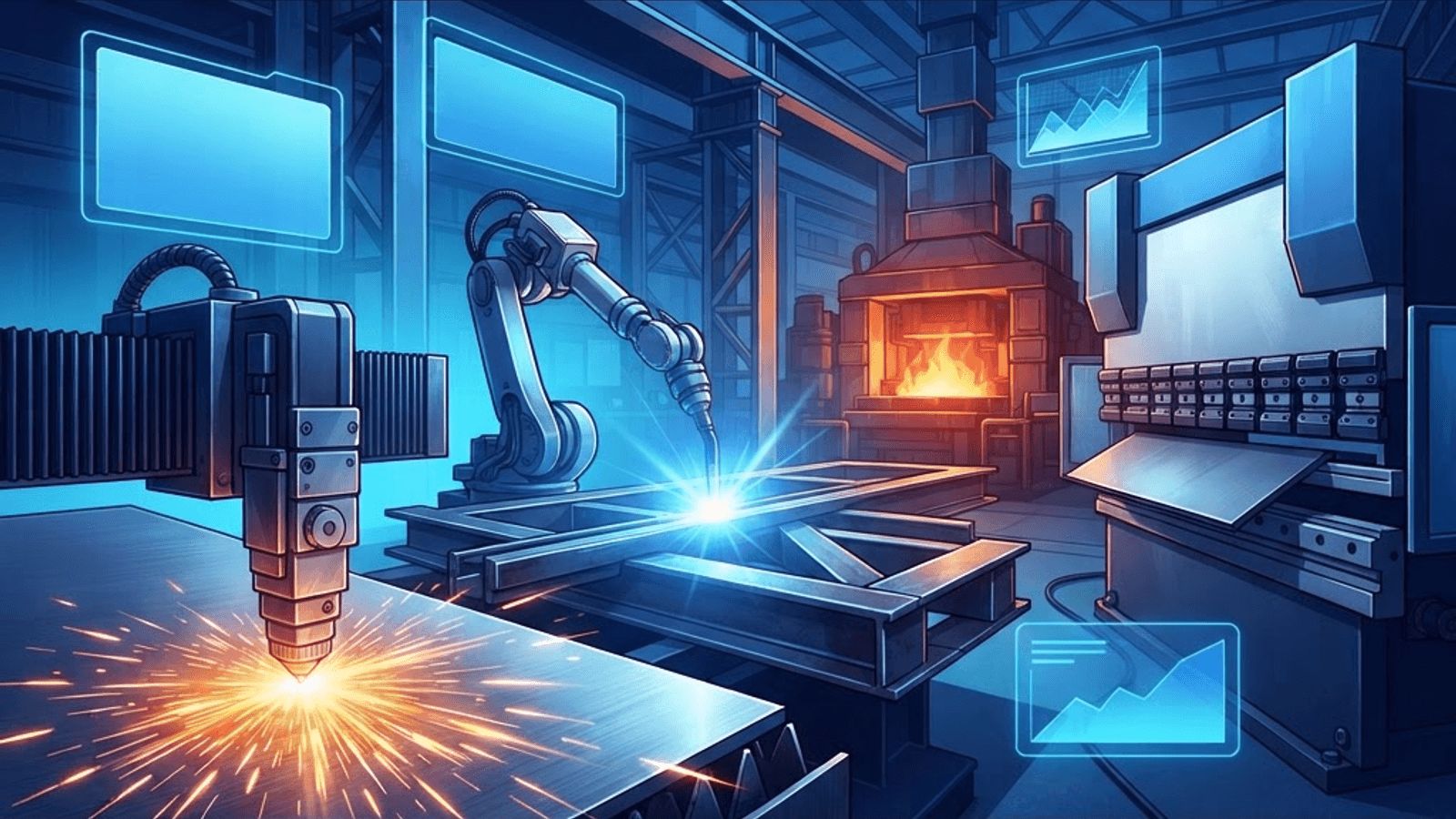
A Region Built on Metal
Bassetlaw sits at the meeting point of two great industrial traditions. To the north lies Sheffield and the South Yorkshire steel country, a name synonymous worldwide with quality metallurgy. To the south lies the Nottinghamshire and Derbyshire engineering belt. Bassetlaw itself developed substantial metalworking capability serving the coal industry, which required continuous fabrication, welding, machining and structural work.
That inheritance remains visible today. Across the district's industrial estates around Worksop, Manton Wood and Harworth, engineering and fabrication businesses produce structural steelwork, pressure equipment, machined components, sheet metal assemblies and architectural metalwork for customers across the country.
Companies Defining the Regional Metals Sector
Several organisations anchor metalworking capability accessible to Bassetlaw. Sheffield Forgemasters is among the most renowned names in British heavy engineering, producing large forgings and castings for defence, nuclear and industrial applications. Outokumpu operates stainless steel production and distribution serving UK manufacturers.
Liberty Steel and British Steel represent primary steel production in the UK, supplying the sections, plate and long products that fabricators convert into finished structures. Tata Steel UK similarly supplies strip, plate and engineering steels widely used across Midlands manufacturing.
In distribution and processing, ArcelorMittal, Barrett Steel and Kloeckner Metals UK supply stockholding and first-stage processing services, cutting and preparing material for fabricators. Righton Blackburns supplies aluminium and specialty metals to engineering customers.
Severfield is one of the largest UK structural steelwork contractors, delivering framed buildings including the distribution warehouses of the type constructed across Bassetlaw. William Hare Group similarly delivers major structural steel projects nationally.
Special Metals and Doncasters Group serve high-specification markets in aerospace, energy and industrial applications requiring advanced alloys. Bodycote provides heat treatment and metallurgical processing services essential to producing components with the required mechanical properties.
Surrounding these larger names is a dense population of smaller fabricators, machinists, welders, laser cutting shops, powder coaters and galvanisers across Nottinghamshire and South Yorkshire, many of which serve Bassetlaw customers directly.
Core Metalworking Processes
Understanding the processes helps buyers specify effectively. Laser and plasma cutting produce accurate profiles from sheet and plate at high speed, with fibre laser technology having dramatically improved speed and edge quality in recent years. Waterjet cutting handles thick sections and heat-sensitive materials without altering metallurgy.
Press braking bends sheet metal into formed components, and modern CNC brakes with automated tool changing handle complex multi-bend parts with high repeatability. Rolling forms plate into cylinders and curves for tanks, vessels and architectural features.
Welding remains the fundamental joining process, spanning MIG, TIG, MMA and submerged arc techniques. Coded welding to recognised standards is mandatory for structural and pressure applications, and reputable fabricators maintain documented welder qualifications and procedures.
CNC machining produces precision components through turning and milling, with multi-axis machines completing complex parts in single setups. Fabrication is completed by finishing processes including shot blasting, galvanising, powder coating and wet painting, which determine corrosion protection and appearance.
Structural Steelwork and Local Construction
Bassetlaw's warehouse and industrial development has created substantial structural steel demand. A modern distribution facility comprises steel portal frames, purlins, cladding rails, mezzanine structures, stairs, walkways and handrails, all designed, fabricated and erected to tight programmes.
Structural steelwork requires execution class certification and factory production control under recognised standards, with CE or UKCA marking of structural components. Buyers should verify certification, as non-compliant fabrication creates serious legal and safety exposure.
Steel offers real advantages for industrial buildings: rapid erection, long clear spans, adaptability for future reconfiguration and excellent recyclability at end of life.
Precision Machining and Component Supply
Beyond structures, the district supports precision engineering serving machinery manufacturers, materials handling companies, energy infrastructure and the automotive supply chain. These businesses produce shafts, housings, brackets, gears, flanges and custom components to drawing.
Quality expectations in these markets are demanding. Customers expect dimensional inspection reports, material certification and traceability. Many require formal quality management certification, and sector-specific approvals for aerospace or automotive work.
Architectural and Decorative Metalwork
A distinct segment serves construction and property with balustrades, staircases, gates, railings, canopies, bespoke cladding and feature elements. This work blends fabrication skill with design sensitivity and often involves stainless steel, aluminium, brass and corten weathering steel.
For Bassetlaw's period properties and conservation areas, traditional blacksmithing and heritage metalwork restoration also have a place, matching historic ironwork with appropriate techniques and materials.
Technology Transforming the Workshop
Metal fabrication has modernised considerably. Nesting software optimises material utilisation across sheets, directly reducing waste and cost. Automated tube and profile cutting handles complex joint preparations that were once laborious hand work.
Robotic welding delivers consistency on repetitive assemblies. Three-dimensional modelling and building information modelling integration allow steelwork to be detailed, checked for clashes and fabricated from a single digital model, substantially reducing site rework.
Additive manufacturing in metal is beginning to appear for complex, low-volume components where conventional machining would be prohibitively wasteful.
Sustainability in Metals
Steel and aluminium are among the most recycled materials in the world, with well-established scrap collection and remelting infrastructure. This gives metal a strong circularity position.
Decarbonising primary production is the major challenge, with electric arc furnace routes using scrap feedstock offering substantially lower emissions than blast furnace production. UK investment is moving in this direction.
For fabricators, sustainability focuses on material efficiency, energy management in cutting and welding operations, solvent-free coating systems and responsible waste handling.
Skills and the Workforce
Metalworking offers strong, well-paid careers. Coded welders, CNC machinists, fabricators, steel detailers and quality inspectors are in persistent demand nationally. Bassetlaw's industrial heritage provides a foundation, and colleges across Nottinghamshire and South Yorkshire deliver relevant engineering provision.
The sector faces an ageing workforce, making apprenticeship investment critical. Firms with structured training programmes are markedly better placed to sustain capability.
Choosing a Fabricator
Match capability to requirement, including material types, thickness range, machine capacity and lifting capability. Verify welding qualifications and quality certification appropriate to the application. Ask to see comparable completed work. Discuss drawing and modelling formats to avoid translation errors. Clarify finishing arrangements, delivery and installation responsibilities. And visit the workshop, since organisation and housekeeping tell you a great deal about quality culture.
Outlook
Metalworking in Bassetlaw remains a genuine strength. Sustained by construction, materials handling, energy infrastructure and general engineering demand, and supported by a skilled regional workforce, the sector continues to offer both capable supply for local businesses and rewarding careers for those entering it.
Want your brand featured in front of decision-makers? Publish a guest post or get a link insertion in our guides through AAMAX's guest post and link insertion service.
Helpful Links
 SponsoredAAMAX — Full-Service Digital Agency
Write for Us
Share your expertise with our readers. We welcome guest contributions from industry specialists.
Pitch your idea