

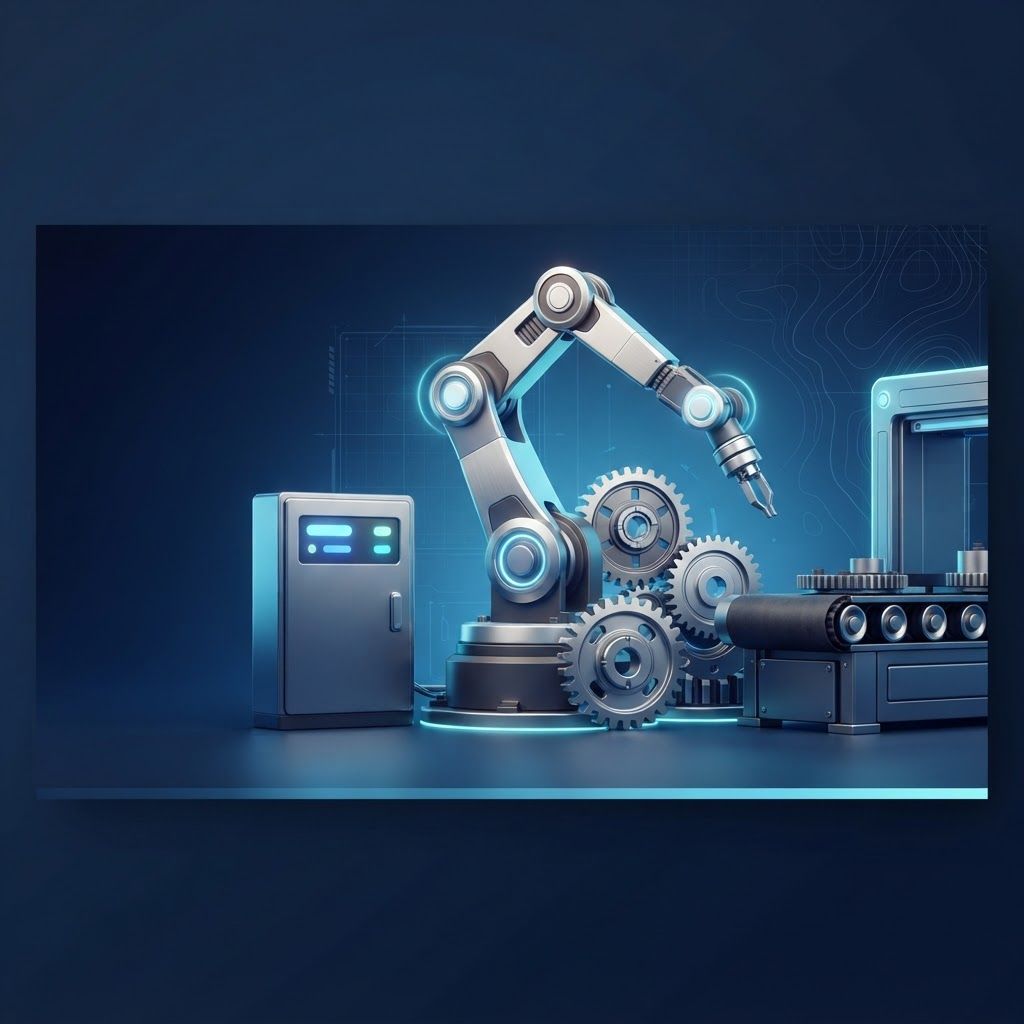
Machinery Manufacturing in the Borough
Machinery manufacture is one of the least visible but most consequential industries in Wokingham. The businesses involved rarely advertise to the public, operate from unremarkable units on industrial estates, and produce equipment that ends up inside factories, laboratories, hospitals and utility installations across the country. Yet this sector represents genuine high-value engineering employment and considerable technical depth.
The borough's industrial areas, notably around Molly Millars Lane, Winnersh and Fishponds Road, host precision machining shops, special purpose machinery builders, control system integrators, fabrication workshops and equipment refurbishment specialists. Demand comes from the Thames Valley's pharmaceutical, electronics, food processing, packaging, water utility and research sectors, all of which require equipment configured to specific processes rather than bought off a shelf.
What Machinery Manufacturers Actually Build
The category spans several distinct activities. Special purpose machinery is designed and built for a single application, such as an assembly cell, a test rig or a bespoke handling system. Automation and robotics integration combines robots, vision systems, conveyors and controls into working production lines. Precision component manufacture supplies machined and fabricated parts to other equipment builders. Control and electrical systems provide panels, programmable logic controller programming and human machine interface development. Mechanical handling equipment covers conveyors, lifts, hoists and material transfer systems. Process equipment includes mixing, filling, filtration, dosing and heat transfer plant. Refurbishment and retrofit extends the life of existing machines with new controls, guarding and drives.
Ten Machinery Manufacturers and Engineering Specialists Serving Wokingham
1. Wokingham special purpose machine builders design and manufacture bespoke equipment from customer specification through mechanical design, fabrication, assembly, control integration and factory acceptance testing, usually as one-off or very small batch projects.
2. Precision CNC machining companies in the borough operate multi-axis turning and milling centres producing components to fine tolerances in aluminium, stainless steel, engineering plastics and exotic alloys, serving equipment builders and research institutions.
3. Automation and robotics integrators based in the Thames Valley deploy collaborative and industrial robots for assembly, palletising, machine tending and inspection, combining hardware selection with safety assessment and programming.
4. Control panel and electrical systems manufacturers serving Berkshire build control cabinets to relevant standards, program programmable logic controllers and supervisory systems, and commission equipment on site.
5. Sheet metal fabrication and welding specialists in the area produce machine frames, guarding, enclosures and hoppers using laser cutting, press braking and certified welding processes.
6. Conveyor and material handling equipment manufacturers supply belt, roller, modular chain and vacuum handling systems configured for specific production layouts, including food-grade and cleanroom variants.
7. Test rig and laboratory equipment builders serving the region's research and pharmaceutical sectors construct environmental chambers, durability rigs, instrumentation frames and validated laboratory apparatus.
8. Hydraulic and pneumatic systems specialists design and assemble power packs, actuator systems, manifolds and pipework, supporting both new equipment and maintenance of installed plant.
9. Machinery refurbishment and retrofit providers upgrade ageing equipment with modern drives, controls, safety systems and guarding, often delivering most of the benefit of replacement at a fraction of the capital cost.
10. Mechanical design and engineering consultancies in the Wokingham area provide computer-aided design, finite element analysis, tolerance stack-up studies and CE or UKCA technical file preparation for clients who manufacture elsewhere.
Machinery Safety and Compliance
Anyone commissioning machinery must understand the regulatory framework, because responsibility can fall on the purchaser as well as the builder. New machinery placed on the market in Great Britain requires UKCA marking supported by a technical file, risk assessment, and a declaration of conformity. Equivalent CE marking applies for the European Union market.
Risk assessment under recognised standards drives guarding, interlocking, emergency stop provision, and safety-related control system performance levels. Functional safety of control systems is assessed against defined performance level requirements, which affects component selection and architecture.
Where existing machines are substantially modified, the modification may create a new obligation to reassess conformity. Retrofit projects should therefore include a compliance review rather than treating the work as maintenance. Employers also carry duties to ensure work equipment is suitable, maintained and inspected.
Selecting a Machinery Partner
Start with a genuine specification. The most expensive machinery projects are those where the requirement was described loosely and discovered incrementally. Define throughput, product variants, changeover expectations, available floor space, utilities, operator interaction, cleaning requirements and acceptance criteria before requesting quotations.
Assess in-house capability against subcontracted work. A builder with its own machining, fabrication and controls capability controls schedule and quality more effectively than one coordinating multiple suppliers.
Examine project management practice. Ask for a design review process, progress reporting, factory acceptance test protocol and site acceptance test plan. Ask what documentation is delivered, including drawings, parts lists, control software, operating and maintenance manuals and the technical file.
Consider lifetime support. Spare parts availability, response times, remote diagnostics access and software licensing terms determine the true cost of ownership over a machine life measured in decades.
Trends in Industrial Machinery
Several developments are shaping the sector. Collaborative robotics has lowered the barrier to automation for smaller manufacturers. Machine vision and inspection have become far more capable and affordable. Condition monitoring and remote diagnostics reduce unplanned downtime and enable service-based commercial models. Energy efficiency is now a specification requirement, with variable speed drives, regenerative systems and improved thermal design. And digital twin simulation is used to validate cycle times and layouts before steel is cut.
Skills remain the sector's constraint. Experienced machine builders, controls engineers and skilled machinists are in short supply nationally, which makes apprenticeship investment a meaningful indicator of a supplier's long-term stability.
Final Thoughts
Wokingham hosts a capable machinery engineering community covering bespoke machine build, precision machining, automation integration, controls, fabrication, handling systems and refurbishment. Invest effort in specification, verify safety compliance capability, favour suppliers with integrated in-house skills, and evaluate lifetime support alongside purchase price.
Want your brand featured in front of decision-makers? Publish a guest post or get a link insertion in our guides through AAMAX's guest post and link insertion service.
Helpful Links
 SponsoredAAMAX — Full-Service Digital Agency
Write for Us
Share your expertise with our readers. We welcome guest contributions from industry specialists.
Pitch your idea

