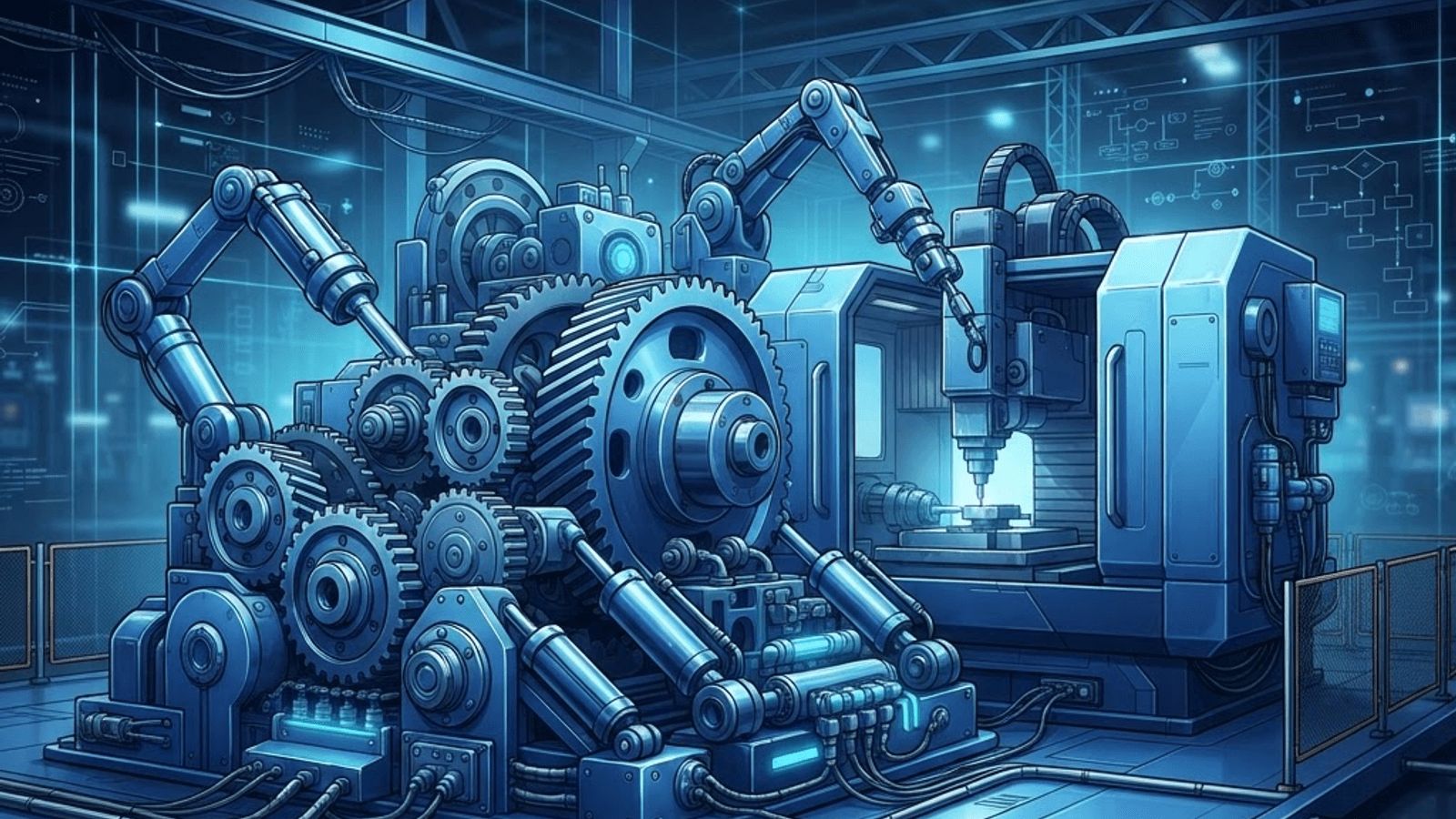
The Machine Builders of West Kent
Machinery manufacturing is one of the least visible yet most valuable industries in any regional economy. The machines built in workshops around Tunbridge Wells rarely carry a consumer brand, but they fill and seal food packaging, sort recyclables, handle materials in warehouses, process crops on Kentish farms and test components to destruction in laboratories. Without them, a great many other businesses simply could not operate.
The sector in West Kent is characterised by bespoke and small batch production. Rather than competing on price with mass produced imported machinery, local firms win work by solving specific problems: a production line that needs a custom handling solution, a process that requires equipment no catalogue supplier offers, or a legacy machine that needs modernising rather than replacing.
What Good Machine Building Looks Like
A well built machine is defined as much by what happens after commissioning as by the initial build quality. Ease of maintenance, availability of spare parts, quality of documentation and the responsiveness of support all determine whether a machine delivers value over a decade or becomes an expensive frustration.
The best manufacturers design with the operator in mind. Guarding that is genuinely safe yet practical, control interfaces that are intuitive, changeover procedures that can be completed quickly and access points that allow routine servicing without dismantling half the machine all mark out thoughtful engineering.
The Top 10 Machinery Manufacturers
1. Weald Machine Systems designs and builds bespoke production machinery for food, pharmaceutical and packaging clients. Its integrated approach, covering mechanical design, controls engineering and software, means customers deal with a single accountable partner.
2. Kent Automation Engineering specialises in robotic cells and automated handling systems, integrating industrial robots with conveyors, vision systems and safety infrastructure to automate repetitive manual processes.
3. Pantiles Precision Machinery builds specialist test rigs, laboratory equipment and measurement systems for research organisations and manufacturers requiring accuracy beyond standard commercial offerings.
4. Southborough Agricultural Machinery manufactures and refurbishes implements and processing equipment for the region's farms, orchards and vineyards, an increasingly important market as Kent's viticulture sector expands.
5. High Weald Conveyor Systems produces belt, roller and modular conveying equipment for warehousing, distribution and light manufacturing, with a strong reputation for robust construction and straightforward maintenance.
6. Calverley Hydraulics and Pneumatics designs power systems, cylinders, manifolds and actuation packages, supplying both other machine builders and end users needing repair or upgrade of existing installations.
7. Rusthall Materials Handling builds lifting equipment, tipping units, bin handling systems and custom trolleys, work that frequently transforms the ergonomics and safety of a production environment.
8. Bidborough Machine Tools refurbishes, retrofits and upgrades existing machine tools, adding modern controls and drives to well built older machines at a fraction of replacement cost, an approach with strong sustainability credentials.
9. Tunbridge Control Engineering focuses on the electrical and software layer, building control panels, programming logic controllers and developing supervisory systems for machinery of all kinds.
10. Weald Fabrication and Assembly provides the heavy engineering foundation, offering structural fabrication, welding and mechanical assembly services to other machine builders across the South East.
Technology Trends in Machine Building
Connected machinery has moved from novelty to expectation. Modern equipment routinely reports performance data, cycle counts, fault histories and consumable status to central systems, enabling predictive maintenance and continuous improvement. Manufacturers that cannot offer this capability increasingly find themselves excluded from tender lists.
Collaborative robotics has opened automation to smaller businesses. Unlike traditional caged industrial robots, collaborative units can work safely alongside people, making automation viable for lower volume operations that could never justify a full automated line.
Digital simulation has transformed the design process. Building a virtual model of a machine allows designers to verify motion, detect collisions and optimise cycle times before any metal is cut, substantially reducing commissioning risk and rework.
Sustainability has also become a design criterion. Energy efficient drives, regenerative braking, reduced compressed air consumption and designs that facilitate eventual disassembly and recycling all feature increasingly in specifications.
Benefits of Bespoke Machinery
Off the shelf equipment forces a business to adapt its process to the machine. Bespoke machinery reverses that relationship, allowing the equipment to fit the process precisely. The result is often significantly higher throughput, lower waste and better product consistency.
Custom machines can also be sized exactly to available floor space, integrate with existing equipment and accommodate product variants that standard machines cannot handle. For businesses with a genuinely distinctive process, this can constitute a durable competitive advantage that competitors cannot simply purchase.
Selecting a Machinery Manufacturer
Begin with a clear specification covering throughput, product variants, available space, utilities, operator skill level and integration requirements. The more precisely you define the problem, the more accurate the quotations you receive will be.
Ask to visit machines the manufacturer has built for other customers and speak to those users about reliability and support. Examine what documentation and training are included, and confirm spare parts availability and lead times. Clarify who owns the design and control software, a point that causes disputes surprisingly often.
Finally, evaluate the commissioning and warranty arrangements carefully. The period immediately after installation is when problems emerge, and a manufacturer committed to being on site during that phase is worth paying for.
Conclusion
Machinery manufacturers around Tunbridge Wells provide the engineering backbone that keeps other industries productive. Their value lies in understanding a customer's process deeply enough to build something genuinely fit for purpose. As automation becomes more accessible and digital capability more essential, the firms profiled here are well positioned to help regional businesses improve productivity and competitiveness.
Want your brand featured in front of decision-makers? Publish a guest post or get a link insertion in our guides through AAMAX's guest post and link insertion service.
Helpful Links
 SponsoredAAMAX — Full-Service Digital Agency
Write for Us
Share your expertise with our readers. We welcome guest contributions from industry specialists.
Pitch your idea