

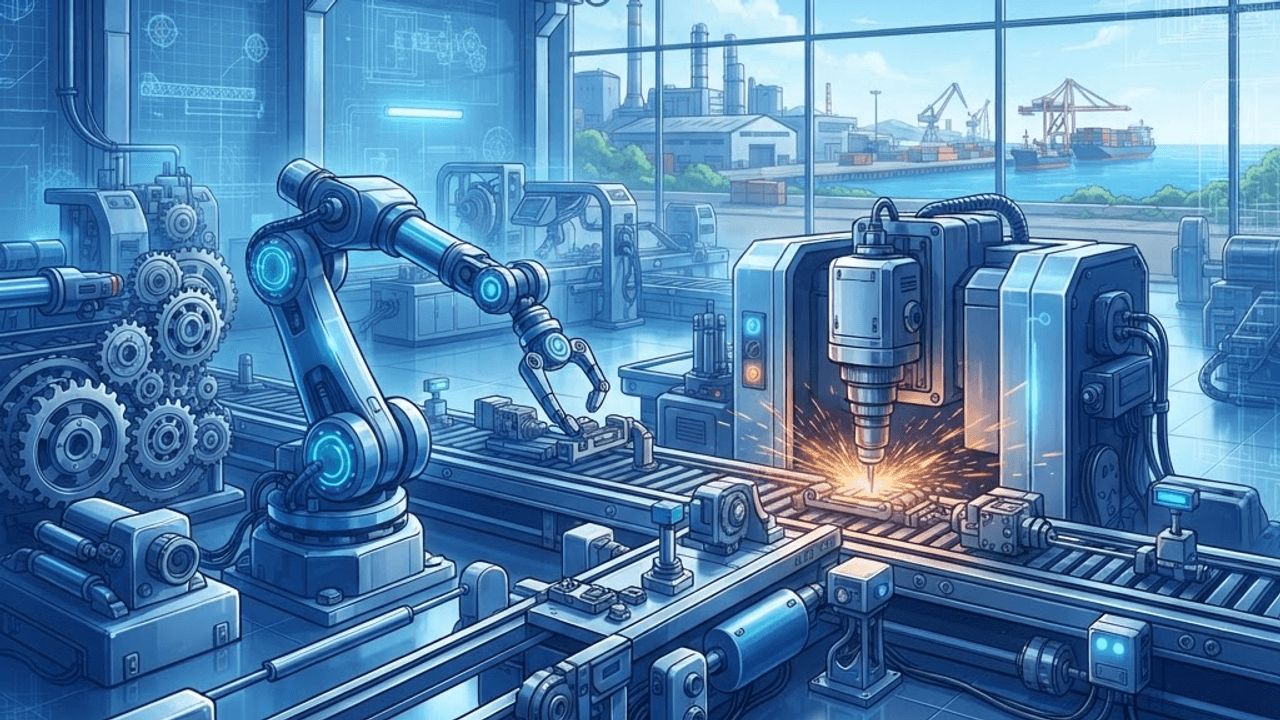
Engineering and Machinery in Thanet
Machinery manufacturing is one of the less visible but more substantial parts of Thanet's industrial economy. The district's engineering firms design and build the equipment that other businesses use to produce goods: conveyors, processing lines, handling systems, agricultural implements, marine machinery and bespoke special-purpose machines built for a single application.
This work sits at the intersection of mechanical design, fabrication, electrical engineering and control software. It is inherently low volume and high value, which suits a district with skilled engineering labour and affordable industrial space but no advantage in mass production. Customers come from across Kent and the south east, drawn by the ability to specify exactly what they need rather than adapting their process to a catalogue product.
The Ten Leading Machinery Manufacturers in Thanet
1. Thanet Engineering Works is the district's foremost bespoke machinery builder, designing and manufacturing special-purpose machines, jigs, fixtures and production equipment from concept through to commissioning on the customer's site.
2. Isle Agricultural Machinery produces and refurbishes equipment for the arable farms of the wider Isle, including handling systems, grain equipment, trailers and implements adapted to local soil and crop conditions.
3. Ramsgate Marine Engineering manufactures and overhauls marine machinery including winches, davits, deck equipment, hydraulic systems and propulsion components for the harbour fleet and offshore support vessels.
4. Margate Industrial Fabrication provides heavy steel fabrication, structural frameworks, tanks, platforms and guarding, with in-house welding coded to recognised standards and full weld inspection.
5. Kent Coast Automation Systems integrates robotics, conveyors, vision systems and programmable controls into complete automated production cells for manufacturers upgrading manual processes.
6. Broadstairs Hydraulics and Pneumatics designs and builds hydraulic power packs, cylinders, pneumatic circuits and control manifolds, alongside servicing and seal replacement for existing plant.
7. Westwood Machine Tool Services supplies, installs, calibrates and maintains machine tools including lathes, milling centres and grinders, keeping local manufacturing capacity operational.
8. Northdown Food Processing Equipment manufactures stainless steel equipment for food and beverage producers, built to hygienic design principles with cleanable surfaces and wash-down rated components.
9. Cliftonville Materials Handling produces conveyors, elevators, sorting systems and bulk handling equipment for logistics, waste processing and manufacturing clients.
10. Thanet Precision Toolmaking creates press tools, moulds, dies and precision fixtures, supporting manufacturers who require tooling designed around their specific component geometry.
Bespoke Machinery Design and Build
The bespoke machine building process follows a recognisable path. It begins with understanding the customer's process: throughput required, materials handled, space available, existing equipment to interface with and the operators who will use the machine. A concept design and budget estimate follow, then detailed mechanical and electrical design, fabrication, assembly, factory acceptance testing, installation and site commissioning.
The commercial reality is that the design phase determines most of the eventual cost and nearly all of the performance. Time invested clarifying requirements before metal is cut pays for itself many times over. Experienced builders push back on vague specifications and insist on documented acceptance criteria, which protects both parties.
Control systems are now as significant as mechanics. A modern machine includes programmable logic control, human machine interface, safety circuits, data logging and often remote diagnostic access, allowing a fault to be investigated without an engineer travelling to site.
Safety, Standards and Compliance
Machinery placed on the market must meet essential health and safety requirements. This involves risk assessment across the machine lifecycle, from installation and normal operation through to maintenance, cleaning and eventual decommissioning.
Safeguarding is central: fixed guarding where access is not needed, interlocked guarding where it is, light curtains and pressure mats where physical barriers are impractical, and emergency stop systems designed to an appropriate performance level. Safety-related control systems must be specified against assessed risk rather than by habit.
Technical documentation, an operating manual and a declaration of conformity accompany the finished machine, and a technical file must be retained. Employers then carry ongoing duties to inspect, maintain and ensure operators are trained.
Materials, Welding and Fabrication Quality
Fabrication quality determines machine longevity. Material selection balances strength, weight, corrosion resistance and cost, with stainless grades essential in food and marine applications and structural steels used for framework.
Welding is a controlled process. Coded welders working to qualified procedures produce joints whose integrity can be demonstrated, and non-destructive testing including dye penetrant, ultrasonic and radiographic methods verifies critical welds. In marine and offshore applications, coating systems and cathodic protection extend service life in an environment that attacks unprotected steel rapidly.
Automation, Robotics and Industry Trends
Labour availability has driven a marked increase in automation enquiries across Kent manufacturing. Collaborative robots, which can work alongside people without full guarding subject to risk assessment, have lowered the entry threshold for smaller manufacturers considering their first automated cell.
Machine vision has become affordable and capable, handling inspection tasks that once required human judgement. Condition monitoring and connected sensors allow predictive maintenance, identifying bearing wear or misalignment before breakdown. Digital simulation of a production cell before build reduces commissioning risk considerably.
Energy efficiency has also entered specifications, with variable speed drives, regenerative braking and compressed air optimisation reducing operating cost over a machine life that may extend twenty years or more.
Maintenance, Spares and Lifecycle Support
A machine is a long-term relationship rather than a one-off purchase. Planned maintenance schedules, spares availability, operator training and responsive breakdown support determine the true cost of ownership. Buyers should establish at the outset what spares are held, what response time is offered and whether remote diagnostics are available.
Obsolescence planning matters too. Control components have shorter lifecycles than mechanical assemblies, and a machine built around a discontinued controller can become difficult to support. Good builders specify components with long availability horizons and document the system thoroughly.
Choosing a Machinery Manufacturer
Look for relevant sector experience, in-house design capability and evidence of completed projects of similar complexity. Ask how requirements will be captured and agreed, what the acceptance testing process involves and who will commission the equipment on site.
Visit the workshop. The condition of the facility, the organisation of work in progress and the willingness of engineers to explain their approach say a great deal about how a project will be executed. Thanet's machinery manufacturers compete on engineering quality and responsiveness, and the best of them welcome that scrutiny.
Want your brand featured in front of decision-makers? Publish a guest post or get a link insertion in our guides through AAMAX's guest post and link insertion service.
Helpful Links
 SponsoredAAMAX — Full-Service Digital Agency
Write for Us
Share your expertise with our readers. We welcome guest contributions from industry specialists.
Pitch your idea

