

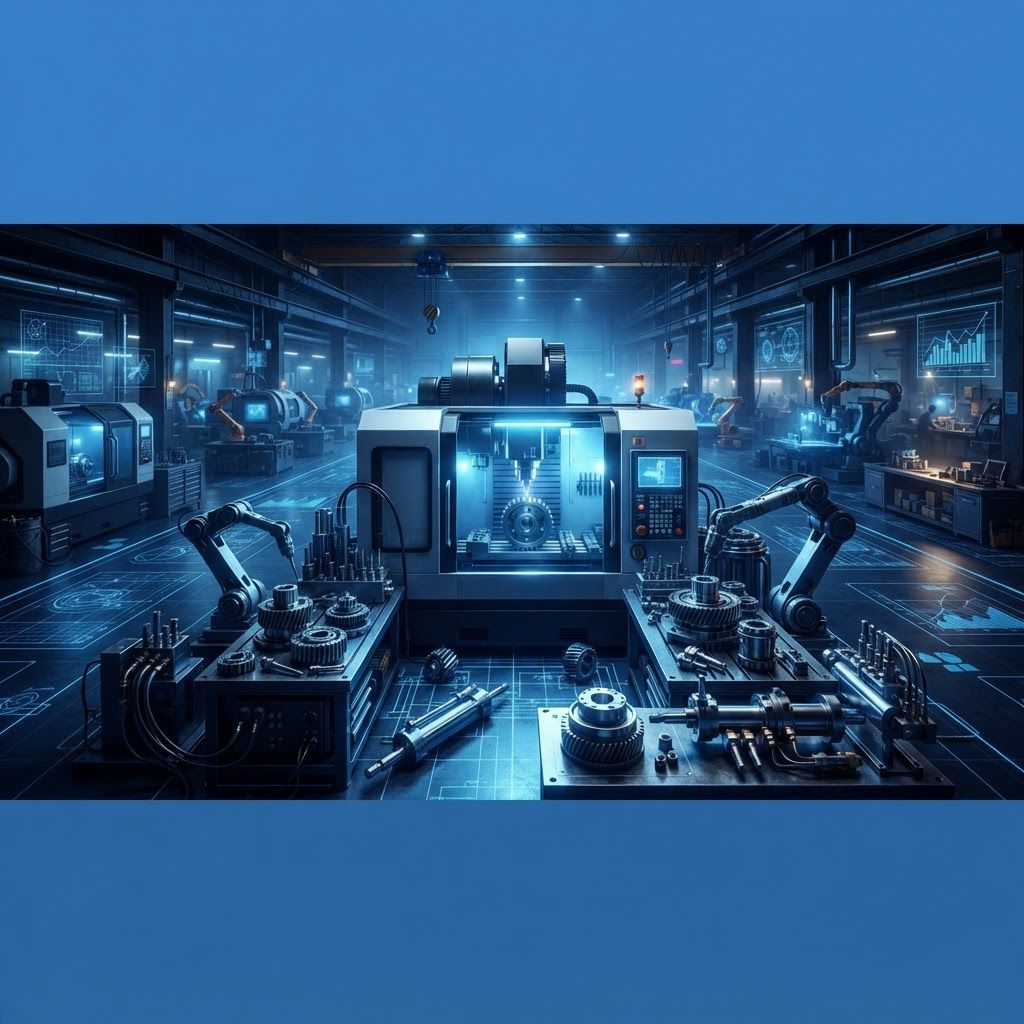
Engineering Machinery in the Teign Valley
Machinery manufacturing is one of the quieter strengths of the Teignbridge economy. The Heathfield industrial area and the estates around Newton Abbot host fabrication shops, machining centres, control engineering firms and assembly operations that build equipment used across Devon and far beyond. Unlike consumer-facing industries, this work is largely invisible to residents, yet it underpins agriculture, food production, quarrying, marine activity, water management and manufacturing throughout the region.
The character of the sector is bespoke rather than volume. Local firms rarely compete with international equipment brands on standard products. Instead they design and build machinery tailored to a specific process, retrofit and upgrade existing plant, integrate automation into established production lines and provide the servicing that keeps capital equipment running. This model suits a skilled, flexible workforce and an economy full of small and medium producers with non-standard requirements.
Ten Machinery Manufacturers Serving the District
Teign Engineering Works designs and builds bespoke industrial machinery, taking projects from concept and mechanical design through fabrication, assembly, control integration and site commissioning for clients across the South West.
Moorland Agricultural Machinery manufactures and adapts equipment for farming and land management, including handling systems, feeding and bedding equipment, trailers, and attachments engineered for Devon's steep terrain and wet conditions.
Haldon Food Processing Systems builds stainless steel processing, conveying, washing and packing machinery for the region's food and drink producers, designed with hygienic construction and washdown resistance in mind.
Newton Abbot Precision Machining operates CNC turning and milling capability producing components and spares to tight tolerance, supporting both its own assemblies and other manufacturers requiring machined parts.
Estuary Marine Engineering manufactures and services deck machinery, winches, hydraulic systems, davits and handling equipment for commercial vessels and harbour operations along the Teign estuary and wider coast.
Riviera Automation and Robotics integrates robotic cells, pick and place systems, vision inspection and programmable control into existing production lines, helping manufacturers increase throughput without complete plant replacement.
Coastway Hydraulic Systems designs, builds and repairs hydraulic power packs, cylinders, pipework and control systems for construction plant, agricultural machinery and industrial equipment.
Chudleigh Materials Handling produces conveyors, elevators, hoppers, screening equipment and bulk handling systems used in quarrying, recycling, agriculture and manufacturing.
Shaldon Fabrication and Structures provides heavy fabrication, welding, structural steelwork and pressure-related assemblies, supplying both finished products and subcontract capacity to other machinery builders.
Dartmoor Plant Maintenance Engineering focuses on the service side, offering planned maintenance, breakdown response, machine refurbishment, obsolescence management and safety upgrades for ageing equipment.
Why Bespoke Machinery Makes Commercial Sense
Many businesses assume custom machinery is inherently expensive, but the calculation is often the reverse. A standard machine that fits a process imperfectly imposes permanent inefficiency: extra handling, higher waste, additional labour or a bottleneck that caps output. A purpose-built machine that matches the process exactly can repay its premium quickly.
Bespoke design also addresses constraints that catalogue equipment ignores, such as awkward building footprints in converted rural premises, unusual product characteristics, seasonal throughput variation or the need to integrate with legacy equipment that cannot be economically replaced.
Retrofit and upgrade work occupies a similar space. Replacing outdated controls, adding safety guarding to older machines, fitting variable speed drives or introducing data monitoring can extend useful life substantially at a fraction of replacement cost.
Standards, Safety and Compliance
Machinery placed on the market must meet applicable safety requirements, with risk assessment, appropriate guarding, emergency stop systems, clear instructions and a declaration of conformity. Responsibility also falls on businesses that substantially modify existing machinery, a point frequently overlooked when a company adapts equipment in-house.
Functional safety of control systems, electrical safety, pressure equipment rules where relevant and noise and vibration considerations all form part of competent design. Employers additionally carry ongoing duties for inspection, maintenance and safe operation once machinery is in service.
Reputable manufacturers in the district handle this documentation as a matter of course and will advise clients where a proposed modification would create compliance obligations.
Technology Trends in Machinery Building
Digitalisation is the dominant theme. Sensors, programmable controllers and connected monitoring now allow condition-based maintenance, where vibration, temperature and current signatures indicate wear before failure occurs. For a food producer or quarry operator, avoiding unplanned downtime is worth considerably more than the monitoring hardware costs.
Automation adoption is rising as labour availability tightens across Devon. Robotic handling, automated packing and vision inspection are increasingly viable at smaller scale thanks to falling equipment costs and simpler programming interfaces.
Energy efficiency features prominently in specifications, with variable speed drives, efficient motors, regenerative systems and reduced compressed air use all reducing operating cost against a background of elevated electricity prices.
Simulation and digital design shorten development, allowing machines to be modelled, stress-analysed and virtually commissioned before metal is cut.
Commissioning Machinery Successfully
Define the requirement in terms of outcome rather than mechanism. Throughput, product characteristics, tolerance, utilities available, footprint, cleaning regime and operator skill level tell an engineer far more than a sketch of a proposed solution.
Agree acceptance criteria before build. A factory acceptance test followed by a site acceptance test, with measurable performance targets, protects both parties and prevents disputes about whether a machine performs as intended.
Plan for support. Spare parts availability, response times, documentation quality and operator training determine long-term satisfaction far more than the initial purchase price.
Finally, use local capability where possible. When a production line stops, the difference between an engineer arriving from Newton Abbot within the hour and waiting days for an overseas supplier is measured directly in lost output.
Want your brand featured in front of decision-makers? Publish a guest post or get a link insertion in our guides through AAMAX's guest post and link insertion service.
Helpful Links
 SponsoredAAMAX — Full-Service Digital Agency
Write for Us
Share your expertise with our readers. We welcome guest contributions from industry specialists.
Pitch your idea

