

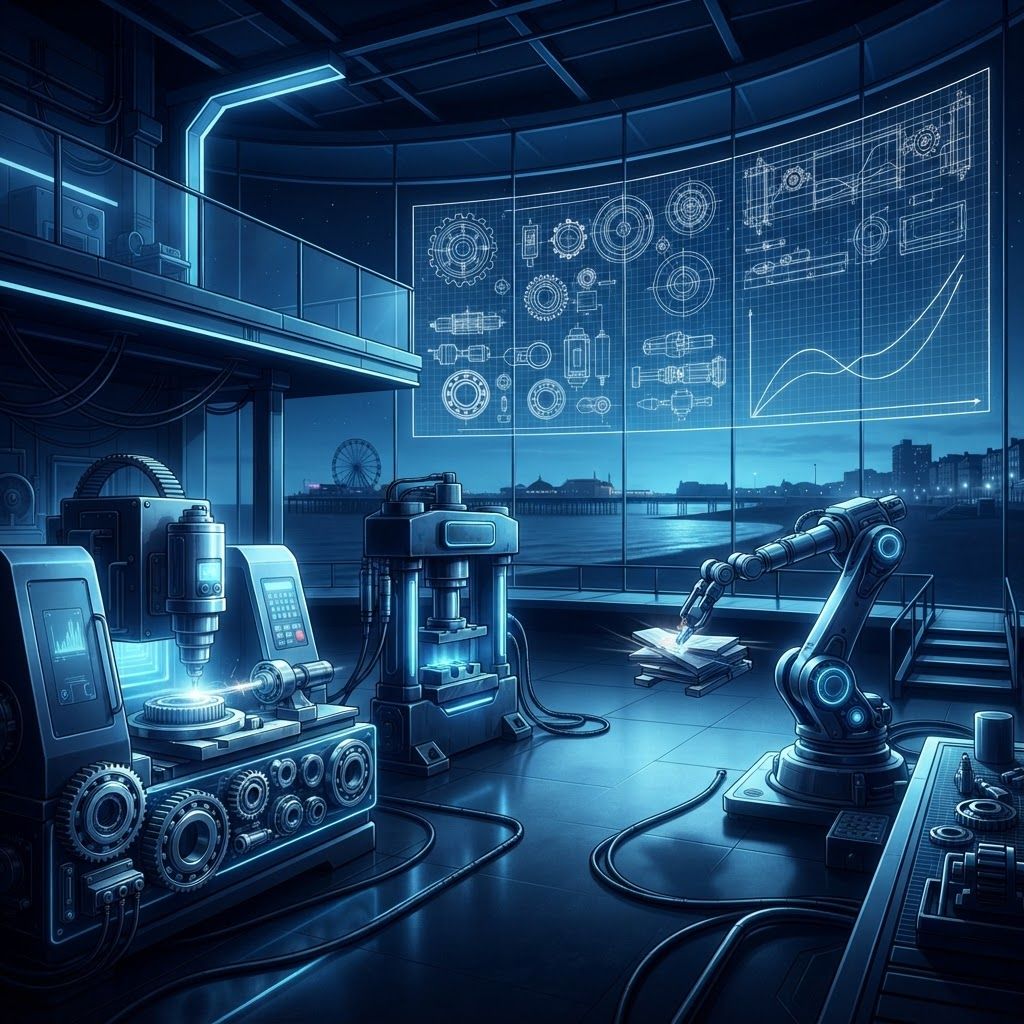
Engineering Capability in Southend-on-Sea
Machinery manufacturing is one of the quieter strengths of the south Essex economy. Across Southend-on-Sea and the surrounding industrial areas sit engineering businesses that design and build the equipment other industries depend on: bespoke automation cells, conveyors and materials handling systems, process and packaging machinery, hydraulic and pneumatic systems, marine and lifting equipment, and precision sub-assemblies.
This capability grew from the region's industrial history in aerospace, marine and light manufacturing, leaving a workforce skilled in mechanical design, fabrication, machining, electrical integration and control systems. Combined with strong road links toward London and the Thames crossings, the area is well positioned to serve customers across the south-east and beyond.
What Local Machinery Manufacturers Build
Bespoke Automation and Special Purpose Machinery
Many local firms specialise in one-off or small-batch machines designed for a specific customer process: assembly stations, robotic handling cells, test rigs, inspection systems and end-of-line automation. This work is engineering-led, beginning with process analysis and concept design before mechanical build and control programming.
Materials Handling and Conveying
Conveyors, elevators, sortation systems, palletising equipment and bulk handling plant serve logistics operations, food producers, recycling facilities and manufacturers. Growth in warehousing and distribution across Essex and the Thames corridor has sustained demand.
Process and Packaging Equipment
Filling, capping, labelling, weighing, mixing and wrapping machinery supports food, beverage, cosmetics and pharmaceutical producers. Hygienic design, washdown-rated construction and validation documentation are important in these sectors.
Hydraulics, Pneumatics and Power Transmission
Specialists design and build hydraulic power packs, cylinders, manifolds and pneumatic systems, and provide hose assembly, filtration and servicing. Marine, construction plant and industrial press applications are common.
Lifting and Marine Equipment
Given the estuary location, cranes, davits, winches, gangways and boat handling equipment feature in local capability, along with associated testing and certification services.
Machine Refurbishment and Retrofit
A substantial share of work involves extending the life of existing plant: rebuilding worn assemblies, replacing obsolete controls with modern programmable logic controllers and drives, upgrading guarding to current safety standards, and improving energy efficiency. Retrofit is frequently far cheaper than replacement.
Precision Machining and Fabrication
Underpinning all of the above are machine shops and fabricators providing turned and milled components, structural steelwork, sheet metal enclosures, welding and surface finishing.
Industry Trends
Industrial automation adoption continues to accelerate, driven by labour availability, wage pressure and quality consistency requirements. Collaborative robots have lowered the entry barrier for smaller manufacturers by reducing the need for extensive guarding and specialist programming.
Digitalisation is reshaping machinery specification. Customers increasingly expect condition monitoring sensors, data logging, remote diagnostics and integration with production management systems. Predictive maintenance based on vibration, temperature and current monitoring reduces unplanned downtime and is becoming a standard commercial requirement rather than a premium extra.
Energy efficiency is now an explicit design criterion. Variable speed drives, regenerative braking, right-sized motors, efficient pneumatics and reduced compressed air leakage all lower operating cost and support carbon reporting obligations.
Machinery safety compliance has grown more demanding. Machines supplied in the United Kingdom must meet applicable supply regulations, requiring risk assessment, appropriate safeguarding, performance-rated safety control systems, technical documentation and conformity marking. Competent manufacturers handle this as part of the build rather than as an afterthought.
Supply chain lead times for drives, controls and specialist components remain longer than historic norms, making early procurement planning essential on capital projects.
Finally, skills shortages in design engineering, controls programming and skilled fitting are widely reported, reinforcing the value of manufacturers who invest in apprenticeships.
Benefits of Buying Machinery Locally
Bespoke machinery is a collaborative product, and proximity matters. Regular design reviews, factory acceptance testing attended in person, and rapid response during commissioning all work better when the builder is nearby.
Aftercare is arguably the biggest advantage. When a production line stops, response time determines the cost of the incident. A local manufacturer holding drawings, spares knowledge and trained engineers can attend quickly, whereas overseas suppliers may require days and considerable expense.
Modification flexibility is another benefit. Processes evolve, and a nearby builder can adapt guarding, tooling or control logic without shipping equipment abroad.
Documentation and compliance support is clearer, with manufacturers familiar with United Kingdom regulatory requirements and able to supply the technical file, declaration of conformity and operating manuals expected by safety inspectors and insurers.
How to Specify and Select a Machinery Manufacturer
Start with a clear user requirement specification. Define the product or material handled, throughput targets, available floor space and services, required accuracy, changeover expectations, cleaning regime, operator interaction and integration with upstream and downstream equipment. Vague requirements produce disappointing machines.
Evaluate engineering depth. Ask whether design is done in-house, which computer-aided design and simulation tools are used, and whether controls software is developed internally. Request examples of comparable projects and speak to previous customers about performance and support.
Confirm safety and compliance competence. The manufacturer should describe its risk assessment process, reference relevant harmonised standards, explain how safety functions will be rated and validated, and confirm what documentation will accompany delivery.
Agree acceptance testing explicitly. Define factory acceptance test and site acceptance test criteria, throughput demonstration conditions and how performance shortfalls will be remedied.
Clarify project management and milestones. Bespoke machinery projects benefit from staged design freeze points, progress reviews and clear change control with cost implications agreed in advance.
Address lifecycle support. Establish spares availability, recommended stockholding, response time commitments, service contract options, training provision and whether control source code or backups are supplied.
Finally, consider total cost of ownership rather than capital price alone. Energy consumption, consumable use, maintenance labour, changeover time and expected availability often outweigh initial cost differences over a machine's life.
Final Thoughts
Machinery manufacturing around Southend-on-Sea combines traditional mechanical craft with modern automation, controls and digital monitoring. Whether the requirement is a bespoke assembly cell, a conveying system, hygienic process equipment or a control retrofit on ageing plant, capable engineering businesses operate within easy reach. The keys to a successful project are a rigorous requirement specification, a builder with demonstrable engineering and compliance competence, clearly defined acceptance testing and a realistic plan for long-term support.
Want your brand featured in front of decision-makers? Publish a guest post or get a link insertion in our guides through AAMAX's guest post and link insertion service.
Helpful Links
 SponsoredAAMAX — Full-Service Digital Agency
Write for Us
Share your expertise with our readers. We welcome guest contributions from industry specialists.
Pitch your idea

