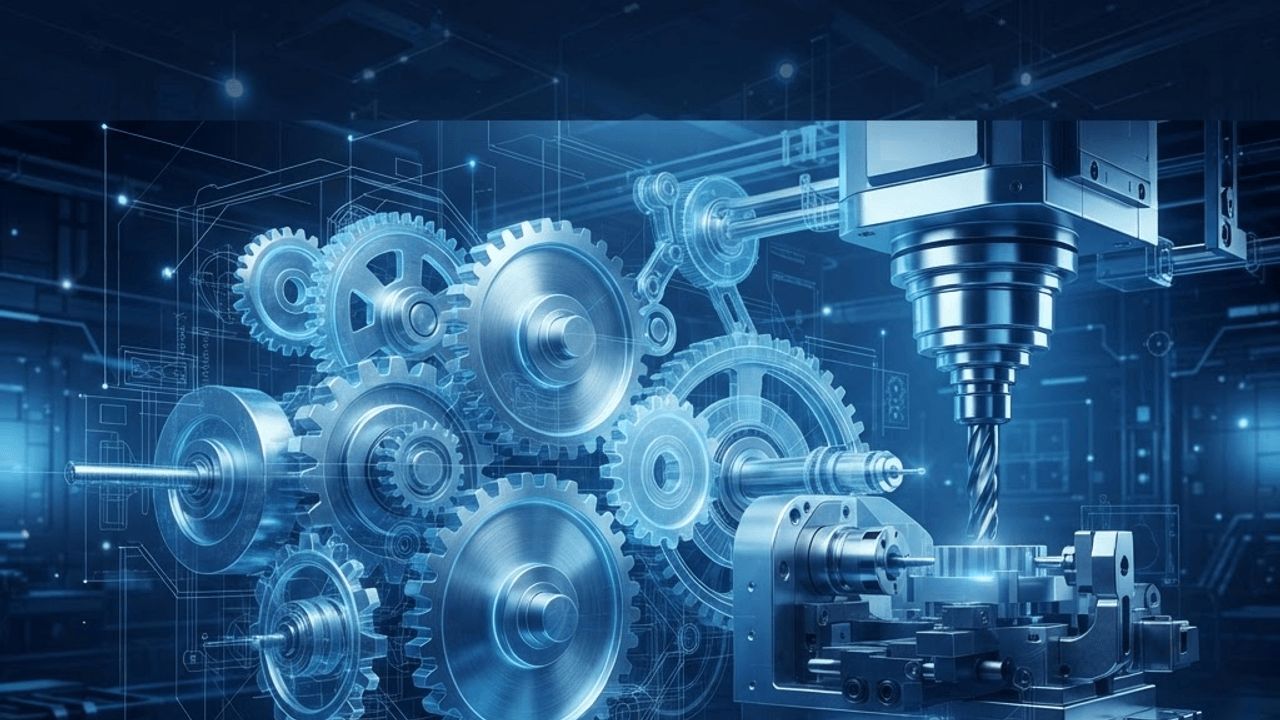
Machinery Building in the East Midlands
Machinery manufacturing is among the most demanding forms of engineering. It combines mechanical design, hydraulics, electrical systems, control software and safety engineering into products that must operate reliably for decades in harsh conditions. South Derbyshire and its surrounding area have built a genuine specialism in this work, supported by a skilled labour pool, established supply networks for castings, fabrications and precision components, and excellent transport links for moving heavy and oversized goods.
The district's machinery sector spans several distinct categories. Construction and earthmoving equipment has a substantial presence just across the county boundary and draws heavily on South Derbyshire suppliers. Materials handling, conveying and bulk processing equipment serves the quarrying, aggregates and waste sectors that remain active locally. Process plant for food, chemical and pharmaceutical production is another strand, as is precision machine tool work and bespoke special-purpose machinery built to individual customer specification.
Ten Machinery Manufacturers Relevant to South Derbyshire
1. JCB is the defining machinery manufacturer of the area, producing backhoe loaders, excavators, telehandlers and a growing range of electric and hydrogen-powered machines from facilities close to the district. Its supply chain reaches deep into South Derbyshire engineering businesses.
2. Terex manufactures materials processing equipment including crushers, screens and washing plant, serving the quarrying and recycling sectors that operate across Derbyshire's former extraction landscape.
3. Bateman Engineering designs and builds bulk materials handling and process plant, combining mechanical fabrication with control system integration for demanding industrial applications.
4. Rolls-Royce contributes advanced manufacturing capability and precision machining standards to the region, and its supplier requirements have raised technical capability across regional machining businesses.
5. Hydro Systems and comparable hydraulics specialists supply the power transmission systems at the heart of construction and industrial machinery, providing design, manufacture and testing of cylinders, power packs and manifolds.
6. Bruderer UK supplies high-speed precision stamping presses and associated tooling to manufacturers across the Midlands, supporting the component production that feeds automotive and electronics supply chains.
7. Mills CNC provides machine tools, automation cells and turnkey machining solutions to engineering businesses, and its applications support has helped many regional firms adopt multi-axis and lights-out machining.
8. Ward CNC supplies and supports machine tools across the region with a strong service network, addressing the uptime requirements that determine profitability in subcontract machining.
9. Riley Surface Welding and similar specialist engineering firms provide hardfacing, refurbishment and wear protection services that extend the operating life of heavy machinery components used in quarrying and materials handling.
10. Pentagon Engineering and comparable bespoke machine builders design and construct special-purpose automation and handling systems tailored to individual production challenges, a capability in strong demand as manufacturers automate.
Automation and Industry 4.0
Modern machinery increasingly ships with connectivity built in. Sensors monitoring vibration, temperature, hydraulic pressure and cycle counts feed data to platforms that identify developing faults before failure occurs. For a quarry operator or construction contractor, avoiding an unplanned breakdown is worth considerably more than a marginal reduction in purchase price.
This has changed how machinery is designed and sold. Manufacturers now build data capture into the specification from the outset, and consider cybersecurity as a design requirement since connected equipment on a customer network represents a potential attack surface.
Within machinery factories themselves, automation has advanced through robotic welding, automated machining cells running unattended overnight, and digital work instructions on assembly lines. The constraint is rarely technology but the engineering time required to implement it well, which favours manufacturers with strong internal process engineering capability.
Servitisation and Aftermarket Value
One of the most significant commercial shifts in machinery has been the move from selling equipment to selling capability. Rather than a one-off transaction, manufacturers increasingly offer long-term contracts covering availability, maintenance and performance guarantees.
This changes incentives substantially. When revenue depends on uptime rather than parts sales, manufacturers design for reliability and serviceability, and invest in condition monitoring that supports predictive maintenance. It also creates recurring revenue that smooths the cyclicality traditionally associated with capital equipment sales, a meaningful benefit for businesses exposed to construction sector volatility.
Aftermarket parts and service remain a substantial profit centre. Manufacturers who maintain spares availability for machines twenty years old build lasting customer loyalty, and the growth of remanufacturing, where worn components are restored to original specification, adds both margin and environmental benefit.
Compliance and Safety Engineering
Machinery placed on the UK market must meet supply of machinery safety requirements, carrying appropriate conformity marking and supported by a technical file demonstrating compliance. Risk assessment under harmonised standards drives design decisions on guarding, emergency stop systems, interlocks and control system safety integrity.
Functional safety has become increasingly rigorous. Control systems performing safety functions must be designed and validated to defined performance levels, requiring engineering discipline and documentation well beyond conventional control design. Manufacturers who treat this as an integral part of design rather than a late compliance exercise produce better machines and avoid costly redesign.
Noise, vibration and emissions requirements apply to mobile machinery in particular, and the shift toward electric and alternative fuel powertrains in construction equipment is driven partly by urban site restrictions on both emissions and noise.
Decarbonisation of Machinery
Heavy machinery presents a genuine decarbonisation challenge because energy density requirements are high and duty cycles are demanding. Battery electric solutions work well for compact equipment and intermittent duty, and adoption has been rapid in smaller excavators and handling equipment used on urban sites.
For larger machines operating long shifts in remote locations, hydrogen combustion and fuel cells are being actively developed, with regional manufacturers among the more visible participants. Hydrotreated vegetable oil offers an immediate partial solution for existing diesel fleets without modification.
Choosing a Machinery Partner
For buyers, evaluate lifetime cost rather than purchase price, including parts availability, service response time and expected energy consumption. Ask about software support commitments, since connected machines depend on it. Visit the manufacturer and assess engineering depth, because the quality of support over a fifteen-year machine life depends on the people behind it far more than the specification sheet.
Want your brand featured in front of decision-makers? Publish a guest post or get a link insertion in our guides through AAMAX's guest post and link insertion service.
Helpful Links
 SponsoredAAMAX — Full-Service Digital Agency
Write for Us
Share your expertise with our readers. We welcome guest contributions from industry specialists.
Pitch your idea