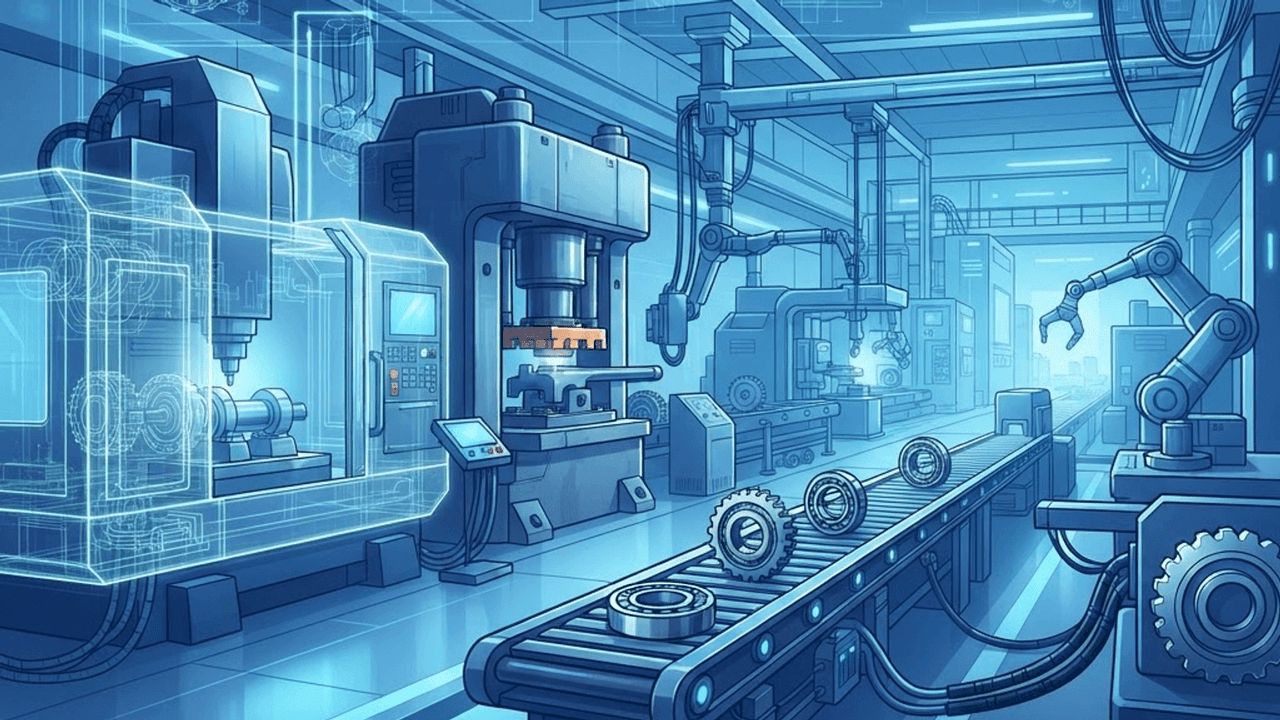
Machinery Manufacturing in an Engineering Town
Rugby's industrial identity was built on making things that make other things. Heavy electrical engineering, turbine and generator work, cement plant equipment and precision engineering all established a base of skilled machinists, fabricators, designers and controls engineers that persists today in a more diversified form.
Modern machinery manufacturing in the town ranges from one-off bespoke automation cells built to a customer's exact process requirements, through standard product lines such as conveyors and material handling equipment, to subcontract precision machining supplying components to other machine builders.
What unites these businesses is problem-solving. A machinery manufacturer is rarely selling a catalogue item. It is selling a solution to a production bottleneck, a quality issue, a safety concern or a labour constraint, and the engineering conversation matters as much as the hardware delivered.
Technologies Driving the Sector
Automation and robotics adoption continues to accelerate, driven by labour availability and quality consistency rather than pure cost reduction. Collaborative robots have lowered the entry barrier considerably, allowing smaller manufacturers to automate tasks that previously required expensive guarded cells.
Digital design and simulation have transformed development. Machines are now modelled, kinematically simulated and virtually commissioned before a single component is cut, reducing build errors and shortening installation time on customer sites.
Condition monitoring and connectivity are increasingly built in as standard. Vibration sensors, current monitoring and predictive maintenance analytics allow machines to signal developing faults before failure, which is particularly valuable where downtime carries high cost.
Additive manufacturing has found practical application in tooling, jigs, fixtures and low-volume complex parts, complementing rather than replacing conventional machining.
The Top 10 Best Machinery Manufacturers in Rugby
1. Warwickshire Special Purpose Machinery
Designing and building bespoke automation and assembly machines for manufacturing clients, covering mechanical design, controls, safety integration and commissioning as a complete turnkey package.
2. Rugby Precision Machining
Operating multi-axis CNC milling and turning for complex components in steel, aluminium, stainless and engineering plastics, with inspection capability including coordinate measuring machines.
3. Central Park Materials Handling
Manufacturing conveyors, elevators, sortation equipment and palletising systems for warehousing and production environments, an area with particularly strong local demand given the logistics sector.
4. Avon Hydraulics and Pneumatics
Producing hydraulic power units, cylinders, manifolds and pneumatic systems, alongside repair and refurbishment services for existing plant equipment.
5. Midland Robotics Integration
Integrating industrial and collaborative robots into production processes, covering cell design, end-of-arm tooling, vision systems, programming and safety assessment.
6. Clifton Fabrication and Heavy Engineering
Fabricating large welded structures, frames, tanks and machine bases, with coded welding and capability for substantial component sizes.
7. Brownsover Packaging Machinery
Building filling, capping, labelling and end-of-line packaging equipment for food, beverage and consumer product manufacturers, with attention to hygienic design requirements.
8. Newbold Gearing and Power Transmission
Manufacturing and reconditioning gearboxes, drive assemblies and power transmission components for industrial machinery, including gear cutting and precision assembly.
9. Hillmorton Machine Tool Services
Providing retrofit, refurbishment and control upgrades for existing machine tools, extending asset life at a fraction of replacement cost while improving accuracy and capability.
10. Dunchurch Test and Measurement Equipment
Designing bespoke test rigs, inspection fixtures and measurement systems for manufacturers needing to verify product performance in production conditions.
Engineering Standards and Compliance
Machinery supplied in the United Kingdom must meet stringent safety requirements. Manufacturers are responsible for risk assessment, appropriate guarding, safe control system design, emergency stop provision and the production of technical files and declarations of conformity.
Buyers should confirm that a machine builder understands these obligations properly. Inadequate safety documentation transfers considerable liability to the purchaser and can render a machine unusable following an insurer or regulator inspection.
Documentation quality more broadly separates competent builders from the rest. Operating manuals, maintenance schedules, spare parts lists, electrical schematics and controls source code availability all determine how supportable a machine is over a twenty-year life.
Selecting a Machinery Partner
Define the requirement in terms of outcome rather than solution. Stating the throughput, tolerance, material, footprint and interface requirements allows an engineering partner to propose an approach you may not have considered, which frequently produces a better result than specifying a machine design yourself.
Assess project management capability. Bespoke machinery projects involve long lead items, multiple disciplines and defined acceptance stages. Builders who provide clear programmes, staged progress reviews and factory acceptance testing deliver far more predictably.
Consider lifetime support seriously. Ask about spare parts availability, response times for breakdown support, remote diagnostics capability and whether the controls platform is a widely supported standard rather than a proprietary system.
Finally, visit the workshop. Cleanliness, organisation, equipment condition and the confidence of the engineering team reveal more about likely delivery quality than any presentation.
The Outlook
Reshoring of manufacturing, persistent labour constraints and the need for greater production flexibility all support continued investment in automation and machinery. Rugby's engineering firms, with their combination of mechanical craft, controls expertise and problem-solving culture, are well positioned to supply that demand. For manufacturers in the region, a capable local machine builder who can visit the site, understand the process and support the equipment for decades remains an exceptionally valuable relationship.
Want your brand featured in front of decision-makers? Publish a guest post or get a link insertion in our guides through AAMAX's guest post and link insertion service.
Helpful Links
 SponsoredAAMAX — Full-Service Digital Agency
Write for Us
Share your expertise with our readers. We welcome guest contributions from industry specialists.
Pitch your idea