

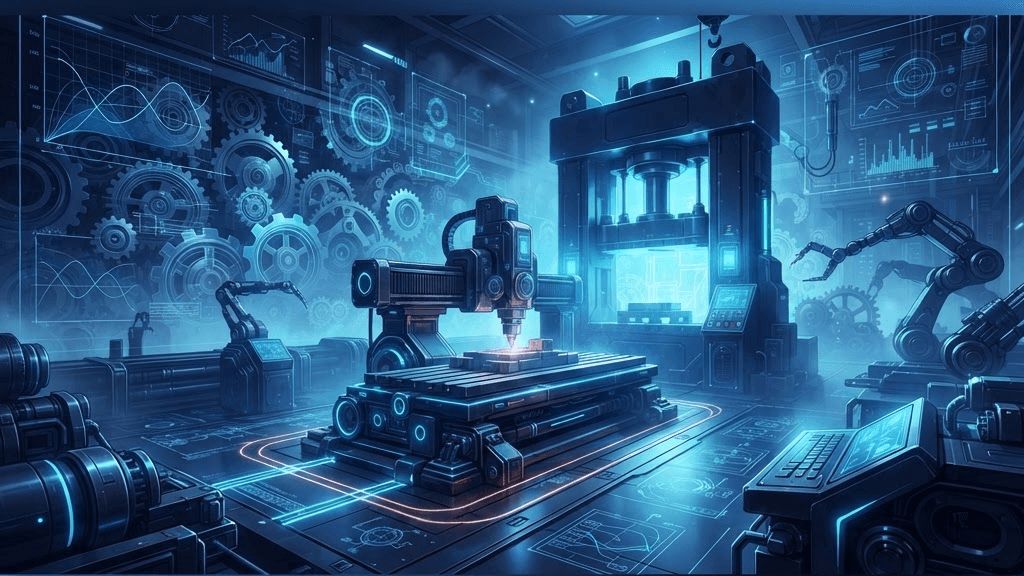
Engineering Heritage Turned Modern Capability
Redcar and Cleveland's industrial story has always been one of making things that make other things. Steel, chemicals and heavy processing created a demand for robust mechanical equipment, and around that demand grew a community of engineers, fabricators, machinists and designers capable of building machinery from first principles. That community still exists, and it remains one of the borough's most valuable economic assets.
Machinery manufacturing here covers an unusually broad spectrum. At one end sit large bespoke plant items such as material handling systems, mixing vessels, conveyor installations and process skids. At the other are precision sub-assemblies, hydraulic power units, specialist tooling and automation cells. Between them lies a vast amount of repair, refurbishment and upgrade work that keeps existing industrial assets productive.
Understanding the Machinery Manufacturing Process
Building industrial machinery is rarely a catalogue transaction. It typically begins with a problem statement rather than a specification: a client needs to move, mix, cut, sort, dry, cool or package something more efficiently. The manufacturer then works through concept design, detailed engineering, material selection, fabrication, machining, assembly, testing, installation and commissioning.
Each stage carries risk. Underestimating duty cycles produces machines that fail prematurely. Ignoring maintenance access creates equipment that is technically functional but practically miserable to service. Skipping proper factory acceptance testing turns commissioning into an expensive firefight. The manufacturers that earn strong reputations are those that manage these risks rigorously rather than optimistically.
The Top 10 Machinery Manufacturers in Redcar and Cleveland
1. Tees Heavy Engineering
Tees Heavy Engineering handles large-scale fabrication and machinery build for process and materials handling applications. The company's capability with substantial weldments, heavy lifting and structural assemblies makes it a natural choice for major plant projects. Its project management discipline on long-lead items is regularly commended.
2. Redcar Conveyor Systems
Specialising in bulk material handling, Redcar Conveyor Systems designs, manufactures and installs belt conveyors, screw conveyors, chutes, hoppers and transfer points. Its engineers understand the practical realities of abrasive materials and dust management, which is where most conveyor installations succeed or fail.
3. Cleveland Hydraulics and Pneumatics
This manufacturer builds hydraulic power units, cylinders, manifolds and pneumatic control systems for industrial and mobile applications. It also provides on-site hose replacement and system troubleshooting, a service that keeps plant running when a failure would otherwise stop production entirely.
4. Saltburn Precision Machining
Saltburn Precision Machining produces machined components and sub-assemblies to tight tolerances using CNC and conventional equipment. Its capability with larger workpieces distinguishes it from general jobbing shops, and its inspection facilities allow proper verification rather than assumption.
5. Guisborough Process Equipment
Focusing on vessels, tanks, mixers, heat exchangers and process skids, Guisborough Process Equipment serves chemical, food and water treatment clients. Its familiarity with pressure equipment requirements and hygienic design standards is essential in these regulated sectors.
6. East Cleveland Automation
East Cleveland Automation integrates robotics, vision systems, conveying and control into complete automated cells. The business is particularly effective at identifying which processes genuinely benefit from automation and which do not, which saves clients from expensive misdirected investment.
7. Skelton Gear and Transmission
Gearboxes, drive assemblies, couplings and power transmission components form the core of Skelton Gear and Transmission's work. Manufacturing, repair and reverse engineering of obsolete units are all offered, the latter being invaluable where original equipment support has ended.
8. Marske Machine Tools
Marske Machine Tools supplies, refurbishes and rebuilds machine tools including lathes, mills and grinders. Full rebuilds restore accuracy at a fraction of new machine cost, making the service attractive to workshops managing capital expenditure carefully.
9. Loftus Lifting Equipment
Manufacturing and certifying lifting beams, gantries, jibs, spreader frames and bespoke lifting accessories, Loftus Lifting Equipment operates in a safety-critical field where design calculation and testing documentation are non-negotiable. Its thorough approach to certification reassures safety-conscious clients.
10. Teesside Packaging Machinery
Teesside Packaging Machinery builds and integrates filling, capping, labelling, wrapping and end-of-line packaging equipment. Food, beverage and consumer goods producers value its ability to adapt standard machine platforms to unusual product formats.
Trends in Industrial Machinery
Condition monitoring has moved from novelty to expectation. Vibration sensors, temperature monitoring and current signature analysis now feature routinely on new machinery, feeding maintenance platforms that flag developing faults weeks before failure. Manufacturers who build monitoring in from the outset deliver considerably more value over an asset's life.
Energy efficiency has risen sharply up specification lists as industrial power costs have climbed. Variable speed drives, efficient motors, optimised hydraulic circuits and reduced-friction designs deliver savings that increasingly justify higher capital cost.
Modularity is the third trend. Skid-mounted, pre-tested modular plant reduces on-site installation time and disruption, which matters enormously when installation windows are short and downtime is expensive.
How to Specify Machinery Successfully
Define the duty properly. Throughput, material characteristics, operating hours, ambient conditions and expected variation should all be documented. Vague specifications produce machines that meet the letter of a requirement while failing its intent.
Insist on factory acceptance testing wherever practical. Discovering problems in the manufacturer's workshop is dramatically cheaper than discovering them in your own plant. Agree the test protocol in writing before build begins.
Consider the whole life cost. A machine that costs less initially but consumes more energy, requires more maintenance and suffers more downtime will prove far more expensive over ten years. Ask for spares lists, maintenance schedules and realistic consumable costs at quotation stage.
Check maintenance access during design review. If a bearing requires partial disassembly of the machine to replace, that decision will be regretted repeatedly for as long as the equipment exists.
Why Local Machinery Manufacturing Matters
The strongest argument for sourcing machinery within Redcar and Cleveland is support. When a bespoke machine develops a fault, having its designers within an hour's drive changes everything. Site visits happen the same day. Modifications get made properly. Institutional knowledge about your specific equipment remains accessible rather than evaporating into an overseas service desk.
Combined with the genuine engineering depth accumulated over generations of Teesside industry, that responsiveness makes the borough's machinery manufacturers a serious proposition for anyone specifying industrial equipment in the North East and well beyond.
Want your brand featured in front of decision-makers? Publish a guest post or get a link insertion in our guides through AAMAX's guest post and link insertion service.
Helpful Links
 SponsoredAAMAX — Full-Service Digital Agency
Write for Us
Share your expertise with our readers. We welcome guest contributions from industry specialists.
Pitch your idea

