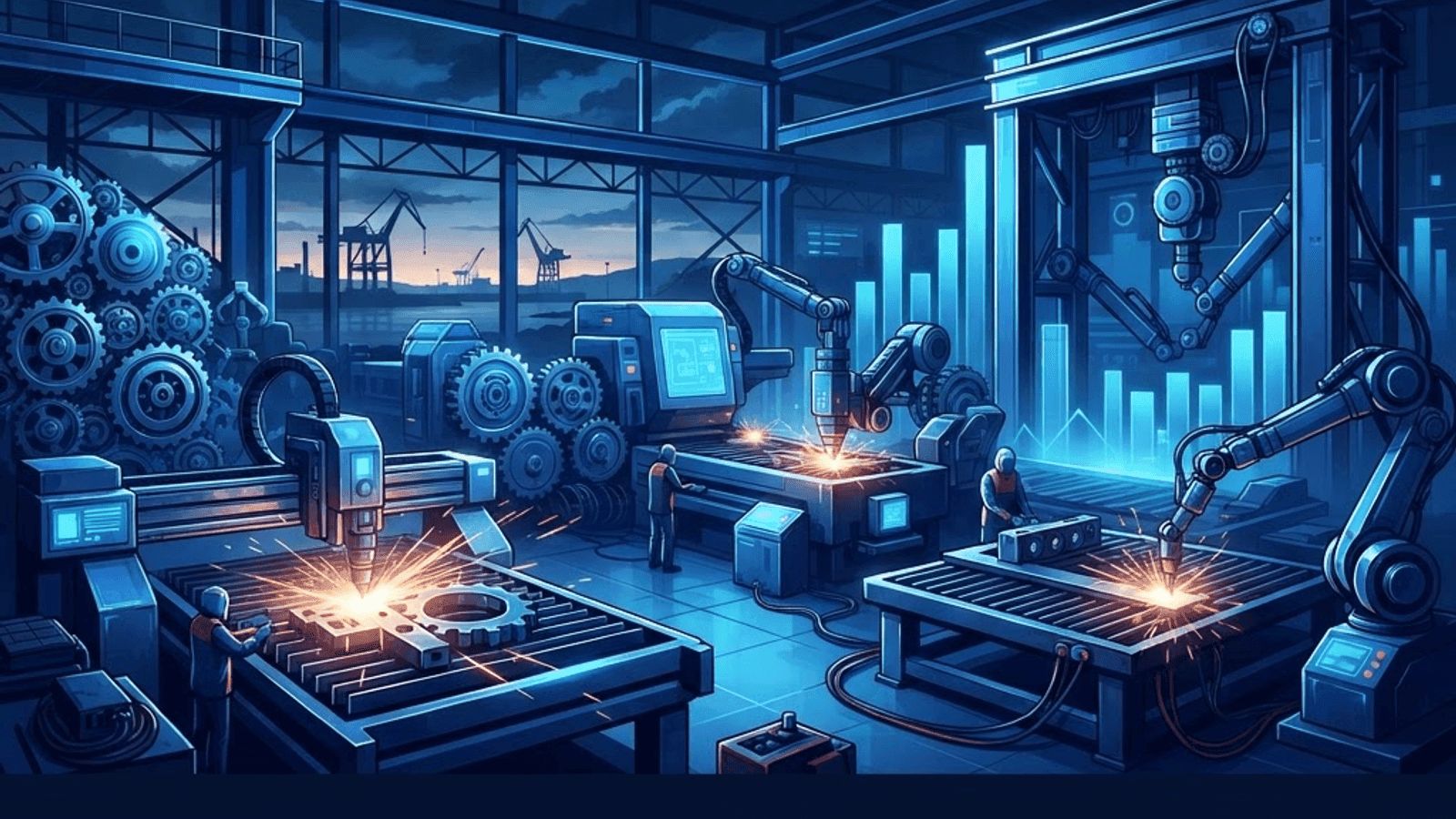
Engineering Built Around Local Industry
Machinery manufacturing in Pembrokeshire has developed to serve the industries that define the county. Agriculture needs handling systems, feeding equipment, grain and livestock machinery. Food processing, including dairy, meat and seafood, needs conveying, washing, grading and packing equipment built to hygienic standards. The marine and port sector needs winches, lifting equipment, deck machinery and handling systems. Energy operations need pressure equipment, skid mounted process packages, access structures and pipework assemblies.
What links these markets is that almost none of the equipment is standard. A farm building has particular dimensions, a processing line has a specific throughput and a vessel has unique deck constraints. Custom machinery building is therefore the county's core competence, supported by fabrication, machining, hydraulics, electrical control and installation capability.
The Capabilities Available Locally
Typical capabilities include structural and sheet metal fabrication in mild steel, stainless steel and aluminium, coded welding to recognised standards, computer numerical control machining and turning, laser and plasma profiling, hydraulic and pneumatic system design, gearbox and drive integration, control panel build and programming, surface treatment and finishing, plus site installation and commissioning. Many businesses also offer reverse engineering, producing replacement parts for machinery whose original manufacturer no longer exists, which is invaluable for farms and factories running long lived equipment.
Ten Machinery Manufacturers and Fabricators in Pembrokeshire
1. Cleddau Engineering Works
A general engineering and machinery builder producing bespoke handling systems, frames and mechanical assemblies, with in house machining, fabrication and assembly under one roof.
2. Preseli Agricultural Engineering
A designer and manufacturer of farm machinery including feeding systems, livestock handling equipment, grain handling and bespoke implements developed in consultation with working farms.
3. Haven Marine Deck Machinery
A builder of winches, davits, capstans and deck handling equipment for fishing vessels, workboats and port operations, including hydraulic power packs and control systems.
4. Milford Process Skids and Pressure Systems
A fabricator of skid mounted process packages, pipework assemblies and pressure equipment for the energy and chemical sector, working to recognised design and inspection codes.
5. West Wales Food Processing Equipment
A manufacturer of hygienic stainless steel machinery for dairy, meat and seafood processing, covering conveyors, wash systems, grading tables and packing line equipment.
6. Pembroke Precision Machining
A computer numerical control machining specialist producing precision components, shafts, housings and replacement parts in small batches with tight tolerance capability.
7. Coastway Hydraulics and Drives
A hydraulic systems house designing, building and servicing power packs, cylinders, manifolds and drive systems for mobile and static machinery across multiple industries.
8. Narberth Automation Systems
An integrator building automated production cells, robotic handling and vision inspection systems for manufacturers seeking to reduce manual handling and improve consistency.
9. St Davids Structural Fabrication
A structural steel fabricator producing platforms, access stairs, gantries, mezzanines and support structures, including design, fabrication, coating and site erection.
10. Pembrokeshire Machinery Refurbishment
A specialist rebuilding and upgrading ageing industrial machinery, including control system modernisation and safety upgrades that bring older equipment up to current standards.
Safety, Certification and Legal Duties
Machinery manufacturing carries significant legal responsibility. Equipment placed on the market must meet applicable machinery safety requirements, supported by a technical file, risk assessment, conformity marking and instructions for safe use. Pressure equipment has its own design and inspection regime. Lifting equipment requires certification and periodic thorough examination. Welding on structural and pressure applications must be carried out by coded welders working to approved procedures. Businesses that modify existing machinery need to recognise that substantial modification can transfer manufacturer obligations to them. Reputable manufacturers treat this documentation as part of the deliverable, not an optional extra.
Automation and Modern Manufacturing Trends
Automation is spreading into smaller operations as costs fall and systems become easier to configure. Collaborative robots can handle repetitive lifting and placing tasks alongside workers without extensive guarding. Vision systems now perform inspection tasks that once required a person. Condition monitoring sensors predict bearing and drive failures before they cause unplanned downtime. For food processors and agricultural businesses facing persistent labour shortages, automation has shifted from a cost saving exercise to an operational necessity. Local integrators that understand both the technology and the practical realities of a working farm or processing plant are in strong demand.
Commissioning Custom Machinery Successfully
Bespoke machinery projects succeed or fail largely on the quality of the specification. Define the required throughput, the materials being handled, the available space, the utilities available and the cleaning regime before approaching a manufacturer. Agree design review stages so that changes are caught on paper rather than in steel. Clarify who is responsible for installation, electrical connection and commissioning. Agree acceptance criteria in advance, ideally with a measurable performance test. Discuss spares availability and servicing from the outset, and ensure operating and maintenance documentation is delivered with the machine.
Skills and the Workforce
The sector depends on welders, fabricators, machinists, mechanical fitters, hydraulic technicians, electrical engineers and design engineers. Apprenticeships remain the primary entry route, and demand for skilled trades in west Wales consistently exceeds supply. For young people, engineering offers well paid, locally available work with transferable skills that apply equally to agriculture, marine, food production and the growing renewable energy sector.
Final Thoughts
Machinery manufacturing rarely attracts attention, yet it underpins almost every other industry in Pembrokeshire. From a stainless steel conveyor in a seafood processing plant to a winch on a workboat or a feeder in a livestock shed, locally engineered equipment keeps the county's economy running. Businesses that invest in a strong relationship with a capable local manufacturer generally find it pays back in reliability, responsiveness and equipment that fits the job precisely.
Want your brand featured in front of decision-makers? Publish a guest post or get a link insertion in our guides through AAMAX's guest post and link insertion service.
Helpful Links
 SponsoredAAMAX — Full-Service Digital Agency
Write for Us
Share your expertise with our readers. We welcome guest contributions from industry specialists.
Pitch your idea