

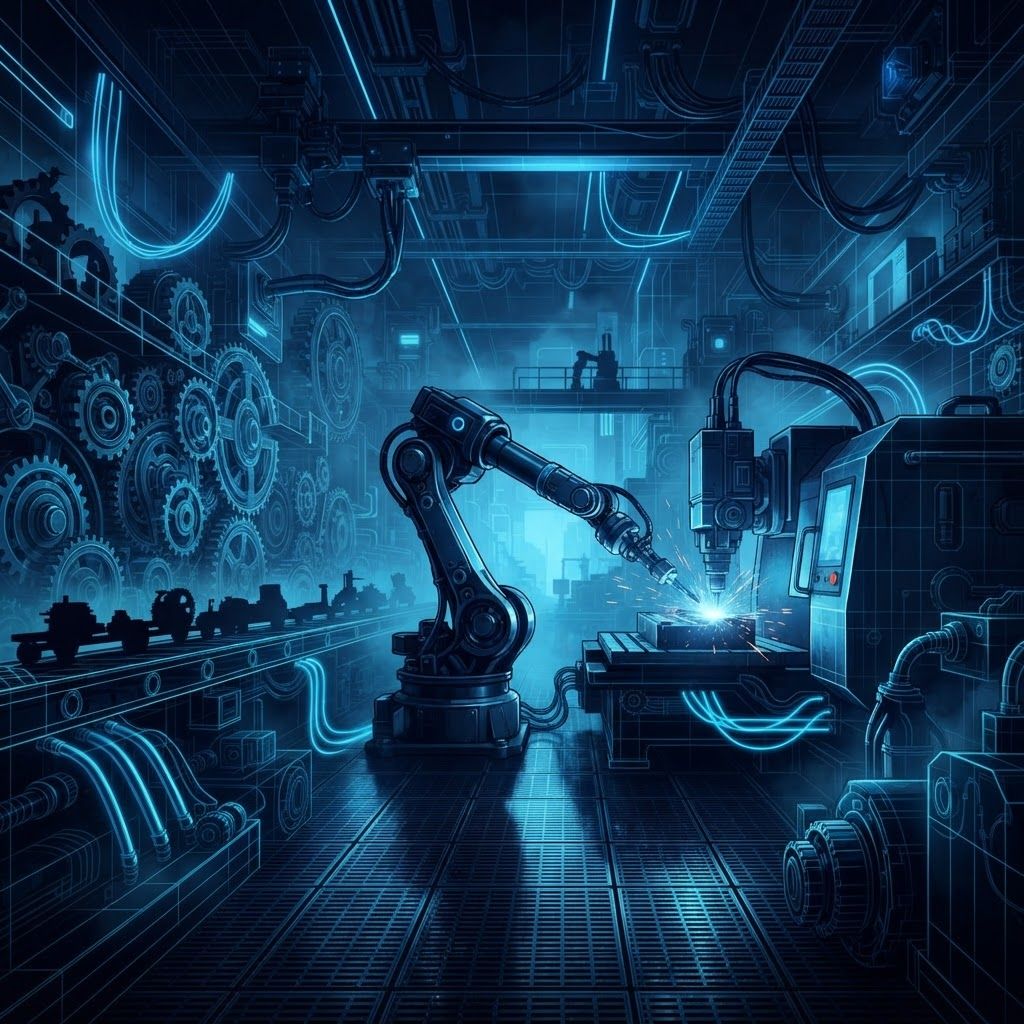
Engineering Capability in the Warwickshire Corridor
Nuneaton and Bedworth sits within a belt of Midlands engineering that has produced machinery for more than a century. The borough's industrial estates and the surrounding Warwickshire and Coventry manufacturing base host machine builders, special purpose equipment designers, materials handling specialists, hydraulic and pneumatic engineers and precision machining operations that supply them all.
Machinery manufacturing differs from volume production in an important way. Much of it is bespoke or low volume, designed around a customer's specific process rather than sold from a catalogue. That makes engineering competence, project management and aftercare far more important than unit price.
Categories of Machinery Produced Locally
The regional sector spans several distinct areas. Special purpose machinery is designed for a single customer process, such as an assembly jig, a test rig or an automated inspection cell. Materials handling equipment includes conveyors, palletisers, lifting equipment and automated storage systems used across the borough's warehousing sector. Process machinery serves food, chemical and plastics producers with mixers, extruders, fillers and packaging lines. Construction and plant equipment covers crushing, screening, compaction and site machinery. Machine tools and metalworking equipment complete the picture, supporting the precision engineering firms that supply automotive and aerospace customers.
Ten Machinery Manufacturers and Engineering Firms Relevant to the Borough
JCB is one of the best known machinery manufacturers in the country, producing construction and material handling equipment used extensively on Warwickshire sites and supported by a substantial Midlands dealer and parts network.
Caterpillar UK maintains significant Midlands operations producing engines and machinery systems, supplying construction and power generation markets.
Terex manufactures materials processing and handling machinery, serving quarrying, recycling and construction operations across the region.
Bosch Rexroth UK supplies hydraulics, drives, controls and factory automation components that form the backbone of machinery built by regional integrators.
Renishaw produces precision metrology and additive manufacturing equipment, supporting the quality assurance requirements of Midlands machining and automotive suppliers.
600 Group manufactures machine tools and laser marking systems, continuing a long British tradition of machine tool production.
Wykes Engineering and comparable Midlands engineering firms provide fabrication, machining and bespoke equipment build services to industrial customers in Warwickshire.
Sandvik Coromant UK supplies tooling and machining solutions that determine the productivity of the region's precision engineering shops.
Kuka Robotics UK provides industrial robots and automation cells widely deployed by machinery integrators serving automotive and logistics customers in the area.
Local Warwickshire special purpose machine builders and control panel integrators complete the market, designing bespoke automation for manufacturers who need equipment tailored to a specific product or process.
Automation and Industry Four Trends
Automation investment across the borough's manufacturing base has accelerated, driven by labour availability, quality consistency and the economics of collaborative robotics. Modern machinery is increasingly instrumented, with vibration, temperature and current monitoring feeding condition based maintenance systems. Digital twins allow a machine to be simulated before it is built, reducing commissioning time. Remote diagnostics permit a builder to interrogate a machine on a customer site without travelling, which shortens downtime considerably.
For smaller manufacturers, the entry point is usually a single automated cell handling a repetitive or ergonomically difficult task rather than a wholesale factory redesign.
Specifying Capital Equipment Properly
Most disappointing machinery purchases trace back to a weak specification. A good user requirement specification defines throughput, cycle time, product variants, tolerance, changeover time, available floor space, utility supply, guarding requirements and interface with upstream and downstream equipment. It should also define acceptance criteria, including a factory acceptance test before delivery and a site acceptance test measured over a realistic production period.
Discuss spares provisioning, documentation, training and software licensing before signing. Machines are often in service for decades, and access to control software and parts determines their long term cost far more than the purchase price.
Safety and Compliance Obligations
Machinery supplied in the United Kingdom must meet the applicable supply regulations, carry appropriate conformity marking and be accompanied by a declaration of conformity and technical file. Employers operating machinery have separate duties under work equipment and inspection regulations, including risk assessment, guarding, safe isolation procedures and thorough examination of lifting equipment. Modifying a machine can make the operator responsible as a manufacturer, so changes should be engineered and documented rather than improvised.
Maintenance Strategy and Whole Life Cost
The purchase price of industrial machinery is typically a minority of its lifetime cost once energy, consumables, spares, downtime and operator time are counted. Planned preventative maintenance beats reactive repair in almost every case, and condition monitoring beats fixed interval servicing where the data is available. Keeping critical spares on site, training internal technicians and maintaining a relationship with the original builder all reduce the risk of extended outages.
Opportunities for Local Engineering Businesses
Demand for automation integration, retrofit control upgrades and machinery refurbishment is strong across the borough, particularly among manufacturers who cannot justify entirely new capital equipment. Skills in programmable logic controller programming, robot integration, vision systems and safety engineering are in short supply and command premium rates. Firms that can combine mechanical design with controls and software capability are best positioned.
Conclusion
Machinery manufacturing remains a core strength of the engineering economy surrounding Nuneaton and Bedworth. Whether procuring a bespoke automation cell or specifying plant equipment, invest time in the specification, insist on proper acceptance testing and plan the maintenance regime before the machine arrives. The firms listed above offer the range of capability needed, from global equipment manufacturers to local integrators who understand a specific process intimately.
Want your brand featured in front of decision-makers? Publish a guest post or get a link insertion in our guides through AAMAX's guest post and link insertion service.
Helpful Links
 SponsoredAAMAX — Full-Service Digital Agency
Write for Us
Share your expertise with our readers. We welcome guest contributions from industry specialists.
Pitch your idea

