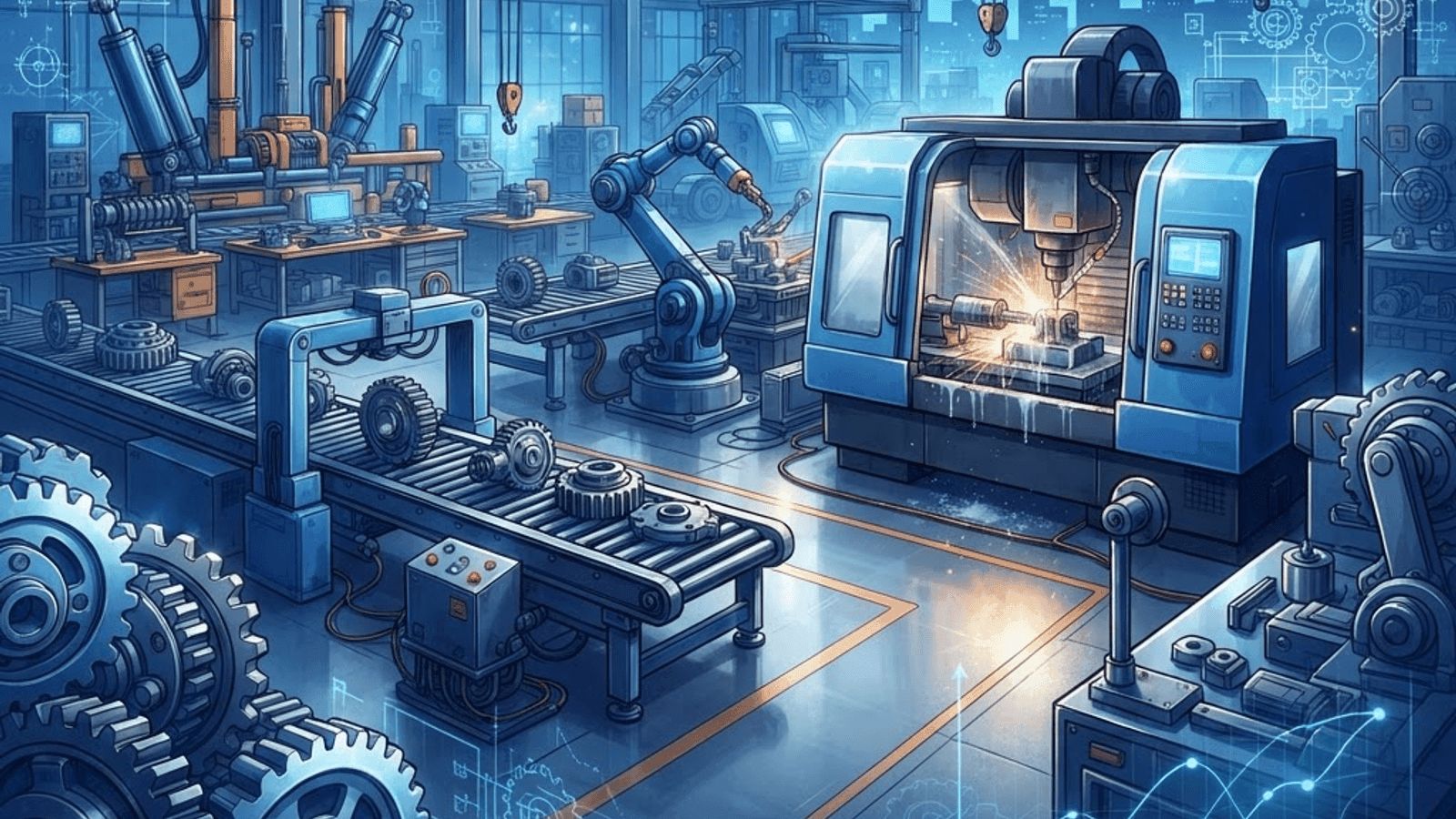
Engineering Born from Mining and Quarrying
The machinery sector in North West Leicestershire has an unusually clear origin. Deep coal mining across the Leicestershire coalfield and large-scale quarrying at Bardon Hill and elsewhere created continuous demand for equipment capable of surviving punishing conditions: crushers, screens, conveyors, winding gear, pumps and handling systems. Serving that demand built a local engineering culture centred on robustness, serviceability and practical problem solving.
The mines have closed but the quarries have not, and the engineering capability proved transferable. Today the district's machinery manufacturers supply materials handling and processing equipment, packaging and production machinery, automation systems, bespoke special-purpose machines and the maintenance services that keep industrial plant running. The explosive growth of warehousing and distribution across the district has created an entirely new customer base for conveyor systems, sortation equipment, dock machinery and automated storage and retrieval systems.
The Top 10 Machinery Manufacturers in North West Leicestershire
1. Bardon Heavy Engineering designs and manufactures crushing, screening and conveying equipment for quarrying, recycling and aggregates processing, with a strong reputation for equipment that remains serviceable in abrasive environments.
2. Coalville Machine Works builds special-purpose machinery to customer specification, taking projects from concept and feasibility through design, manufacture, installation and commissioning.
3. Donington Automation Systems integrates robotics, vision systems and programmable control into production and packaging lines, serving food, pharmaceutical and general manufacturing clients.
4. Ashby Precision Machinery manufactures CNC machined components, sub-assemblies and precision mechanisms for other machinery builders and original equipment manufacturers.
5. Measham Materials Handling supplies conveyor systems, sortation equipment, palletisers and loading dock machinery to the district's substantial distribution and warehousing sector.
6. National Forest Agricultural Machinery produces and refurbishes equipment for farming, forestry and land management, including specialist woodland machinery suited to the National Forest planting and management programme.
7. Kegworth Hydraulics and Pneumatics manufactures and services hydraulic power packs, cylinders, manifolds and pneumatic systems, providing both new equipment and on-site repair capability.
8. Ibstock Industrial Fabrication undertakes heavy steel fabrication, pressure vessel work, structural frameworks and machine guarding, with coded welding and inspection capability.
9. Whitwick Packaging Machinery builds filling, capping, labelling and end-of-line packaging equipment, with expertise in changeover flexibility for producers running multiple formats.
10. Ivanhoe Engineering Services provides planned maintenance, breakdown response, machine relocation and refurbishment services, supporting manufacturers who need existing plant kept productive.
Automation and Industrial Digitalisation
Automation adoption has accelerated sharply, driven by labour availability as much as by cost. Warehousing operations across the district compete for the same workforce, and automating repetitive handling tasks has become a practical necessity rather than an efficiency ambition. Collaborative robots that operate safely alongside people have lowered the entry barrier considerably, allowing smaller manufacturers to automate specific tasks without redesigning entire production halls.
Industrial digitalisation adds a further layer. Sensors on machinery feed condition data to monitoring platforms, enabling predictive maintenance that replaces components before failure rather than after. Overall equipment effectiveness monitoring reveals where availability, performance and quality losses actually occur, frequently contradicting assumptions held on the shop floor. Digital twins allow process changes to be simulated before physical implementation.
The practical caution is that data collection without analysis achieves nothing. Successful implementations start with a specific question, such as why a particular line underperforms on a particular shift, and instrument accordingly.
Machinery Safety and Compliance
Machinery placed on the market must meet essential health and safety requirements, with conformity assessment, technical file preparation and appropriate marking. Risk assessment during design must identify hazards and apply the hierarchy of controls: eliminate by design where possible, guard where elimination is impossible, and provide warnings and instructions only as a last resort.
Functional safety of control systems, covering emergency stops, interlocks and safety-rated components, is assessed against recognised performance levels appropriate to the risk. For machinery users, separate duties apply around provision and use of work equipment, inspection regimes and operator training. Buyers commissioning bespoke machinery should be clear about who carries the responsibilities of the manufacturer, particularly where a machine is assembled from components supplied by several parties or substantially modified after installation.
Specifying Capital Equipment Properly
Machinery procurement fails most often at the specification stage. A clear user requirement specification should state throughput, product range and variability, changeover expectations, available floor space and services, integration points with existing equipment, and the environmental conditions the machine must tolerate. Vague specifications produce machines that meet the contract but not the need.
Factory acceptance testing before delivery, using representative product, catches problems while they remain the manufacturer's to fix in their own workshop. Site acceptance testing confirms performance in the real environment. Both should have defined pass criteria agreed in advance rather than negotiated afterwards.
Whole-life cost matters more than purchase price. Energy consumption, spare part availability and cost, expected maintenance intervals, ease of access for servicing and the manufacturer's support responsiveness all contribute far more to total cost over a ten or fifteen year life than the initial differential between competing quotations.
Skills and the Engineering Pipeline
The sector's long-term constraint is skilled people. Toolmakers, fitters, controls engineers and design engineers with practical manufacturing experience are scarce nationally. Businesses in the district have responded by rebuilding apprenticeship programmes, working with regional colleges and offering progression routes that retain people beyond qualification. The firms with the healthiest order books are consistently those that treated training as continuous rather than cyclical.
Final Thoughts
Machinery manufacturing in North West Leicestershire retains the practical, durability-focused engineering culture that heavy industry demanded, now applied to automation, materials handling and production equipment. For buyers, success comes from specifying requirements rigorously, testing before acceptance, and evaluating suppliers on support capability as much as on machine design. Capital equipment decisions shape operations for over a decade, and they deserve corresponding care.
Want your brand featured in front of decision-makers? Publish a guest post or get a link insertion in our guides through AAMAX's guest post and link insertion service.
Helpful Links
 SponsoredAAMAX — Full-Service Digital Agency
Write for Us
Share your expertise with our readers. We welcome guest contributions from industry specialists.
Pitch your idea