

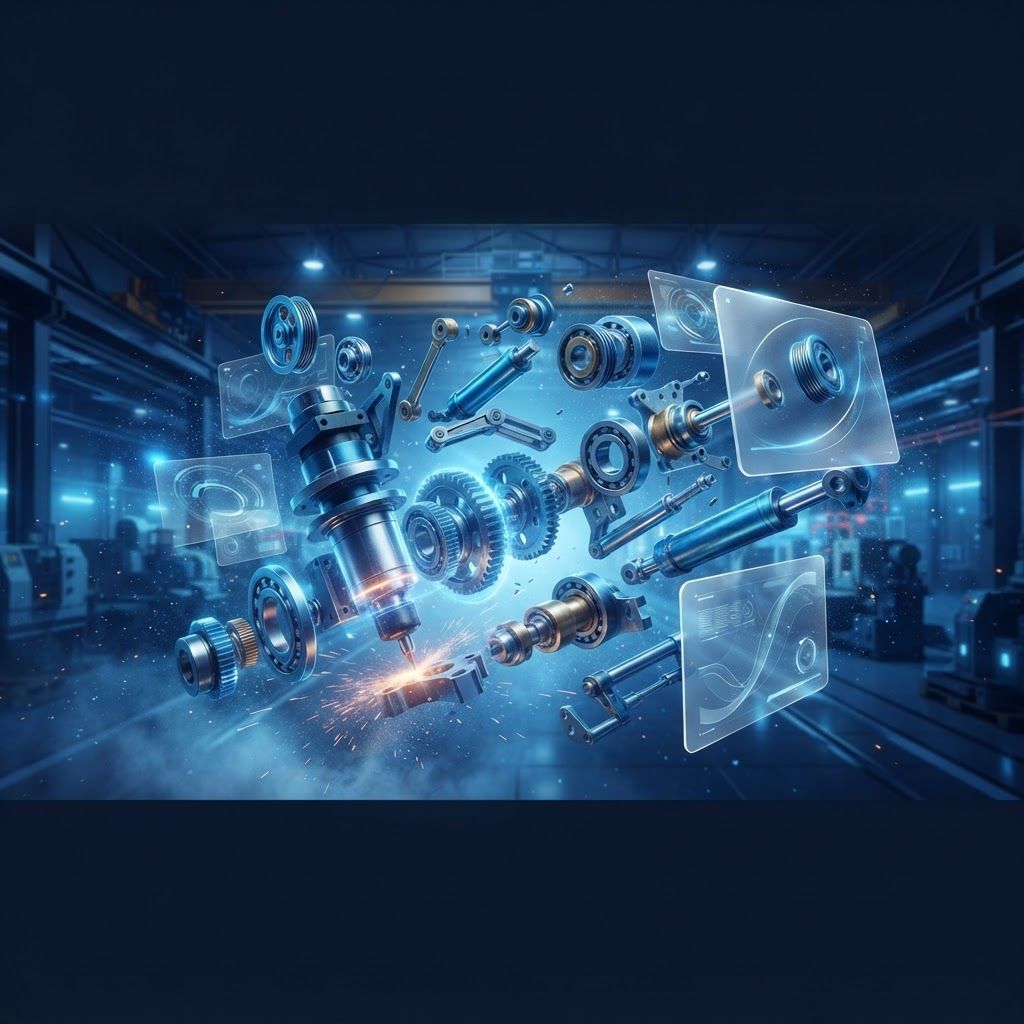
Heavy Engineering in an Industrial Borough
Neath Port Talbot's engineering capability was forged around steel, coal and heavy industry, and that inheritance persists in a network of machine builders, fabricators, precision machinists and maintenance engineers. Unlike sectors that arrived recently, machinery manufacturing here has deep roots, with skills passed through generations and firms that have served the same industrial customers for decades.
The sector today serves a broad customer base: steel and metals processing, chemicals, food production, renewable energy, water treatment, quarrying and aggregates, ports and logistics, and general manufacturing across South Wales and further afield.
Types of Machinery Businesses
Bespoke machine builders design and manufacture equipment to customer specification. This might be a materials handling system, a specialist processing machine, an automated assembly cell or a test rig. The work combines mechanical design, electrical and control engineering, fabrication, assembly and commissioning.
Heavy fabrication companies produce structural steelwork, pressure vessels, tanks, hoppers, chutes, ducting and large weldments. Capability is defined by crane capacity, bay height, welding procedure approvals and the ability to handle heavy plate.
Precision machining specialists operate CNC turning and milling centres producing components to tight tolerances, often working from customer drawings for maintenance spares, production parts or prototype work. Large-capacity machining, including horizontal boring and heavy turning, is a particular regional strength given the historic industrial demand.
Materials handling specialists design and supply conveyors, screw feeders, bucket elevators, vibratory equipment and pneumatic conveying systems, all essential to bulk processing industries in the borough.
Automation and control integrators add programmable logic control, robotics, vision systems and supervisory control to machinery, increasingly in collaboration with mechanical builders rather than as separate suppliers.
Maintenance, repair and overhaul providers keep existing plant running, offering breakdown response, planned shutdown support, gearbox and pump refurbishment, on-site machining and reverse engineering of obsolete parts.
Capability Considerations for Buyers
When selecting a machinery manufacturer, physical capability sets the boundaries. Maximum component weight and dimensions, crane lifting capacity, machine tool envelope, welding processes and material types accepted all determine whether a supplier can undertake the work at all.
Design capability is the next question. Some companies build only to customer drawings, while others provide full concept-to-commissioning design. For complex projects, a supplier with in-house mechanical, electrical and controls design capability reduces coordination risk considerably.
Compliance expertise is essential. Machinery supplied in Great Britain must meet supply of machinery safety requirements, including risk assessment, safety integrity of control systems, guarding, and preparation of technical files and declarations of conformity. Pressure equipment carries additional obligations. Suppliers who handle this properly protect their customers from significant liability.
Welding quality assurance matters in fabrication work. Approved welding procedures, qualified welders, appropriate non-destructive testing and, for structural steelwork, execution class certification provide objective assurance.
The Value of Local Manufacturing
Proximity delivers practical benefits that overseas procurement cannot match. Site surveys before design, progress inspections during build, rapid response when commissioning issues arise and quick turnaround on breakdown repairs all depend on being nearby.
For process industries where downtime costs are measured in thousands of pounds per hour, a fabricator who can machine a replacement shaft overnight is worth considerably more than a cheaper supplier weeks away.
Local manufacturers also retain drawings, patterns and knowledge of installed equipment, often across decades, which makes them uniquely able to support ageing plant.
Technology and Modernisation
The sector has modernised substantially. Three-dimensional computer aided design and simulation have replaced drawing boards. Finite element analysis validates structural designs before steel is cut. Computer aided manufacturing drives multi-axis machining centres. Laser and plasma profiling produce accurate blanks rapidly.
Digital technologies are extending into delivered machinery. Condition monitoring sensors, remote diagnostics, data logging and predictive maintenance analytics increasingly form part of the offering, allowing operators to anticipate failures rather than react to them.
Robotics and collaborative automation are being adopted both within machinery manufacturers' own workshops and in the equipment they supply, addressing both productivity and the shortage of skilled operators.
Sustainability and Efficiency
Customers increasingly specify energy efficiency in machinery, including high-efficiency motors, variable speed drives, optimised pneumatic systems and heat recovery. Over a machine's operational life, energy cost often exceeds purchase cost, making efficiency a genuine commercial consideration rather than a compliance exercise.
Refurbishment and life extension of existing machinery is also gaining favour as a lower-carbon and lower-cost alternative to replacement. Engineers able to assess remaining life, upgrade controls and replace worn mechanical elements deliver strong value.
Skills and Apprenticeships
The sector depends on skilled trades that take years to develop: coded welders, toolmakers, fitters, machinists, electrical technicians and design engineers. Demographic pressure is real, with experienced tradespeople retiring faster than replacements are trained.
Machinery manufacturers in the borough that run structured apprenticeship programmes, often with regional colleges, are securing their future capability. For young people in Neath Port Talbot, these routes offer genuinely well-paid, durable careers.
Final Thoughts
Machinery manufacturers serving Neath Port Talbot range from heavy fabricators with substantial lifting capacity to precision machinists and full-service machine builders offering design through to commissioning. The best combine broad technical capability, rigorous safety compliance, strong welding and machining quality, responsive service and investment in apprenticeships. For industrial operators in the borough, a capable local engineering partner is not simply a supplier but a critical element of operational resilience.
Want your brand featured in front of decision-makers? Publish a guest post or get a link insertion in our guides through AAMAX's guest post and link insertion service.
Helpful Links
 SponsoredAAMAX — Full-Service Digital Agency
Write for Us
Share your expertise with our readers. We welcome guest contributions from industry specialists.
Pitch your idea

