

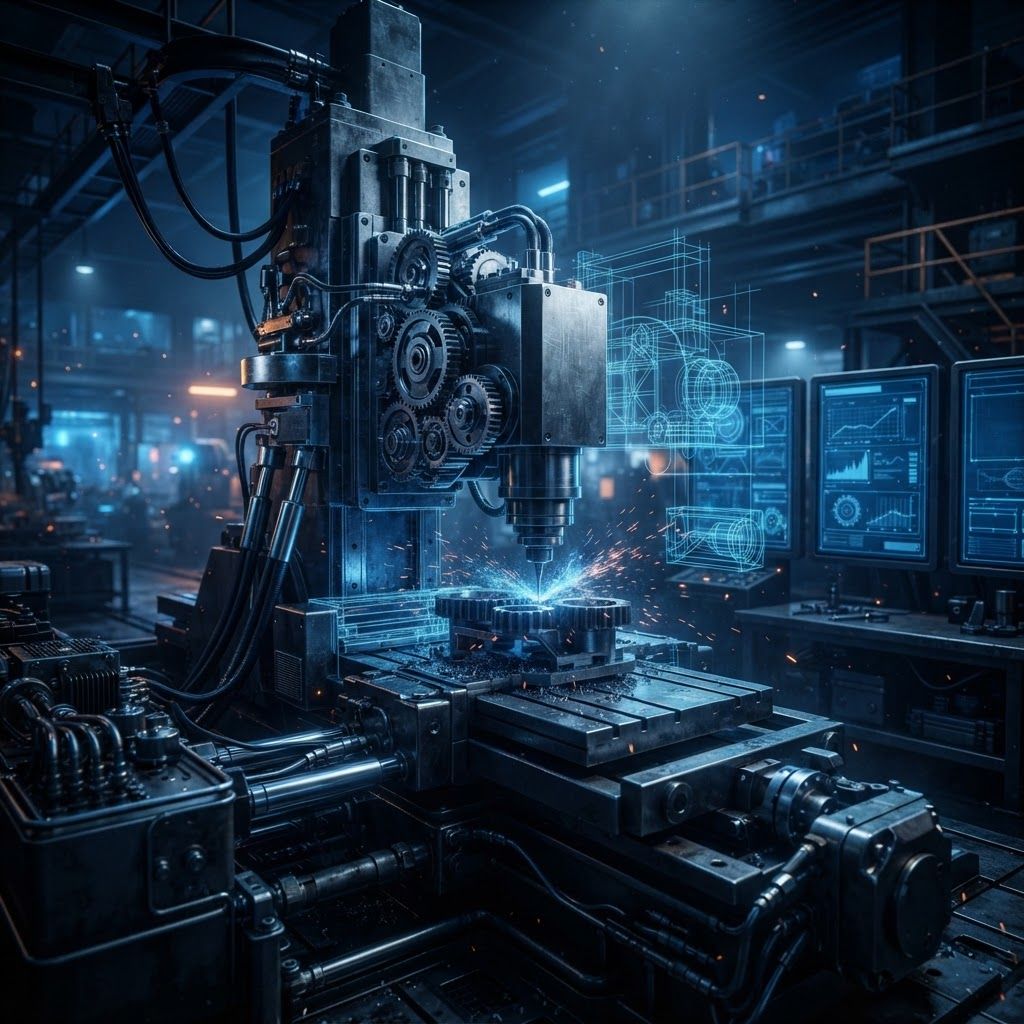
Machinery Building in the Heart of Kent
Machinery manufacturing is one of the least visible but most consequential industries in Maidstone. Every packaged product, processed food item, printed carton and bottled drink that leaves a Kent factory has passed through equipment that someone designed, built and commissioned. A significant share of that equipment originates within a short drive of the county town, where a network of machine builders, automation integrators and fabrication specialists has grown up alongside the region's food, packaging, paper and agricultural sectors.
What makes the Maidstone machinery cluster distinctive is its bespoke orientation. Rather than producing catalogue machines in volume, most local builders design equipment around a specific customer problem: a product that will not run on standard handling gear, a factory with an awkward footprint, or a process that needs to double in throughput without doubling in floor space. This is engineering as problem solving, and it demands a combination of mechanical design, controls expertise and practical fabrication skill that relatively few businesses can offer under one roof.
The Ten Leading Machinery Manufacturers
1. Maidstone Machine Builders is the best known name in local bespoke equipment, designing and manufacturing complete production and assembly lines. The company handles concept design, mechanical build, control system programming, factory acceptance testing and site installation, which removes the coordination risk that plagues multi-supplier projects.
2. Medway Automation Engineering concentrates on robotic cells, pick-and-place systems and vision-guided handling. Its engineers are particularly strong in integrating collaborative robots into existing manual lines, an approach that lets manufacturers automate incrementally rather than rebuilding a whole facility.
3. Kent Agricultural Machinery Works builds and refurbishes equipment for the county's substantial fruit growing, hop and arable sectors, including grading lines, conveyors, sprayers and orchard implements. Deep familiarity with the seasonal pressures of Kentish agriculture means the team understands that a breakdown during harvest is a commercial emergency.
4. Invicta Packaging Systems manufactures filling, capping, labelling and case packing machinery for food, drink and personal care producers. With Kent's growing vineyard and craft beverage scene, demand for flexible small-batch packaging equipment has risen strongly, and the company has built modular platforms to serve exactly that market.
5. Weald Precision Machinery produces high-accuracy machine tools, jigs, fixtures and special purpose machines for engineering customers. Its metrology capability allows it to certify the accuracy of what it builds, which is essential when the machine itself defines the tolerance of the parts it produces.
6. Maidstone Conveyor and Handling designs belt, roller, modular and pneumatic conveying systems for warehouses, distribution centres and factories. As e-commerce fulfilment has expanded across the South East, the company has increasingly delivered sortation and buffering systems that raise throughput without additional labour.
7. Bearsted Hydraulics and Machine Systems specialises in hydraulic power packs, presses and heavy actuation equipment. Its service arm supports the machines it builds throughout their working lives, an approach that customers value because heavy equipment often remains in service for decades.
8. Kentish Industrial Fabrication and Machinery combines heavy steel fabrication with machine assembly, producing frames, hoppers, silos, platforms and structural elements for process plants. Being able to fabricate and machine in the same facility avoids the delays and tolerance mismatches that arise when structural and precision work are split between suppliers.
9. Loose Valley Control Systems approaches machinery from the electrical and software side, delivering control panels, programmable logic controller software, human machine interfaces and data collection systems. Increasingly it is called in to retrofit modern controls onto sound mechanical machines, extending asset life at a fraction of replacement cost.
10. Boughton Engineering and Machine Services occupies the maintenance, overhaul and modification niche, rebuilding worn machinery, upgrading guarding to current safety expectations and re-engineering equipment for new products. For manufacturers under capital constraint, this route often delivers most of the benefit of a new machine for a much smaller outlay.
Trends Driving Machinery Demand
Labour availability has become the single largest driver of automation enquiries across Kent. Manufacturers who once staffed repetitive packing and handling roles easily now find recruitment difficult and turnover high, so equipment that removes manual handling has moved from nice to have to essential.
Energy efficiency is the second major theme. Rising industrial energy costs have made drive efficiency, compressed air consumption and thermal design commercially significant, and machine specifications now routinely include energy performance requirements alongside throughput targets.
Data is the third. Modern machinery is expected to report its own performance: cycle counts, downtime reasons, changeover duration and rejected product. Local builders that offer meaningful production data as standard help customers identify bottlenecks that were previously invisible.
Flexibility completes the picture. Product ranges are proliferating and batch sizes are shrinking, so equipment must handle multiple formats with quick, tool-free changeover. Machines designed around a single product specification are increasingly poor investments.
Specifying a Machinery Project Well
Successful machinery projects almost always begin with a clear user requirement specification. Define the products to be handled, their dimensions and variability, the required throughput, the available floor space, utility supplies and the environment the machine will work in. Ambiguity at this stage becomes cost and delay later.
Insist on a design review before fabrication begins. Reviewing layout drawings, safety strategy and access for cleaning and maintenance while the machine is still on screen is far cheaper than modifying steel. Pay particular attention to how operators will interact with the equipment day to day, because usability determines whether the promised output is actually achieved.
Agree factory acceptance testing criteria in writing. Running the machine with real product at the builder's works before delivery surfaces problems in a controlled environment. Equally, plan site acceptance testing and operator training, since an excellent machine poorly commissioned will underperform indefinitely.
Finally, consider lifetime support. Ask about spares availability, response times, remote diagnostics and documentation quality. In Maidstone's machinery sector, the strongest reputations belong to companies that answer the phone years after the invoice was paid.
A Sector With Solid Foundations
Machinery manufacturing in Maidstone rests on a durable combination of practical engineering heritage and modern automation capability. For food producers, packaging converters, growers, logistics operators and general manufacturers across Kent, having capable machine builders within an hour's drive is a genuine competitive advantage, one that shortens projects, simplifies support and keeps engineering expertise firmly rooted in the local economy.
Want your brand featured in front of decision-makers? Publish a guest post or get a link insertion in our guides through AAMAX's guest post and link insertion service.
Helpful Links
 SponsoredAAMAX — Full-Service Digital Agency
Write for Us
Share your expertise with our readers. We welcome guest contributions from industry specialists.
Pitch your idea

