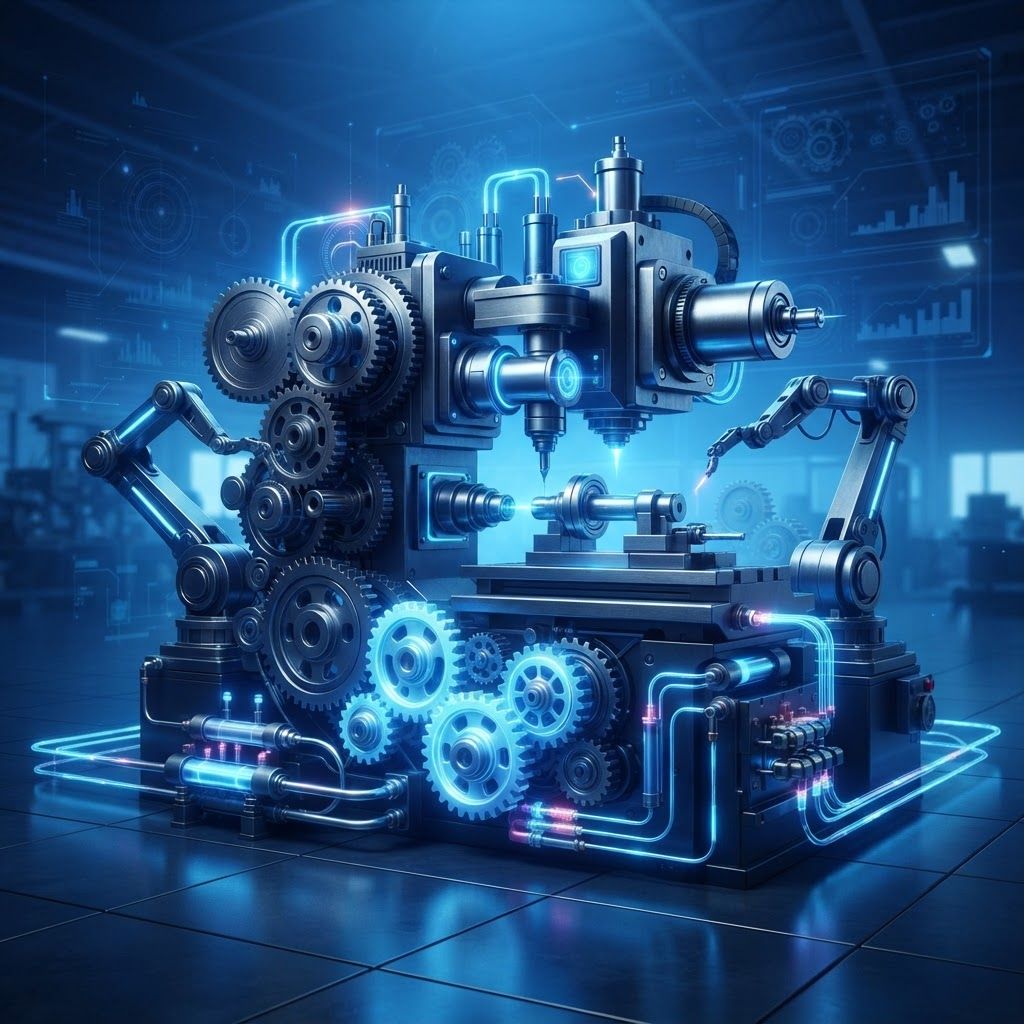
Machinery Manufacturing in Kingston upon Thames
Machinery manufacturing is one of the least visible but most consequential parts of the industrial economy. Every packaged product, processed food, filled bottle and assembled component passes through machinery that someone designed and built. Kingston upon Thames supports a cluster of firms in this space, focused on bespoke and specialist equipment rather than standard catalogue machines.
The borough's position within south west London gives local machinery builders access to skilled engineers, established subcontract suppliers and a diverse customer base spanning food production, pharmaceuticals, packaging, water treatment, laboratories, logistics and light manufacturing. Because the work is engineering intensive and highly customised, proximity to clients is a genuine commercial advantage rather than an incidental convenience.
Categories of Machinery Built Locally
Bespoke automation and special purpose machinery is designed for a specific customer process where no standard equipment exists. Assembly stations, inspection systems, feeding mechanisms and robotic cells fall into this category, typically produced as one offs or small series.
Process equipment covers mixers, conveyors, filling systems, dosing equipment, heat exchangers and tanks for food, beverage, chemical and pharmaceutical production. Hygienic design, cleanability and material compliance are critical in these applications.
Materials handling equipment includes conveyors, lifting systems, palletising equipment, tipping units and bespoke trolleys or transfer systems that move product safely and efficiently through a facility.
Precision machining and subcontract manufacture supports the wider sector, producing machined components, fabricated frames, guarding and sub assemblies for machine builders and end users alike.
Top Machinery Manufacturers in the Borough
1. Thames Special Purpose Machinery designs and builds bespoke automation for manufacturers who need equipment tailored to a specific process. Its engineers handle mechanical design, controls and commissioning, and the firm is known for solving problems that off the shelf machinery cannot address.
2. Kingston Precision Engineering provides CNC turning, milling and grinding to tight tolerances, supplying machined components to machine builders and equipment operators. Dimensional consistency and dependable lead times underpin its long client relationships.
3. Surbiton Process Systems manufactures hygienic process equipment including mixing vessels, transfer systems and dosing units for food and pharmaceutical clients, with documentation and finish standards suited to regulated production.
4. Riverside Conveyor Solutions builds conveyors and materials handling systems designed around each client's layout, throughput and product characteristics. Practical installation planning is a notable strength.
5. New Malden Automation Controls specialises in control systems, PLC programming, HMI development and machine safety integration, frequently working alongside mechanical builders to complete machinery projects.
6. Coombe Fabrication and Machine Frames produces welded frames, guarding, enclosures and structural elements for machinery, combining fabrication capability with an understanding of machine building requirements.
7. Hampton Wick Test and Measurement Equipment designs bespoke test rigs and measurement machinery for laboratories and manufacturers, enabling repeatable testing where commercial equipment does not exist.
8. Berrylands Machine Refurbishment rebuilds, upgrades and re controls existing machinery, extending asset life and improving performance at a fraction of replacement cost. Obsolete control system replacement is a particular specialism.
9. Kingston Packaging Machinery manufactures and integrates filling, capping, labelling and case packing equipment for small and mid sized producers, offering line solutions scaled appropriately to growing businesses.
10. Thames Valley Robotics Integration implements robotic cells for handling, palletising, machine tending and inspection, covering cell design, safety assessment, programming and operator training.
Trends in the Machinery Sector
Automation demand continues to grow, driven by labour availability, wage costs and quality consistency requirements. Businesses that once considered automation only at high volume now evaluate it for medium and even low volume operations, particularly where tasks are repetitive or ergonomically difficult.
Digitalisation is now expected rather than optional. Machinery increasingly includes condition monitoring, production data capture, remote diagnostics and integration with factory systems. This improves uptime and gives operators insight that supports continuous improvement.
Energy efficiency and sustainability influence specification more than previously. Efficient motors, regenerative drives, reduced compressed air dependence and lower water consumption all feature in modern briefs, reflecting both cost and environmental pressure.
Modularity and flexibility have become important as product lifecycles shorten. Machinery that can be reconfigured for new formats or products protects investment better than rigidly dedicated equipment.
Choosing a Machinery Manufacturer
Sector experience is the strongest predictor of success. A builder who understands hygienic design will approach a food project very differently from a general engineering firm. Ask for examples of comparable machines and, where possible, speak to clients running them in production.
Evaluate the depth of the engineering process. Good machine builders invest time in specification, risk assessment, concept design and design review before cutting metal. Suppliers who quote immediately without understanding the process often deliver equipment that disappoints.
Confirm compliance responsibility. Machinery supplied in the UK must meet safety requirements including risk assessment, appropriate guarding, safety related control systems, declaration of conformity and adequate documentation. Establish who takes responsibility for these obligations before ordering.
Discuss support arrangements thoroughly. Installation, commissioning, operator training, spare parts availability, response times and long term technical support all affect total cost of ownership far more than initial purchase price differences.
Commissioning Machinery Locally
Businesses in and around Kingston upon Thames gain meaningful benefit from working with nearby machinery builders. Site surveys, design reviews, factory acceptance testing and post installation support all happen more easily, and problems get resolved in hours rather than weeks.
Prepare by documenting your process clearly, including throughput requirements, product variation, available floor space, services and integration points with existing equipment. Well defined requirements let capable manufacturers design confidently, and the firms profiled here have the expertise to deliver machinery that performs reliably for many years.
Want your brand featured in front of decision-makers? Publish a guest post or get a link insertion in our guides through AAMAX's guest post and link insertion service.
Helpful Links
 SponsoredAAMAX — Full-Service Digital Agency
Write for Us
Share your expertise with our readers. We welcome guest contributions from industry specialists.
Pitch your idea